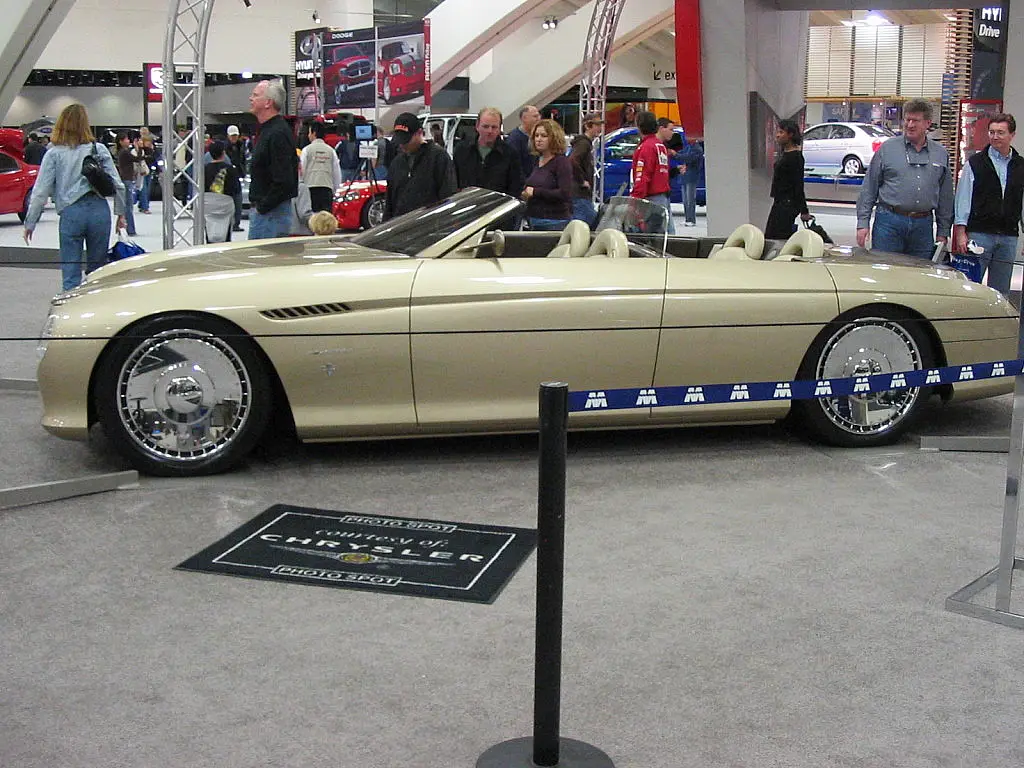
The Chrysler Phaeton was a four-door convertible sedan concept built in 1997 and inspired by Chrysler’s historic Newport Phaeton and Imperial Parade Phaeton. With two windscreens, a 425 hp V12 assembled from two 2.7-litre V6 engines and separate controls for front and rear passengers, it translated 1930s and 1940s touring cars into a modern convertible.
Chrysler Phaeton at a glance
| Type | four-door convertible sedan concept |
|---|---|
| Year | 1997 |
| Inspired by | 1940 Newport Phaeton, Imperial Parade Phaeton |
| Engine | 5.4 L V12, 48 valves, built from two 2.7 L V6s |
| Power | 425 hp (317 kW) |
| Transmission | four-speed automatic |
| Drive | rear-wheel drive, body-on-frame |
| Axle | Dana 40 |
| Front suspension | double wishbone |
| Rear suspension | independent double A-arm, similar to the Viper |
| Wheels | 22×8 inch cast aluminium |
| Brakes | four-wheel discs |
This page is based on one source, the English Wikipedia article on the Chrysler Phaeton. No free photographs of the concept were found, so the page keeps the existing lead image.
History of the Chrysler Phaeton
The idea
The Phaeton was inspired by Chrysler’s historic Newport Phaeton and by the Imperial Parade Phaeton. John E. Herlitz, Chrysler’s vice-president of product design, said the car “embraces and contemporizes elegant, classic design cues from historic touring automobiles of the 1930s, 40s and 50s”. The dual-cowl four-door hardtop convertible layout came from the 1940 Newport parade car, a vehicle used mainly to carry dignitaries and members of elite families. K. Neil Walling, the company’s design director, described the result as taking “an elegant design execution that was originally intended for the wealthy” and turning it into “a practical, contemporary convertible”, with a retractable rear-compartment windscreen. Walling said the Phaeton captured images from the Chrysler LHX and Chrysler Atlantic and translated them into a convertible.
Inside
The front and rear compartments were entirely separate, each with its own radio, climate controls, armrests and centre console, and both had speedometer and tachometer gauges so that rear passengers could watch the car’s performance. The interior was trimmed in cream and brown leather with woven cream leather inserts, satin metal details and Zebrano wood accents.
Engineering
The Phaeton was powered by a 48-valve 5.4-litre aluminium V12 made from two 2.7-litre Chrysler LH V6 engines, producing 425 hp. The body-on-frame, rear-wheel-drive car used a four-speed automatic and a Dana 40 axle, double wishbone suspension at the front and an independent double A-arm rear suspension similar to the Dodge Viper’s, with 22×8-inch cast aluminium wheels, four-wheel disc brakes and Goodyear P245/55R22 tyres. The car remained a concept and never entered series production; it also appeared in the PlayStation game Gran Turismo 2 as a prize car, listed under Dodge.
Design and features
- Four doors and two windscreens: a dual-cowl convertible sedan with a retractable rear screen.
- V12 from two V6s: a 5.4-litre, 48-valve unit made of two 2.7-litre LH V6 engines, with 425 hp.
- Separate rear compartment: its own radio, climate controls and instruments.
- Viper-style rear suspension: independent double A-arms on a body-on-frame, rear-drive chassis.
- Large wheels: 22-inch cast aluminium rims with 245-section tyres.
Chrysler Phaeton versions
- Phaeton concept (1997): the single show car, never produced.
The Phaeton reworked the idea of the 1940 Newport Phaeton and drew on the Atlantic; its V12 was built from the V6 used in the Concorde and LHS. More cars are in the Chrysler collection.
Sources
- Chrysler Phaeton, English Wikipedia: design, interior, engine, chassis
- Chrysler Phaeton, Wikimedia Commons: photographs