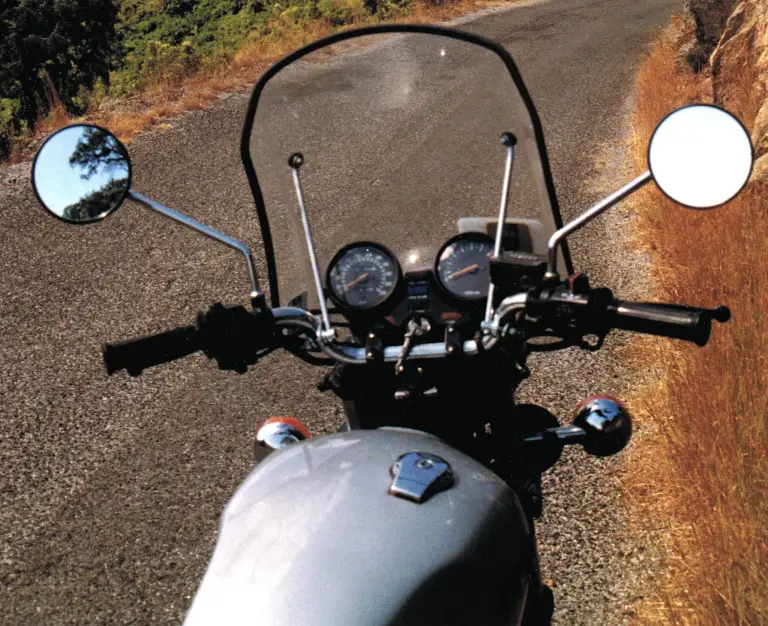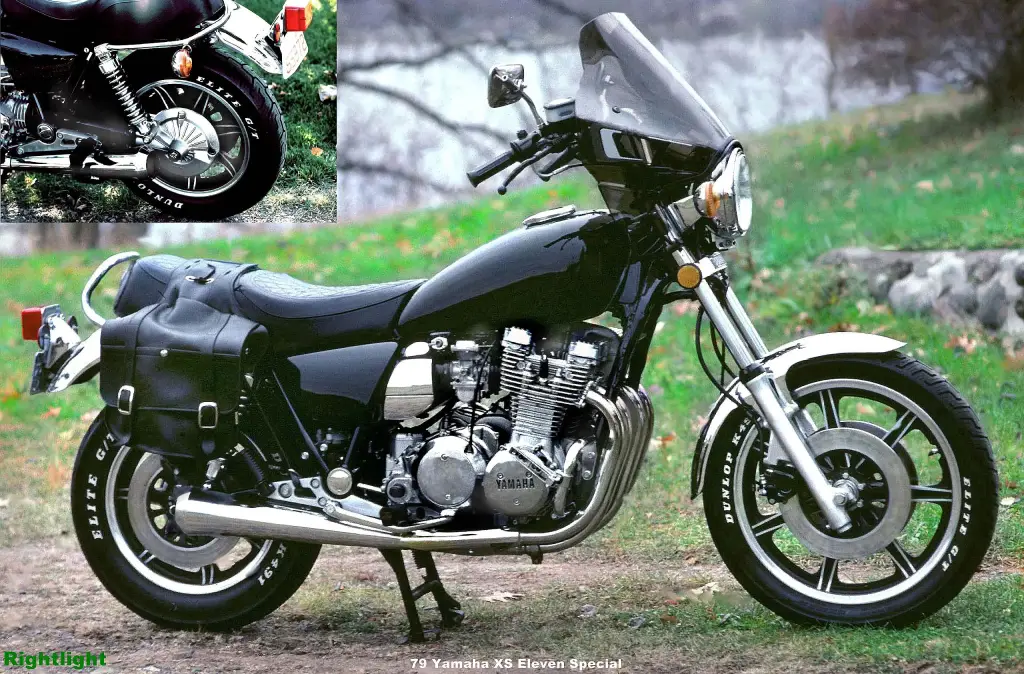
The Yamaha XS Eleven, also called the XS 1100, was Yamaha’s first four-cylinder four-stroke motorcycle. Built from late 1977 to 1983, it was the largest-displacement production motorcycle of its time and set new performance standards.
Yamaha XS Eleven at a glance
| Maker | Yamaha Motor Company |
|---|---|
| Also called | XS 1100, XS 1.1 |
| Production | late 1977–1983 |
| Engine | 1,101 cc air-cooled DOHC inline-four |
| Bore and stroke | 71.5 × 68.6 mm |
| Frame | duplex cradle with swingarm |
| Final drive | shaft |
| Front brakes | dual discs |
| Rear brake | single disc |
| Quarter mile | 11.78 seconds at 114.21 mph |
| Top speed | 135 mph |
| Awards | Cycle World Ten Best Bikes, 1978 and 1979 |
Based on one source (English Wikipedia).
History of the Yamaha XS Eleven
The XS Eleven was the first four-cylinder four-stroke from Yamaha. It built on technology used in the earlier XS 750 triple but was an entirely new design with several unconventional elements. The engine used the same 68.6 mm stroke as the XS 750 but a larger 71.5 mm bore, making it oversquare, and it transmitted power through a wide hy-vo chain to an intermediate jackshaft with a cush-drive damper rather than directly from the crankshaft to the clutch. That allowed the engine to rotate clockwise, unlike most transverse motorcycle engines of the day, and let the electric starter engage the jackshaft. The engine was mounted in rubber bushings, making it almost vibration-free.
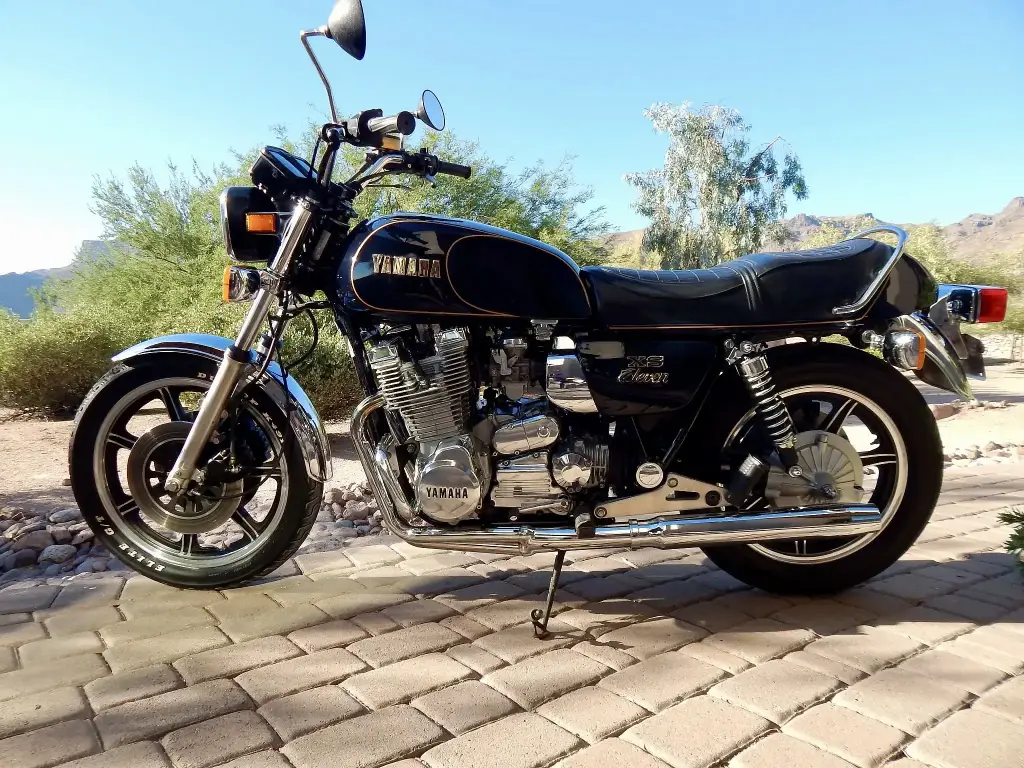
Yamaha also gave the XS 1100 multi-angle “polyspheric” combustion chambers, which required six machining processes. They allowed high compression without large piston domes and ignition advance of more than 40 degrees, reducing the risk of pre-ignition. The valves were the same as the XS 750’s but at a different angle. Four Mikuni BS34II constant-velocity carburettors fed the engine, and ignition was by a contactless inductive trigger with a transistorised electronic unit and vacuum advance.
The XS Eleven quickly earned a reputation as heavy, very powerful and reliable. It was the first production bike to post a sub-12-second quarter mile, 11.78 seconds at 114.21 mph with a 135 mph top speed in Cycle World’s February 1978 test, a figure only beaten later that year by Honda’s CBX. It remained the strongest production motorcycle for torque and in-gear roll-on until the Yamaha FJ series arrived in 1984, and it won Cycle World’s Ten Best Bikes award as best touring bike in 1978 and 1979. Handling was less admired: testers called it a bullet in a straight line and warned that high-speed cornering was done at the rider’s own risk. The US Standard came as the E for 1978, F for 1979 and G for 1980–81, and the 1979 Special added pullback handlebars, a stepped seat, a 16-inch rear wheel, a tear-drop tank and air-assisted forks, becoming the best-selling XS Eleven variant in America. An all-black Midnight Special followed in 1980.
Design and features
- First Yamaha four: the company’s first four-cylinder four-stroke motorcycle.
- Polyspheric chambers: a complex combustion chamber design allowing high compression and lots of advance.
- Jackshaft drive: a hy-vo chain and cush-drive jackshaft instead of a direct crank-to-clutch drive.
- Straight-line performance: the first production bike under 12 seconds for the quarter mile.
Yamaha XS Eleven versions
- XS Eleven Standard E (1978): the original US model.
- Standard F (1979) and G (1980–81): updated standard versions.
- XS Eleven Special (1979): factory custom with pullback bars and a 16-inch rear wheel.
- XS Eleven LH Midnight Special (1980): all-black version sold worldwide.
The XS Eleven was Yamaha’s first big four, a role later taken by the FZ1 and FJR1300. More models are in the Yamaha collection.
Sources
- Yamaha XS Eleven, English Wikipedia: history, engine, performance, awards, US models