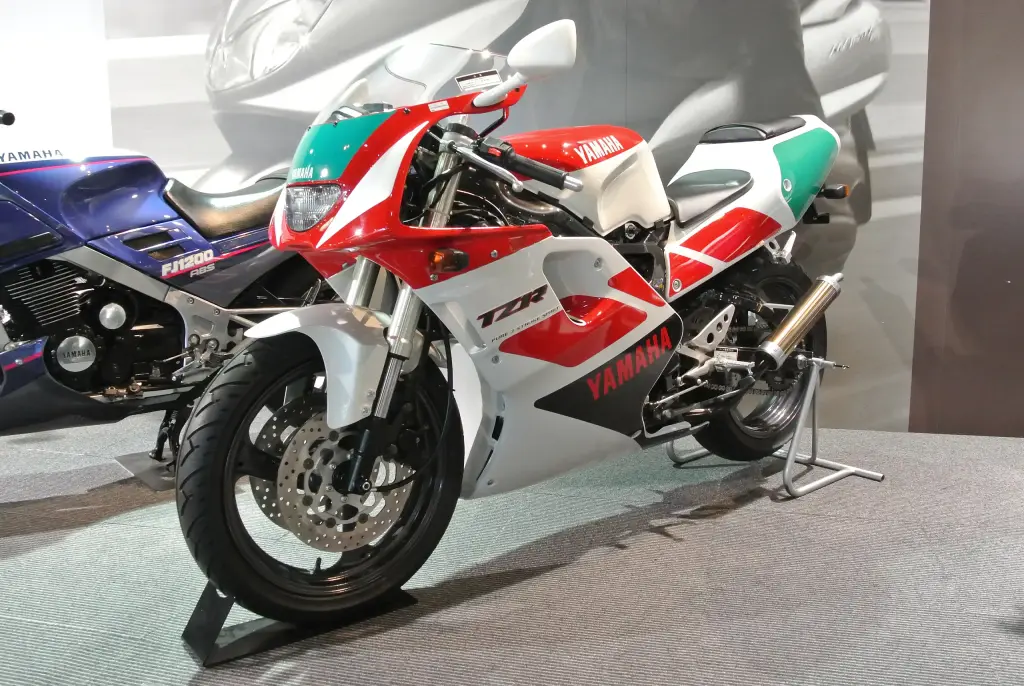
The Yamaha TZR250 is a fully faired two-stroke sport motorcycle that Yamaha built from 1986 to 1995. It was loosely based on the TZ250 racing machine and replaced the RD250 and RD350LC in Yamaha’s range.
Yamaha TZR250 at a glance
| Maker | Yamaha Motor Company |
|---|---|
| Class | Two-stroke sport motorcycle |
| Production | 1986–1995 |
| Unveiled | autumn 1985 |
| Engine | 249 cc two-stroke twin |
| Power | 45 hp restricted, about 50 hp unrestricted |
| Frame | aluminium alloy |
| Swingarm | aluminium alloy |
| Valve system | YPVS, opening at about 6,000 rpm |
| Generations | parallel twin, reverse cylinder, 90° V-twin |
Based on one source (English Wikipedia).
History of the Yamaha TZR250
The TZR250 was shown in autumn 1985 and went into production in June 1986. It was based on the TZ250 racing motorcycle and introduced a more modern design than the RD250 and RD350LC it replaced, with an aluminium alloy frame and swingarm, full bodywork and Yamaha’s Power Valve System, which varied the exhaust port height with engine speed. The servo began opening the valve at about 6,000 rpm. In standard form the engine produced 45 hp because of restrictions in the exhaust and ignition boxes, but removing them could raise output to nearly 50 hp.
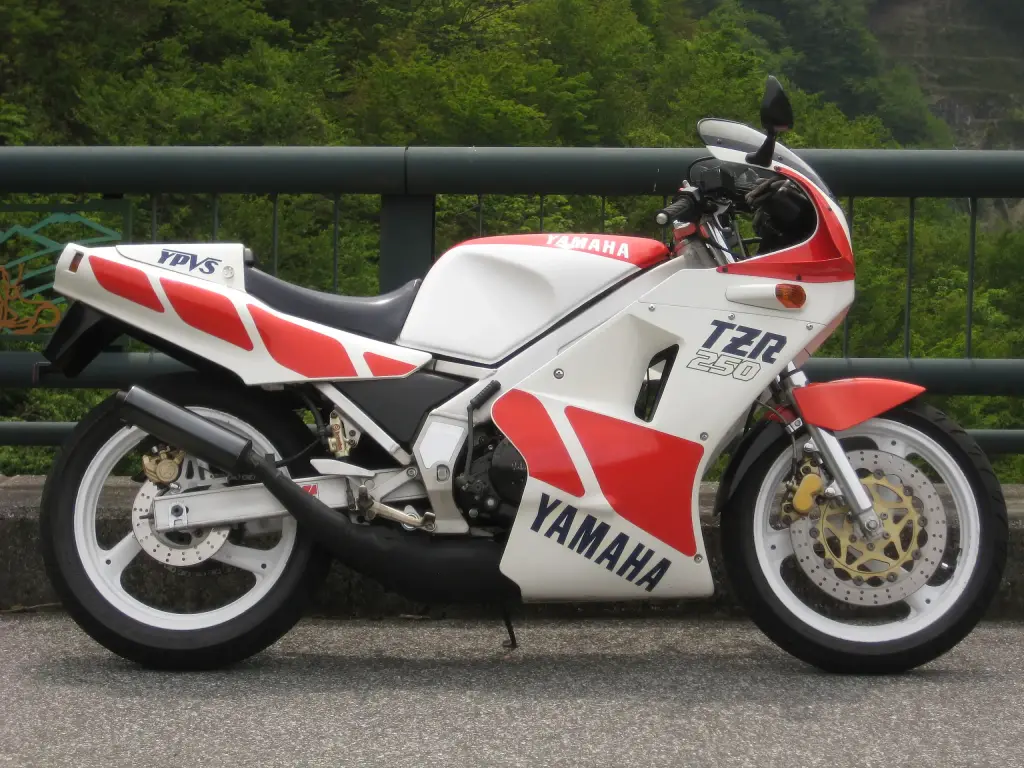
The first generation used the parallel-twin 2MA layout for the UK, mainland Europe, Oceania and Canada, while the Japanese-market 1KT had a more restrictive CDI to meet a 45 hp limit for 250 cc motorcycles. The two were otherwise almost identical apart from labelling and lighting details, and the UK version used indicator stalks to meet type approval. After the 2MA, Yamaha sold later TZR250 models only in Japan. In 1989 came the parallel-twin reverse-cylinder 3MA, which gained upside-down forks and a differently shaped expansion chamber for more midrange in 1990.
From 1991 to 1995 the TZR250 used a 90-degree V-twin, the 3XV, in TZR250R, RS, SP and SPR forms. These closely followed the competition TZ250, sharing engine cases and frames and, in some models, cylinders, carburettors and power valves. Yamaha ended official domestic distribution just before the 2000s, mainly because of emissions rules, and the last specification change was the pillion-capable 3XVC TZR250SPR of January 1995. The model was still raced in the Yamaha Past Masters series as late as 2024, with racing engines making about 56 hp at 11,000 rpm.
Design and features
- TZ250 influence: a road bike built with racing geometry and an aluminium frame.
- YPVS: a power valve that opens at about 6,000 rpm to broaden the powerband.
- Three engine layouts: parallel twin, reverse cylinder and 90-degree V-twin.
- Racing life: still campaigned in classic series long after production ended.
Yamaha TZR250 versions
- 2MA (1986–1988): parallel-twin export model.
- 1KT (1986–1988): Japanese parallel twin with a more restrictive CDI.
- 3MA (1989–1990): reverse-cylinder parallel twin, upside-down forks in 1990.
- 3XV (1991–1995): 90-degree V-twin in R, RS, SP and SPR forms.
The TZR250 replaced the RD350 and sits alongside the smaller TZR50. More models are in the Yamaha collection.
Sources
- Yamaha TZR250, English Wikipedia: production, engine, generations, racing, market details