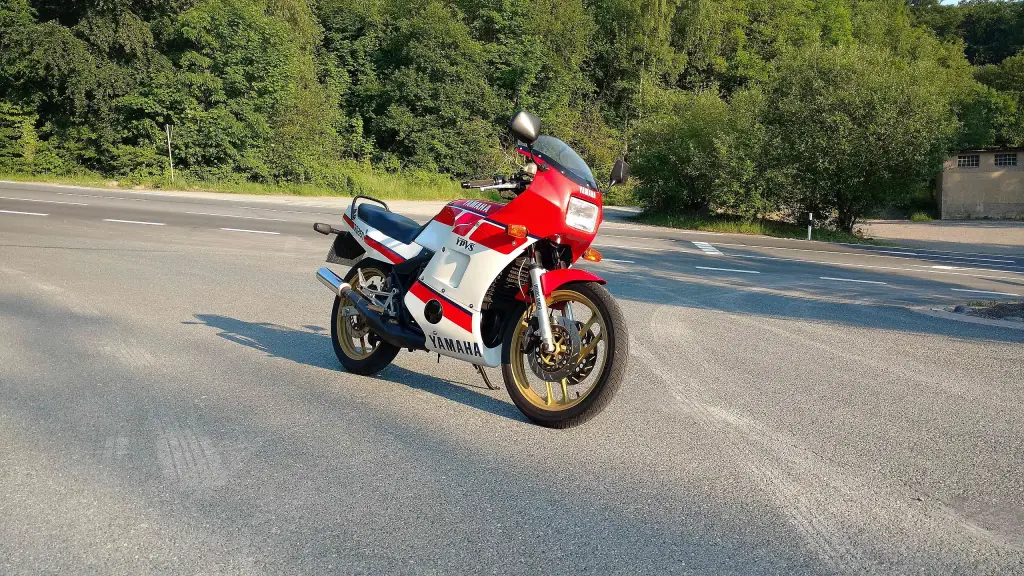
The Yamaha RD350 is a two-stroke motorcycle that Yamaha produced from 1973 to 1975. It evolved from the earlier R5 and became one of the defining sport bikes of its time, with a licensed version later assembled in India.
Yamaha RD350 at a glance
| Maker | Yamaha Motor Company |
|---|---|
| Class | Sport motorcycle |
| Production | 1973–1975 |
| Predecessor | Yamaha R5 |
| Engine | 347 cc air-cooled parallel twin two-stroke |
| Induction | reed valve |
| Gearbox | six-speed, five-speed on the first UK model |
| Power | 39 bhp at 7,500 rpm, 32 bhp at the rear wheel |
| Front brake | single disc |
| Rear brake | drum |
| Rims | 18-inch WM2 front, WM3 rear |
| Lubrication | Autolube oil injection |
Based on one source (English Wikipedia).
History of the Yamaha RD350
The RD350 evolved directly from the Yamaha R5, a 350 cc twin with piston-port induction, a front drum brake and a five-speed gearbox. The RD added reed-valve induction and a six-speed gearbox, although the first model was sold with five speeds in some markets such as the UK. The air-cooled parallel twin produced 39 bhp at 7,500 rpm, or 32 bhp at the rear wheel, which was very fast for the period. A contemporary comparison was the Kawasaki H2 750 triple with 74 hp.
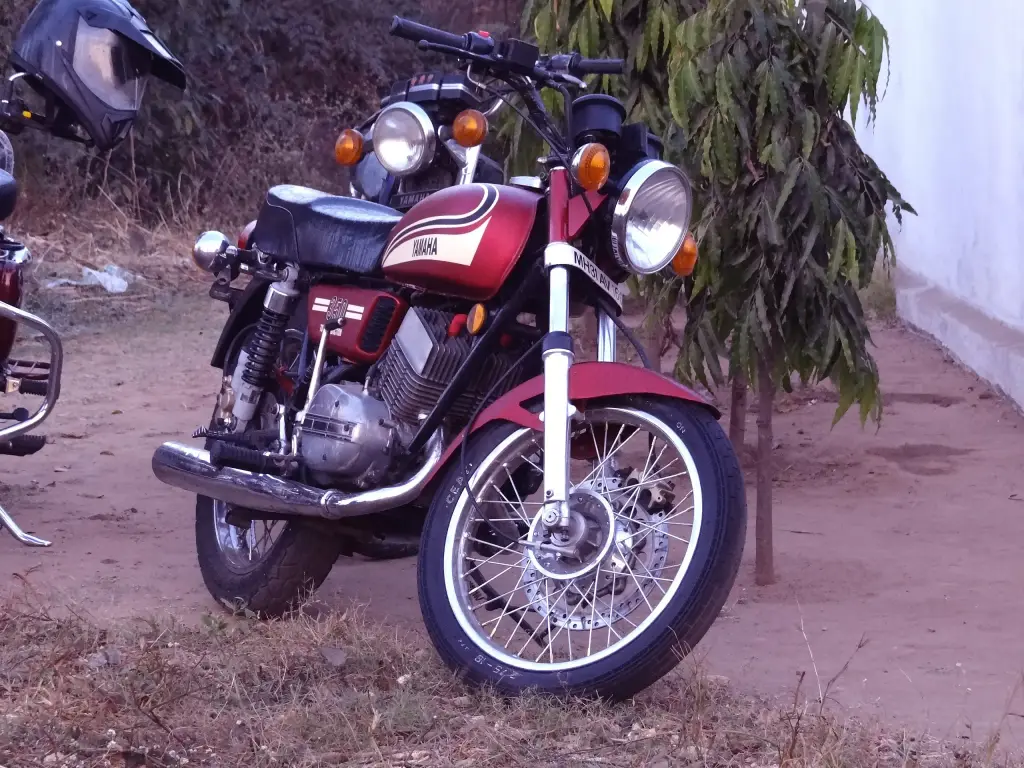
The chassis was closely related to Yamaha’s TZ250 and TZ350 road racers. The street frame differed mainly in weight and fork rake, about 27 degrees on the RD against 25 on the TZ, and the road frame weighed almost twice as much as the racing item. The RD used 18-inch chromed wire-spoked rims, WM2 at the front and WM3 at the rear, with narrower 1.60 and 1.85 rims in the UK. Brakes were a single front disc and a rear drum, a combination Cycle magazine called the best in its class. Autolube oil injection saved owners from mixing fuel and oil.
The 350 was developed into the more refined RD400C in 1976, followed by the RD400D and RD400E in 1977–1978 and the white RD400F in 1979. In India a licensed version of the RD350B was assembled by the Escorts group as the Rajdoot 350 between 1983 and 1990. It was offered in High Torque and Low Torque forms making 30.5 and 27 bhp, used 180 mm drum brakes and was almost entirely Indian-sourced by the end of production. About 7,000 were made by the end of 1990, and the Rajdoot 350 became India’s first sporting motorcycle.
Design and features
- Reed-valve two-stroke: a 347 cc parallel twin with 39 bhp and a broad powerband for its day.
- Racing-derived frame: geometry close to the TZ250 and TZ350 racers.
- Autolube: automatic oil injection instead of premixed fuel.
- Indian legacy: the Rajdoot 350 was the first sporting motorcycle built in India.
Yamaha RD350 versions
- RD350 (1973–1975): the original air-cooled twin.
- RD400C, D, E and F (1976–1979): developed successors.
- Rajdoot 350 High Torque: Indian-built version with 30.5 bhp.
- Rajdoot 350 Low Torque: detuned Indian version with 27 bhp.
The RD350 followed the DS7 and led to the later two-strokes; its engine family also produced the RX-Z. More models are in the Yamaha collection.
Sources
- Yamaha RD350, English Wikipedia: production, engine, chassis, performance, Indian version