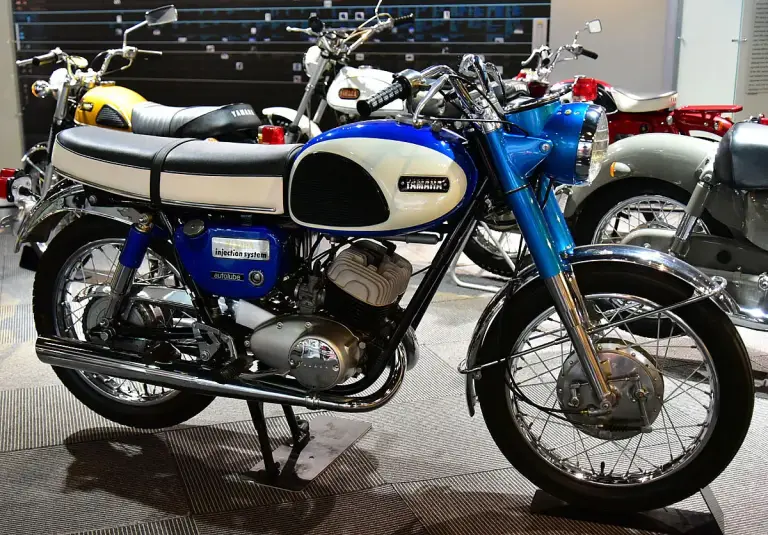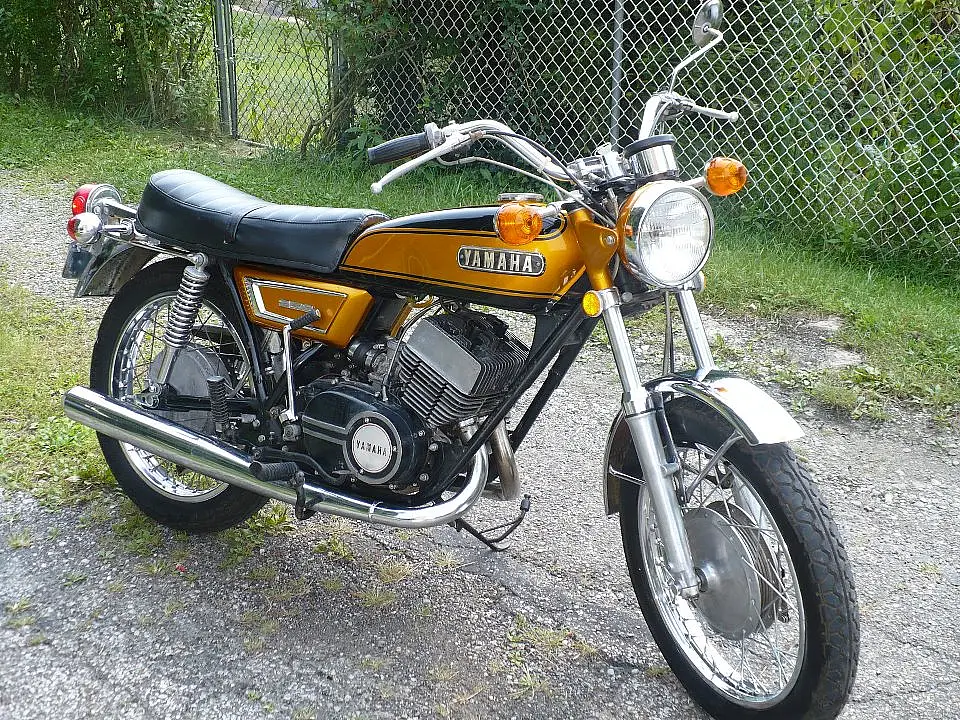
The Yamaha DS7 was a 250 cc two-stroke twin made from 1970 to 1972 and sold in Britain as the YDS7. It is remembered as the direct ancestor of Yamaha’s RD series, which began in 1973.
Yamaha DS7 at a glance
| Maker | Yamaha Motor Company |
|---|---|
| Also called | YDS7 in the United Kingdom |
| Production | 1970–1972 |
| Engine | 250 cc air-cooled two-stroke twin |
| Bore and stroke | 54 × 54 mm |
| Power | nearly 30 hp (22 kW) at 7,500 rpm |
| Top speed | 93 mph |
| Quarter mile | 14.8 seconds |
| Carburettors | two Mikuni VM26 round-slide |
| Transmission | five-speed, left-foot gear change |
| Ignition | 12 V battery |
| Brakes | twin leading shoe front, single leading shoe rear |
Based on one source (English Wikipedia).
History of the Yamaha DS7
The DS7 was Yamaha’s 250 cc sporting twin of the early 1970s. Its air-cooled two-stroke engine had cast-iron-lined aluminium cylinders with two-ring pistons and a bore and stroke of 54 by 54 mm. Two Mikuni VM26 round-slide carburettors fed the engine, which made nearly 30 hp at 7,500 rpm and pushed the bike to a published 93 mph with a 14.8-second quarter mile.
The engine used piston-port induction, as did the earlier R5. That is the main difference between the DS7 and the RD250 and RD350 that replaced it in 1973, because the RD engines switched to reed-valve induction. The DS7 also used a 12-volt battery ignition and a five-speed gearbox with a direct left-foot gear change.
Lubrication was by oil injection straight into the intake port, with oil drawn from a tank under the seat, so the rider did not have to mix fuel. Brakes were a twin-leading-shoe drum at the front and a single-leading-shoe drum at the rear. Yamaha based the frame and suspension on its racing machines of the period, which gave the DS7 handling that was reasonable for its class.
Design and features
- Piston-port induction: the feature that separates the DS7 from the later reed-valve RD engines.
- Oil injection: oil fed directly into the intake port from a tank under the seat.
- Racing-derived chassis: frame and suspension influenced by Yamaha’s contemporary racers.
- Strong performance: nearly 30 hp, 93 mph and a 14.8-second quarter mile.
Yamaha DS7 versions
- DS7: the standard 250 cc model.
- YDS7: the name used in the United Kingdom.
- RD250 and RD350 (from 1973): successors with reed-valve induction.
The DS7 led to the RD350, and it belongs with other early two-strokes such as the YM1. More models are in the Yamaha collection.
Sources
- Yamaha DS7, English Wikipedia: production, engine, performance, brakes, relation to RD