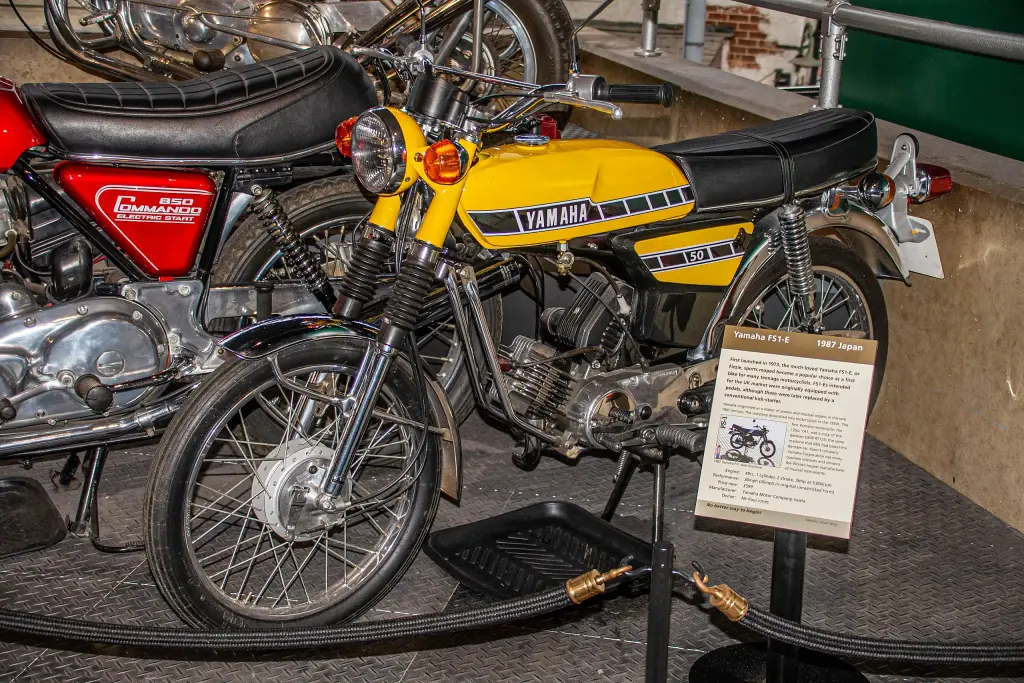
The Yamaha FS1 is a small two-stroke moped of the 1970s. Letter suffixes marked versions built for different countries, and the British FS1-E became so popular that it earned the nickname Fizzy.
Yamaha FS1 at a glance
| Maker | Yamaha Motor Company |
|---|---|
| Class | Moped / light motorcycle |
| Engine | 49 cc single-cylinder two-stroke |
| Induction | rotary disc valve |
| Cooling | air-cooled |
| Gearbox | five-speed originally, four-speed on the FS1-E |
| Fuel mix | 20:1 petrol and two-stroke oil |
| Frame | pressed steel tubular backbone |
| Ignition | magneto, 6 V AC lighting and 6 V DC battery circuit |
| UK speed limit | 31 mph for machines registered from 1 August 1977 |
| UK production | about 200,000 |
| Notable version | FS1-E DX with front disc brake |
Based on one source (English Wikipedia).
History of the Yamaha FS1
The FS1 was originally designed as a five-speed light motorcycle. European rules pushed Yamaha to detune it for the moped class, and the FS1-E used a four-speed gearbox instead. Its 49 cc single-cylinder two-stroke engine had rotary disc-valve induction and air cooling, and it ran on a 20:1 mixture of petrol and two-stroke oil.
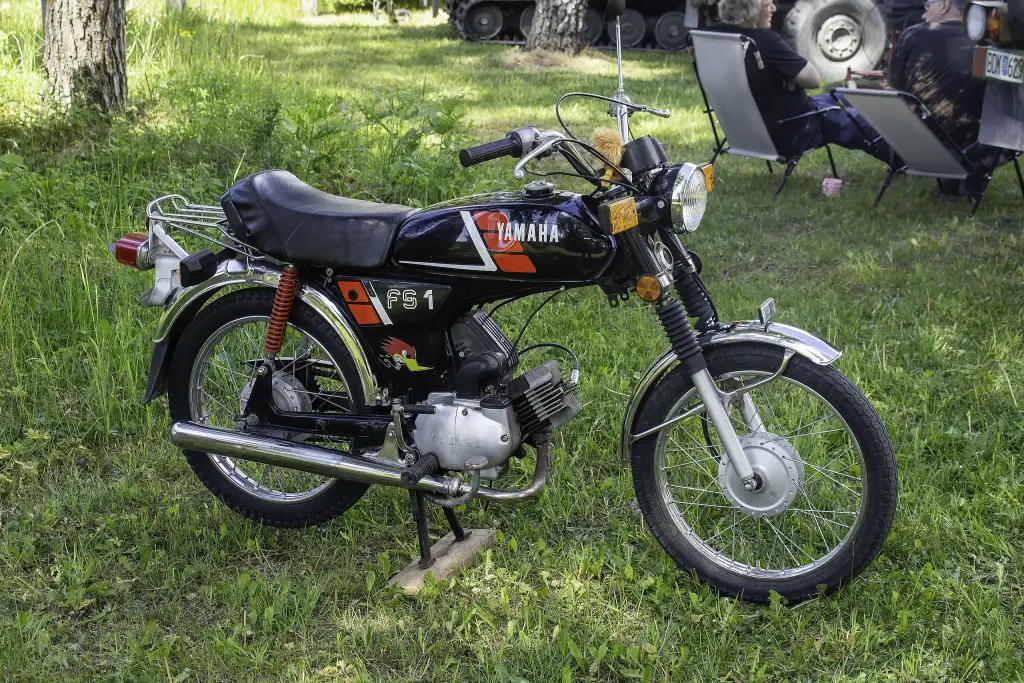
The FS1-E was the British version, the E standing for England. It shared more cycle parts with other UK-imported Yamahas than the versions sold elsewhere. Over the years Yamaha added a front disc brake on the FS1-E DX and later an autolube system with a separate oil tank and pump, which removed the need to mix oil into the fuel by hand.
British moped law required pedals, so the FS1-E could be driven by bicycle-style cranks. The special cranks let both pedals rotate forward to form motorcycle footrests in normal use; to pedal, the left crank was rotated backwards and locked and a drive gear engaged. Pedalling was hard work because there was no freewheel and the gearing was very low, and the engagement mechanism often seized. The pedal system was designed by Henk Dullens for the earlier Yamaha F5. Machines registered in Britain from 1 August 1977 were restricted to 31 mph, and the Honda SS50 was the FS1’s closest rival.
Design and features
- Rotary disc valve: a two-stroke induction system that helped the small engine breathe.
- Pedal drive: a legal requirement for British mopeds, with cranks that doubled as footrests.
- Autolube option: later models carried a separate oil tank and pump instead of premix.
- DX equipment: the FS1-E DX added a front disc brake and a handlebar-mounted ignition switch.
Yamaha FS1 versions
- FS1: the original five-speed light motorcycle.
- FS1-E: British four-speed moped, about 200,000 built.
- FS1-E DX: front disc brake and revised switchgear.
- FS1P and DX NL: versions adapted to Dutch regulations.
The FS1 belongs with other small Yamaha two-strokes such as the DT125. More models are in the Yamaha collection.
Sources
- Yamaha FS1, English Wikipedia: models, engine, pedals, electrics, UK market