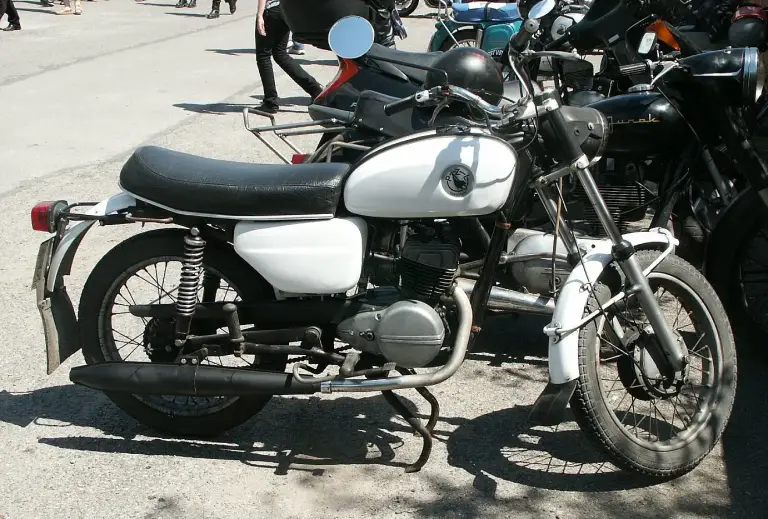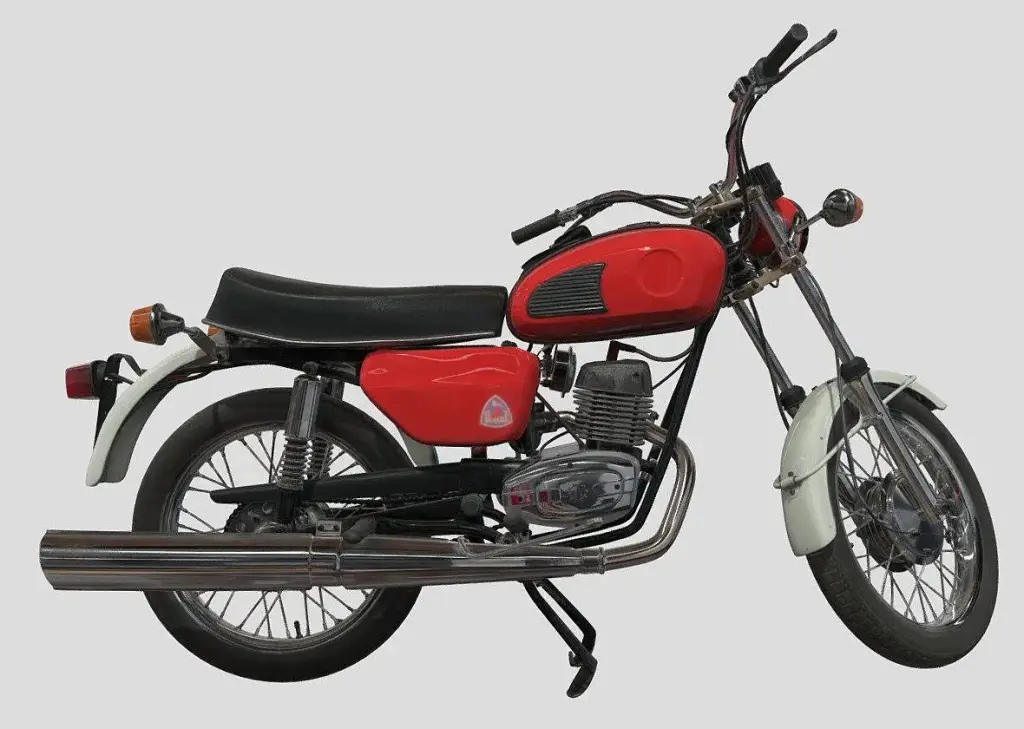
The WSK M21W2 Perkoz was a prototype motorcycle of the Polish maker WSK, created in 1977 as the continuation of the line based on the M21 model. It brought a new frame, larger brake drums and a redesigned telescopic fork, and although about a thousand machines of a trial series were made, the model never entered large-scale production.
WSK M21W2 Perkoz at a glance
| Maker | WSK, Świdnik |
|---|---|
| Year | 1977 |
| Status | prototype, trial series of about 1,000 |
| Engine | type 059, later 060, two-stroke single, air-cooled |
| Capacity | 175 cm³ |
| Power | 14 hp (10.3 kW) at 5,800–6,000 rpm |
| Compression | 9:1 |
| Ignition | battery, 6 V 8 Ah accumulator |
| Gearbox | four-speed, chain drive |
| Frame | cradle, doubled in the lower part |
| Brakes | 150 mm drums with lining wear windows |
| Weight | 123 kg, payload 160 kg |
| Top speed | 105 km/h |
| Fuel consumption | 3.8 l/100 km |
Based on one source: the Polish Wikipedia article, which covers the prototype and its technical data. The name Perkoz is Polish for grebe, one of the bird names used by WSK in the 1970s.
History of the WSK M21W2 Perkoz
A new frame and fork
The Perkoz was created in 1977 as the next step in the 175 cm³ family that had grown out of the M21. Its frame was of a semi-double cradle type, doubled in its lower part, and the brake drums were enlarged to 150 mm, with windows for checking the wear of the linings. The most important change was a telescopic fork of a new design, with progressive springing and yokes and sliders cast in aluminium alloy.
Everyday equipment brought up to date
The motorcycle was fitted with indicators, rear-view mirrors and new combined electrical switches on the handlebar. Another novelty for WSK was a stop-light switch worked by the front brake lever. The engine was the type 059, later the 060, a single-cylinder two-stroke of 175 cm³ with battery ignition and a four-speed gearbox; the machine weighed 123 kg, could carry 160 kg and reached 105 km/h on 3.8 litres of fuel per 100 km.
A trial series only
About 1,000 machines of a trial series were completed, but large-scale production was not undertaken. The Perkoz therefore remains a rare sight: the design work that went into it – the progressive fork, the bigger front hub, the aluminium castings – reached the production line only in part, through later versions of other WSK models.
Design and features
- Progressive telescopic fork: a new design with yokes and sliders cast in aluminium alloy.
- Semi-double cradle frame: doubled in its lower part for greater stiffness.
- 150 mm brake drums: larger than on earlier models, with lining wear windows.
- Front-brake stop light: a first for WSK.
- Full road equipment: indicators, mirrors and combined handlebar switches.
WSK M21W2 Perkoz versions
- Perkoz (1977): the only version, built as a trial series of about 1,000 machines.
- Type 059 and type 060 engines: the earlier and later engine used in the model.
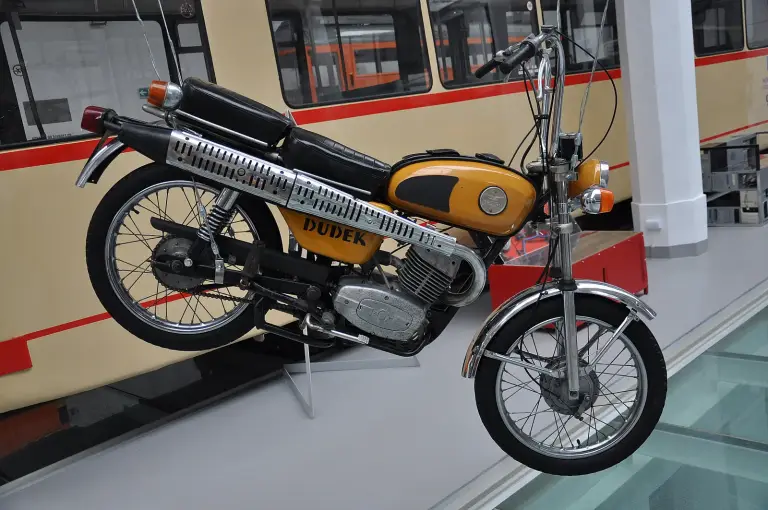
The Perkoz was the most advanced of the 175 cc WSK family, alongside the WSK M21W2 Dudek; the 125 cc volume model was the WSK M06 B3. More are in the WSK collection.
Sources
- WSK M21W2 Perkoz, Polish Wikipedia: design, equipment, technical data