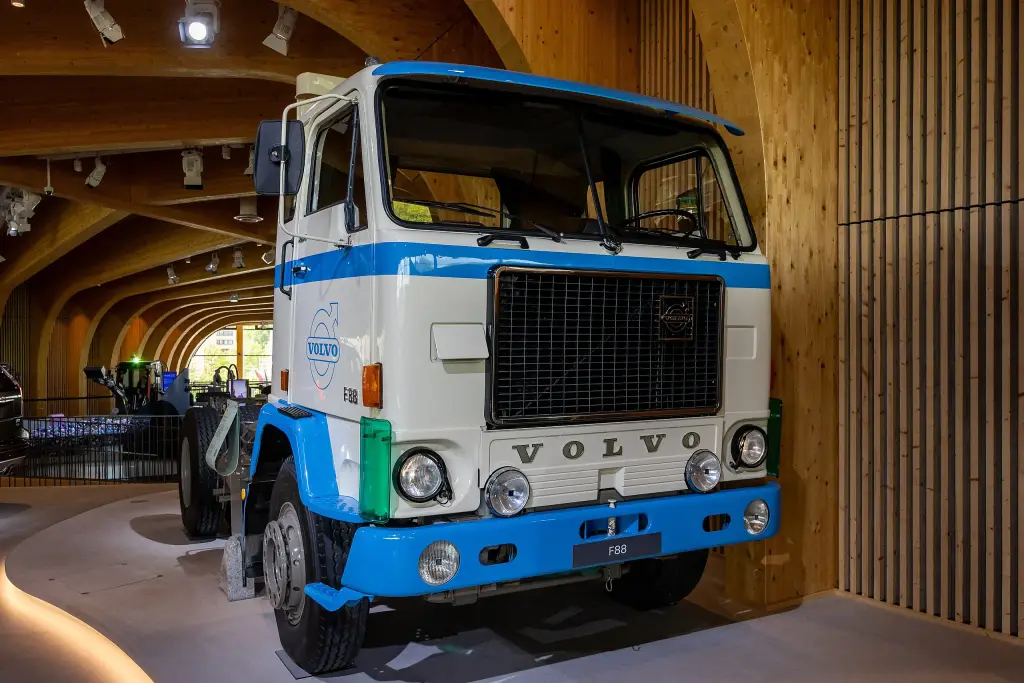
The Volvo F88 and F89 were heavy trucks built from 1965 to 1977. The F88 was the first part of Volvo’s export-oriented System 8, which laid the foundation of the company’s truck business, and the F89 of 1971 brought a twelve-litre engine for the heaviest class.
Volvo F88 at a glance
| Production | 1965–1977 |
|---|---|
| Models | F88, G88 from 1970, F89 from 1971 |
| Cab | forward control, introduced on the Titan Tiptop in 1964 |
| F88 engine | 9.6-litre TD100 turbo six, 260 hp, 940 Nm |
| G88 | front axle moved 300 mm forward, GCWR up to 52.5 tonnes |
| F89 engine | 12-litre TD120 turbo six, 330 hp, 1,257 Nm |
| F89 detail | engine inclined to fit under the cab, so no right-hand drive |
| RHD markets | F88 with the engine boosted to 312 hp |
| Driveline | new eight-speed gearbox, stronger chassis and suspension |
History of the Volvo F88
Volvo presented the forward-control F88 in 1965 as the first part of its export-oriented System 8, the programme that served as the basis for the truck maker Volvo became. The cab had already appeared on the predecessor Titan Tiptop in 1964, but everything else was redesigned: a new engine, a new eight-speed gearbox and a stronger chassis and suspension. The F88 sold well internationally and began Volvo’s reputation for durable cab-over trucks.
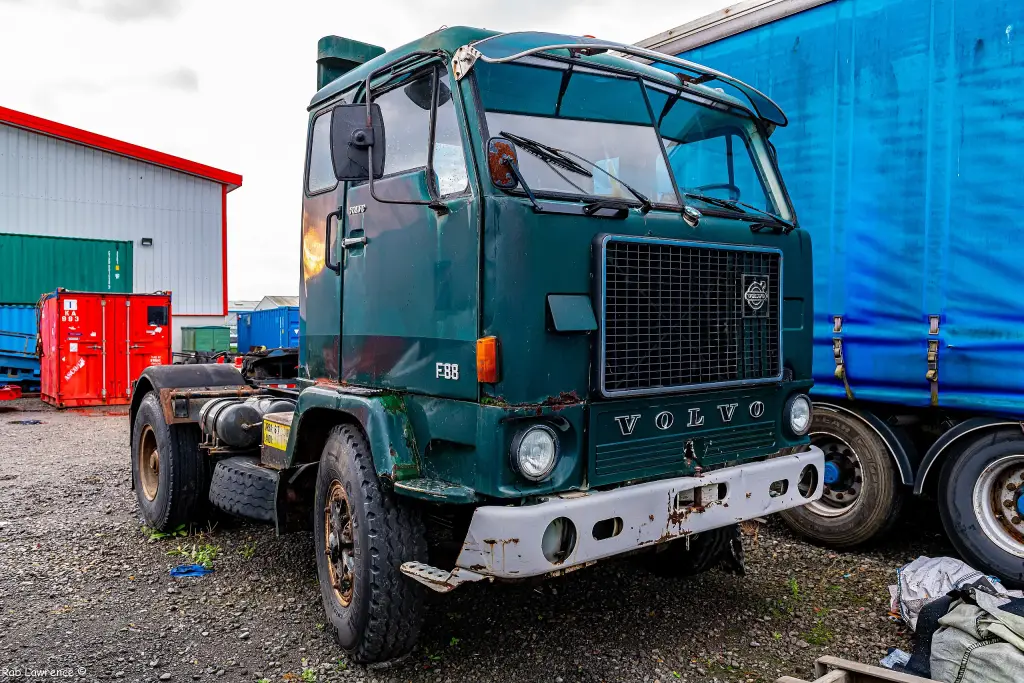
In 1970 Volvo added a derivative, the G88, mechanically the same truck but with the front axle fitted 300 mm further forward to allow a greater axle spread. That raised the gross combination weight rating to 52.5 tonnes, which mattered to operators running heavy combinations.
The F89
In 1971 the larger F89 arrived with a new twelve-litre engine whose development had started in 1969. Truck and engine were designed to meet a West German rule that set a minimum horsepower for a given gross combination weight; to keep selling in the heaviest class, Volvo built a more powerful engine, and the F89 was the first Volvo truck sold with turbocharged engines only. The TD120 was so tall that it had to be mounted at an angle in the frame to fit under the cab, which made right-hand drive impossible. Countries driving on the left had to make do with a stronger F88 whose engine was boosted to 312 hp.
The F88 and F89 were replaced in 1977 by the F10 and F12, which took the same cab-over concept further with more power, comfort and safety.
Design and features
- System 8: the export programme that made Volvo a major truck maker.
- TD100 engine: 9.6 litres, 260 hp and 940 Nm.
- G88 axle spread: a 300 mm forward front axle for 52.5-tonne combinations.
- Twelve-litre F89: 330 hp and turbocharging as standard.
- Rugged cab: the shape that British and European hauliers trusted.
Volvo F88 versions
- F88 (1965): the original System 8 heavy truck.
- G88 (1970): forward front axle for heavier combinations.
- F89 (1971): 12-litre TD120, left-hand drive only.
- 312 hp F88: the strongest version for right-hand-drive markets.
The F88 and F89 were replaced by the Volvo F10 and F12, and they followed the Volvo Titan whose cab they used. More trucks are in the Volvo collection.
Sources
- Volvo F88, English Wikipedia: history, G88, F89, engines, right-hand-drive issue