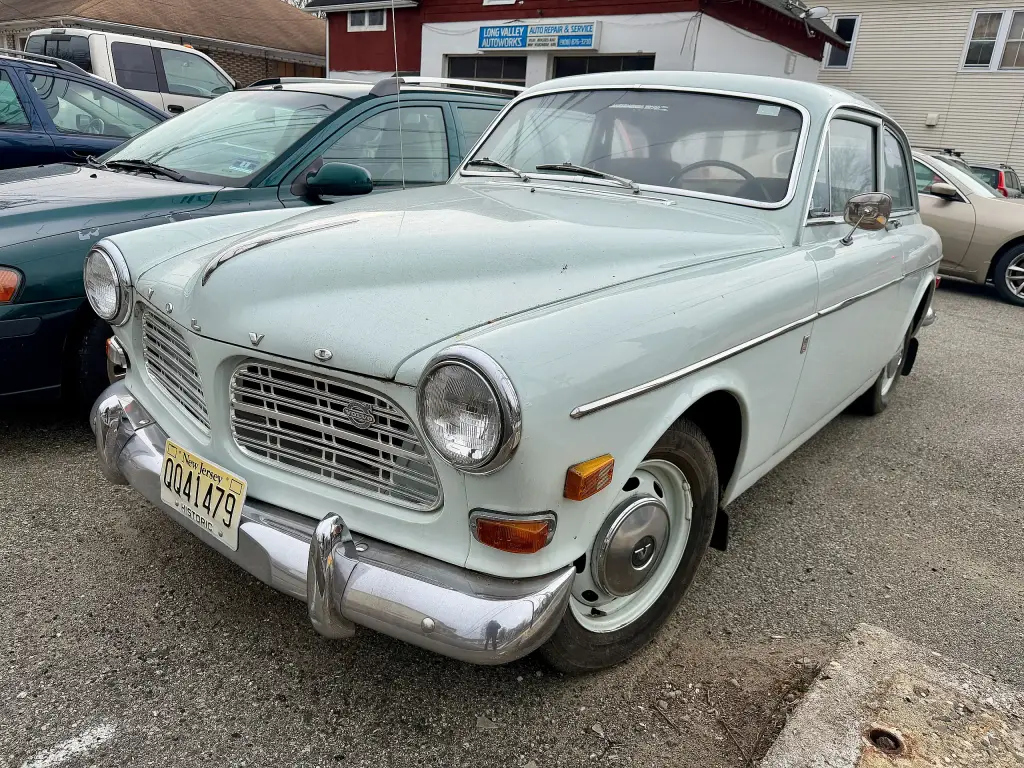
The Volvo Amazon was a mid-sized car built from 1956 to 1970 in two-door, four-door and five-door estate forms. Sold abroad as the 120 Series, it was the car on which Volvo made front seat belts standard equipment, a world first, in 1959.
Volvo Amazon at a glance
| Production | 1956–1970 |
|---|---|
| Bodies | two-door, four-door, five-door estate from 1962 |
| Built at | Lundby, Gothenburg, then Torslandaverken from 1964 |
| Built | 234,653 four-doors, 359,917 two-doors, 73,220 estates |
| Total | 667,791, of which 60% exported |
| Engines | 1.6 and 1.8-litre B16/B18, later 2.0-litre B20 |
| Models | 121 with a single carburettor, 122S with twin carburettors |
| Safety first | front seat belts standard on all models from 1959 |
| US debut | 122S, New York International Auto Show, 1959 |
| Design | Jan Wilsgaard |
History of the Volvo Amazon
The Amazon was released to the press in February 1956, with production due to start that July and deliveries from August. It shared the wheelbase, tall posture and high seating position of the PV444/544 it replaced, and was drawn by Jan Wilsgaard, whose inspiration was a Kaiser he had seen in Gothenburg harbour. The body was ponton-styled with pronounced shoulders and small tail fins, built of phosphate-treated steel with heavy undersealing.
The name caused trouble: Volvo wanted Amason, after the Greek warriors, but the German motorcycle maker Kreidler had already registered Amazone, so the car could be called Amazon only in Sweden, with the spelling changed. As Volvo moved to three-digit names the line became the 120 Series. The first cars reached buyers in February 1957 in two-tone red and black with a light grey roof.
Range and safety
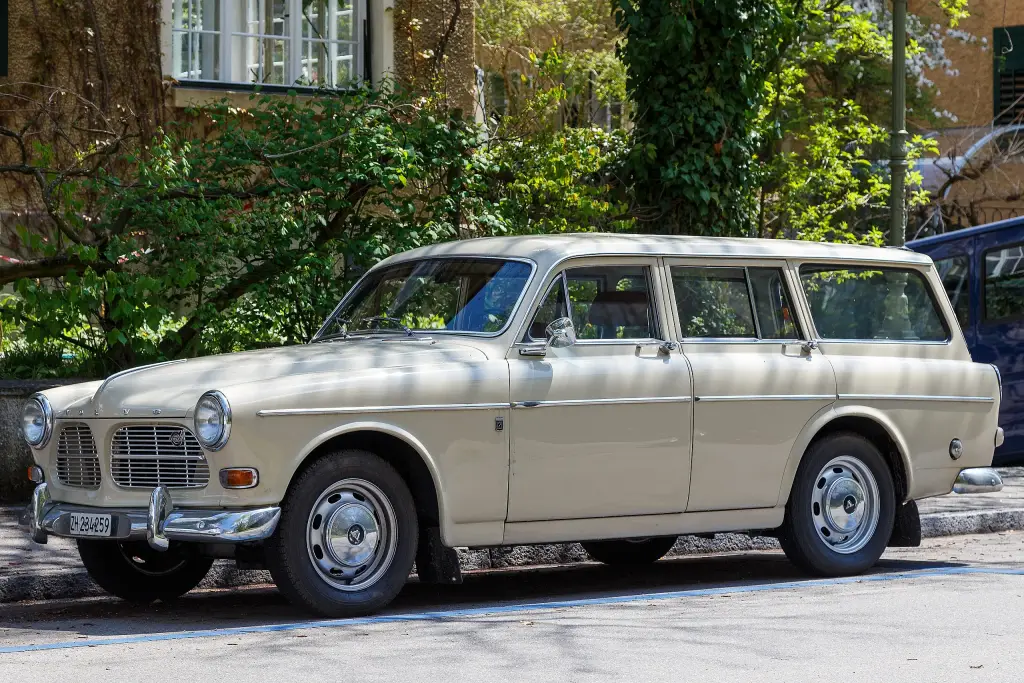
The 121 was the base model with a single-carburettor engine of 66 bhp; the 122S of 1958 had twin carburettors and 85 bhp. In 1959 Volvo became the first manufacturer to fit front seat belts as standard on all Amazon models, export cars included, and later the first with three-point belts as standard. The estate arrived at the 1962 Stockholm show with a two-piece tailgate whose lower half folded down as a load surface and carried a folding number plate.
The 123GT of 1967 brought the high-compression B18B engine from the P1800, an M41 gearbox, reclining seats, fog and driving lights, an alternator and a tachometer. The four-door saloon was dropped in 1967 as the 140 Series took over, and in 1969 the B18 grew into the 2.0-litre B20. The Amazon Favorit of 1966 was a cheaper version without exterior chrome, with a three-speed gearbox.
Odd jobs
A white Amazon estate became the first foreign police car used by a British force when Hampshire Constabulary bought one in 1965 as an accident tender, later adding four more, a purchase that caused local controversy. The Amazon platform also underpinned the P1800 and 1800ES.
Design and features
- Seat belts as standard: the world’s first carmaker to fit front belts to every car, in 1959.
- Ponton styling: American-influenced three-box shape with small tail fins.
- Three bodies: two-door, four-door and a practical estate with a folding tailgate.
- Durable body: phosphate-treated steel and heavy anti-corrosion treatment.
- Sporting 123GT: the P1800 engine and gearbox in a saloon.
Volvo Amazon versions
- 121: base model, single carburettor, 66 bhp.
- 122S (1958): twin carburettors, 85 bhp, the export hero.
- Estate (1962): five-door wagon, 73,220 built.
- Favorit (1966): stripped-down cheap version.
- 123GT (1967): high-compression B18B and M41 gearbox.
The Amazon came after the Volvo PV444/544 and was replaced by the Volvo 140 Series; its platform also carried the Volvo P1800. More cars are in the Volvo collection.
Sources
- Volvo Amazon, English Wikipedia: history, models, styling, production numbers, police use