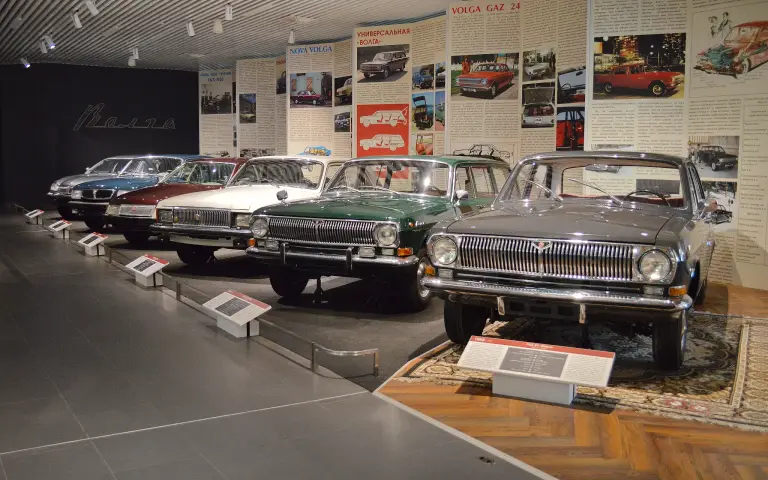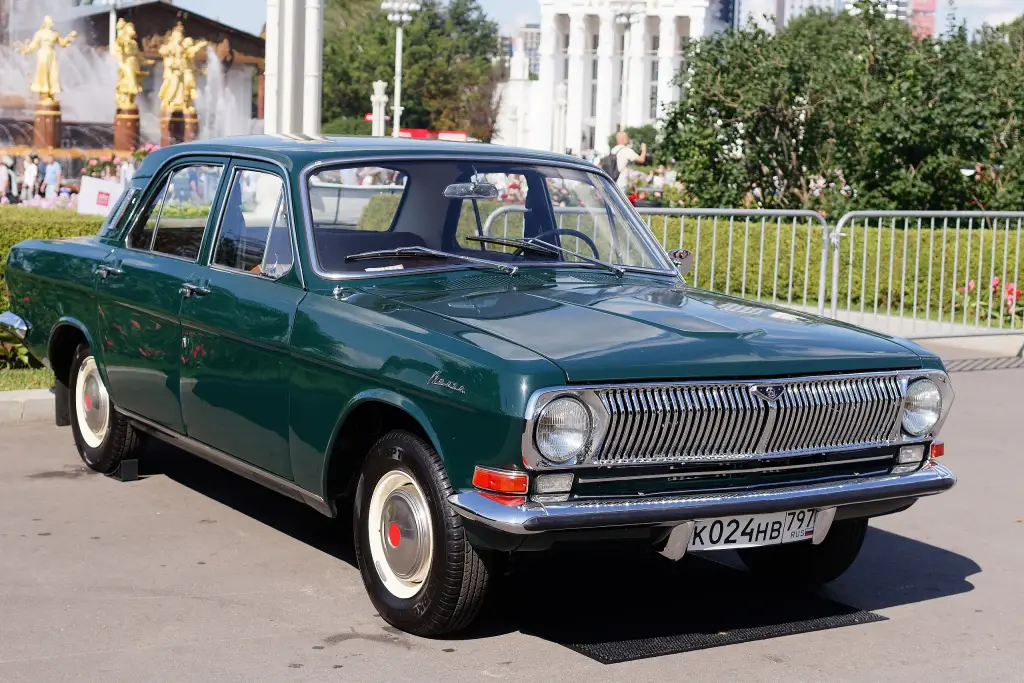
The GAZ-24 Volga replaced the GAZ-21 in July 1970. It was longer in wheelbase but lower and more angular, with a roomier interior, and it remained in production until 1986; a heavily revised GAZ-24-10 carried on until 1992. In the Soviet Union it was a symbol of status rather than a car anyone could simply buy.
GAZ-24 Volga at a glance
| Maker | GAZ, Gorky |
|---|---|
| Production | July 1970–1986; GAZ-24-10 to 1992 |
| Predecessor | GAZ-21 Volga |
| Body | four-door saloon; estate as GAZ-24-02 |
| Engine | 2,445 cc ZMZ-24D four, 95 PS |
| Gearbox | four-speed manual, floor shift, fully synchronised |
| Suspension | kingpin front, live rear axle |
| Wheelbase | 2,800 mm |
| Length | 4,735 mm |
| Height | 1,490 mm |
| First year output | 18,486 cars in 1970 |
| Belgian assembly | Scaldia-Volga M24 and M24D |
Based on one source: the English Wikipedia article on the GAZ-24. That article does not cover the third-series bodies in detail, so the page stays with the saloon and its listed derivatives.
History of the GAZ-24 Volga
Development and pre-series
The GAZ-24 was developed to replace the GAZ-21 of the 1950s. Design work was mostly finished in 1966, when twelve prototypes of the third series had been built and approved, and the car was unveiled towards the end of 1967. Only 32 were built in 1968, mostly for road tests, and another 215 in 1969; these are often called preserial cars. The first prototypes had two outside mirrors on the front wings, while most preserial and all serial cars had a single mirror on the front left door. Full-scale manufacturing started on 15 July 1970 with 18,486 cars that year.
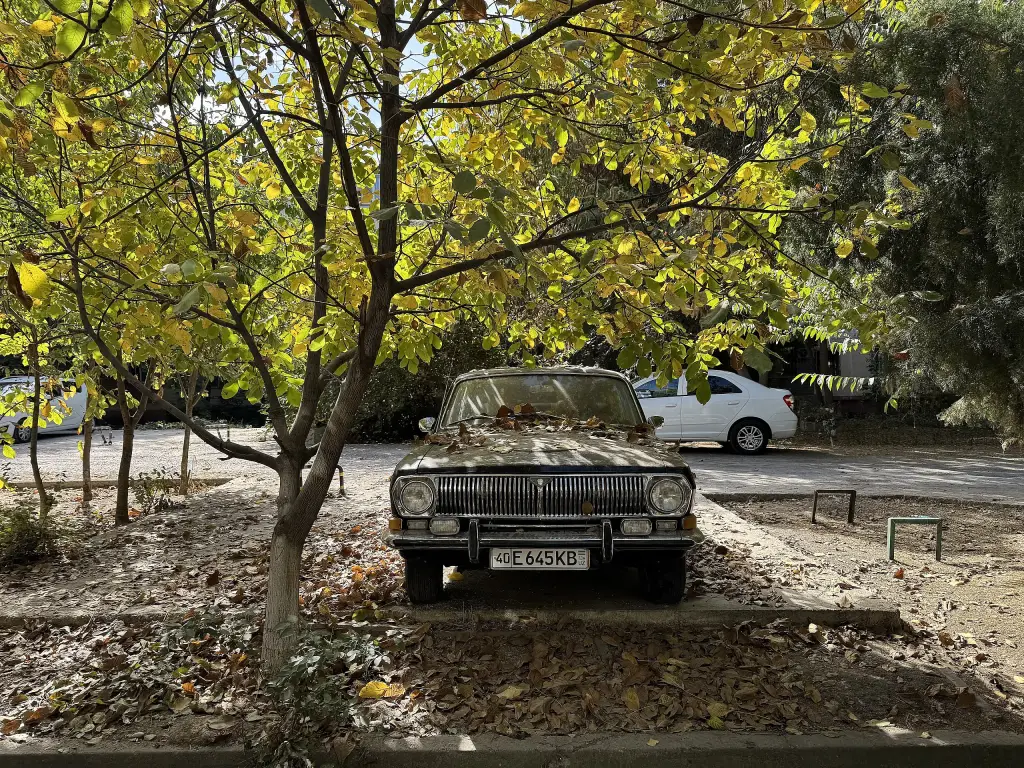
A roomier body
The new Volga had a wheelbase of 2,800 mm against the GAZ-21’s 2,700 mm, yet it was slightly shorter overall at 4,735 mm and much lower at 1,490 mm. Thinner linings in the doors, roof and other panels increased interior space, and bucket seats with lower bases plus a flat roof made it comfortable for five or six. The body was designed to last for years in severe road conditions; the reinforced unitary construction made the car heavy, and without power steering it earned the nickname barzha, the barge. The standard engine was the aluminium-block 2,445 cc ZMZ-24D overhead-valve four with a twin-choke carburettor, an evolution of the ZMZ-21A, producing 95 PS. Prototypes with an automatic and with a column-shift manual were built, but only the four-speed floor-change manual went into production. The brakes gained a vacuum servo and a separate parking brake.
Modernisation
From 1970 to 1974 the car changed little. In 1972–1973 it received a new boot lid lock, flat ashtrays in the rear doors, a new rear bumper and a revised radio; a dashboard with a simulated wood insert appeared in 1973, and the ignition switch moved under the steering wheel to reduce knee injuries. In 1974 came additional parking lights on the C-pillars, in the manner of American opera lights. The strip speedometer was replaced by a dial in 1975, seatbelts became available in 1977, and the GAZ-24-01 was joined in 1977 by the GAZ-24-07, converted to run on liquefied propane.
Export and the GAZ-24-10
The GAZ-24 was shown at the London Motor Show in 1970, and export sales began in 1971. In Belgium the car was assembled and rebadged as the Scaldia-Volga M24 and M24D for Western Europe. In 1978 about 1,000 right-hand-drive GAZ-24-56 cars were built for India, Pakistan and Singapore with a Peugeot XDP 4.90 engine; they were the last right-hand-drive vehicles GAZ made. A largely redesigned version, practically a new car in the old body, appeared in April 1986 as the GAZ-24-10 and was built until the summer of 1992.
Design and features
- Roomier cabin: a 2,800 mm wheelbase and thinner trim gave more space inside than the GAZ-21.
- ZMZ-24D engine: a 2,445 cc aluminium four with 95 PS and a twin-choke carburettor.
- Four-speed floor change: fully synchronised, unlike the gearbox of its predecessor.
- Recognition points: chromed rhombic vents on the C-pillar, two chromed fangs under the front bumper and vertical tail lights.
- Status symbol: sold only with a special permit for much of its life, alongside taxi, police and ambulance use.
GAZ-24 Volga versions
- GAZ-24 (1970–1986): the standard saloon.
- GAZ-24-01: taxi version.
- GAZ-24-07 (1977): converted to run on liquefied propane.
- GAZ-24-02: estate derivative.
- GAZ-24-56 (1978): right-hand drive for Asia with a Peugeot diesel.
- GAZ-24-10 (1986–1992): heavily revised model in the old body.
The GAZ-24 followed the GAZ-21 and was developed further into the GAZ-3110. Its place in the range is told in the Volga line.
Sources
- GAZ-24, English Wikipedia: development, dimensions, engine, updates, export, GAZ-24-10