The GAZ M21 Volga was the first car to carry the Volga name. It was built by GAZ in Gorky from 1956 to 1970 and became the biggest and most luxurious car officially sold to private owners in the Soviet Union. Three series were made, most easily told apart by their grilles.
GAZ-21 Volga at a glance
| Maker | GAZ, Gorky (Gorkovsky Avtomobilny Zavod) |
|---|---|
| Production | 1956–1970 |
| Also called | GAZ-M21 Volga |
| Body | four-door saloon; GAZ-22 estate from 1962 |
| Early engine | 2,432 cc sidevalve four, 65 PS |
| Engine from 1957 | 2,445 cc OHV four, 70 PS |
| Transmission | three-speed manual; automatic on about 700 early cars |
| Suspension | independent front, live rear axle |
| Wheelbase | 2,700 mm |
| Length | 4,810 mm |
| Price in 1957 | 5,400 rubles |
| Built | 639,478 |
The German Wikipedia page titled GAZ-21 describes a 1930s GAZ prototype, not this car, so it was not used.
History of the GAZ-21 Volga
Development
Work on the car that became the GAZ-21 began in November 1953. Alexander Nevzorov, head of the design team, was given a free hand to create a car that could compete with American automobiles, and designer Lev Eremeyev followed the fashion set by the Chevrolet Bel Air, Plymouth Savoy and Ford Mainline. A prototype appeared in the first quarter of 1954 with an overhead-camshaft four; because that engine was not ready in time, production cars used a 65 PS 2,432 cc sidevalve four derived from the GAZ-20. The Volga made its public debut in 1955 with a demonstration drive from Moscow to the Crimea. Only five cars were assembled in 1956, the first on 10 October, and full production began in 1957 at a list price of 5,400 rubles.
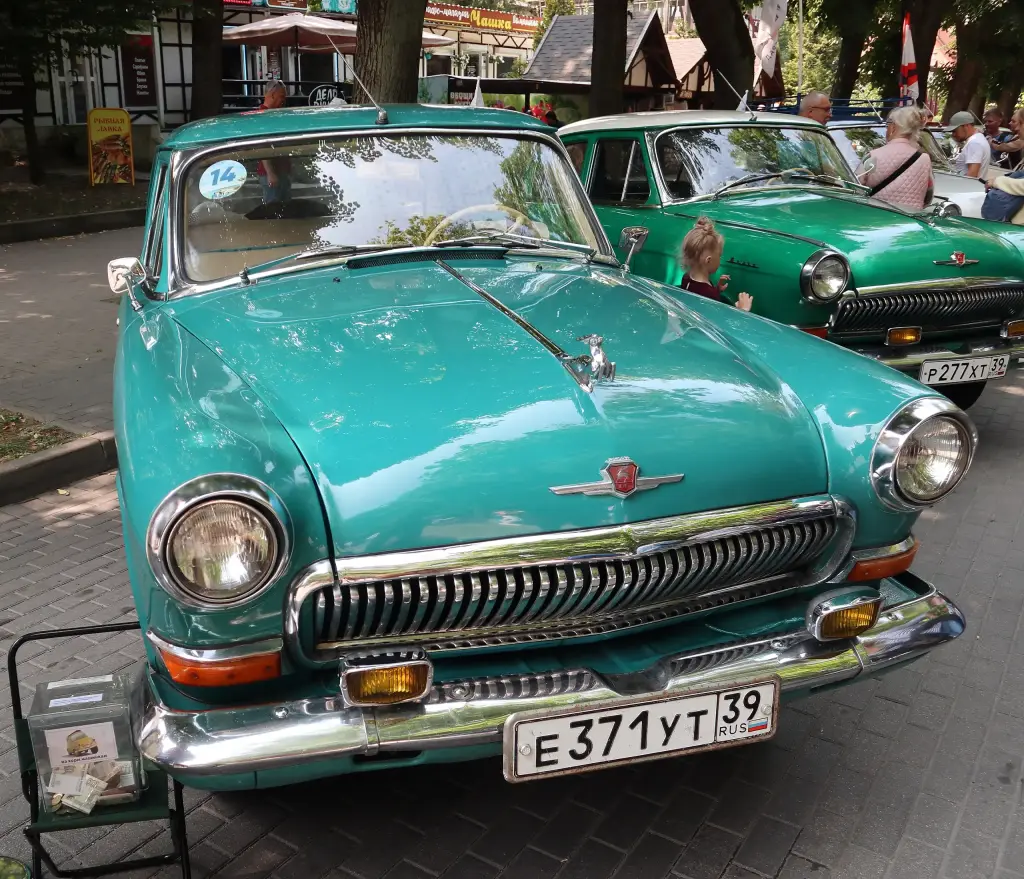
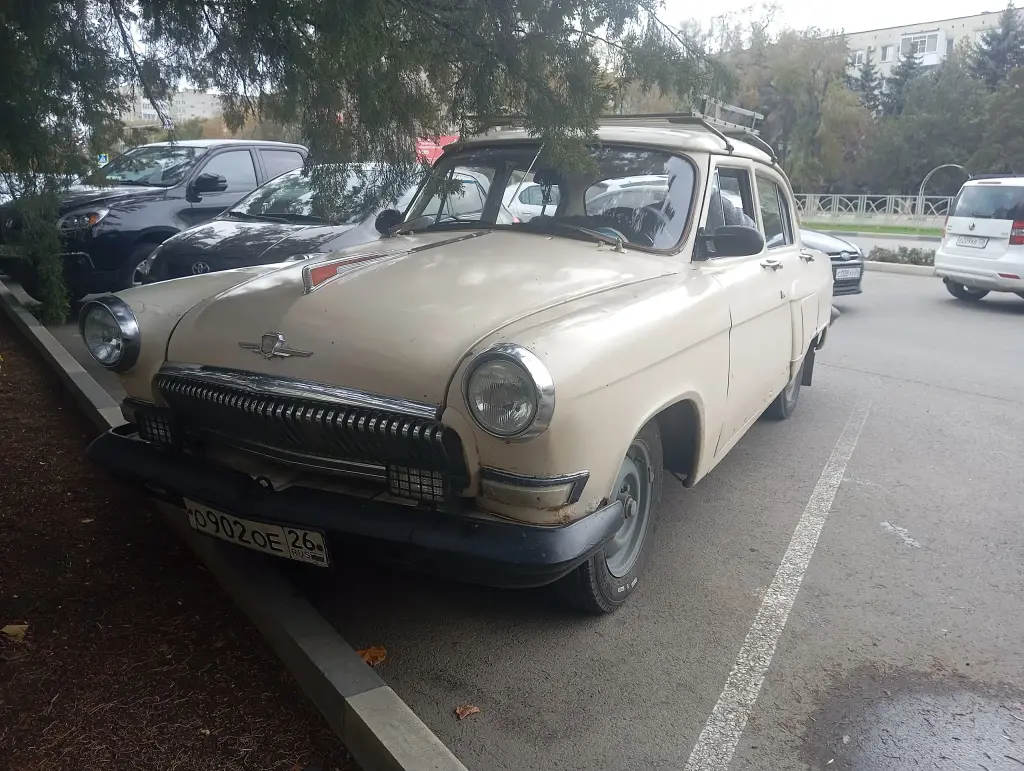
First series: the Star
The first series was built from late 1956 until 1958. Its grille was a lattice of three large horizontal bars with a medallion carrying a star in the centre, which gave the car its nickname. The 1957 cars had a new 2,445 cc overhead-valve engine from the Zavolzhye engine factory, with an aluminium block and head, a gear-driven camshaft and a compression ratio of 6.6:1; it produced 70 PS at 4,000 rpm and 167 N·m at 2,200 rpm. The automatic transmission was soon dropped after only about 700 cars because Soviet drivers and workshops found it hard to maintain, and from 1958 a three-speed manual with synchromesh on the top two gears was the only choice. Export cars had a higher 7.2:1 compression and 80 PS.
Second series: the Shark
The second series arrived in 1959 with a new grille painted in the body colour or in chrome and 16 vertical slits, hence the Shark nickname. Halfway through the 1959 run a vinyl cover was added to the dashboard, and windscreen washers and tubeless tyres became available. Just before the series ended, telescopic shock absorbers replaced the lever type at all four corners. The 1961 cars were priced at 5,100 rubles.
Third series: the Baleen
In 1962 came the third series with a grille of 34 thin vertical rods, nicknamed the Baleen; that grille became a Volga trademark for decades. The same year brought the GAZ-22 estate, assembled in small numbers, and a rare V8-engined version built for the KGB’s 9th Directorate as a motorcade escort. Production of the third series continued until 15 July 1970, when the GAZ-24 took over the line.
Design and features
- High ground clearance: the Volga sat noticeably higher than Western cars of similar size, which suited Soviet roads.
- Rugged suspension and engine: built to survive years of hard use, with rustproofing unusual for the 1950s.
- Luxury equipment: reclining front seat, cigarette lighter, heater, windscreen washer and a three-wave radio.
- Three grilles: Star, Shark and Baleen front ends make the series easy to recognise.
GAZ-21 Volga versions
- M21G: the standard saloon of the first series.
- M21B and M21A: taxis with a taximeter instead of the radio and separate front seats.
- M21GYU: tropical version of the first series.
- M21D and M21E: export cars with 80 PS, manual and automatic respectively.
- GAZ-22: custom-assembled estate from 1962.
- KGB V8 escort: a rare eight-cylinder version for motorcades.
The GAZ-21 was replaced by the GAZ-24, and its story is part of the Volga line. More Soviet cars are in the Volga collection.
Sources
- GAZ-21, English Wikipedia: development, series, engines, variants, production
- Volga, English Wikipedia: GAZ-22 estate, KGB V8 version, end of production