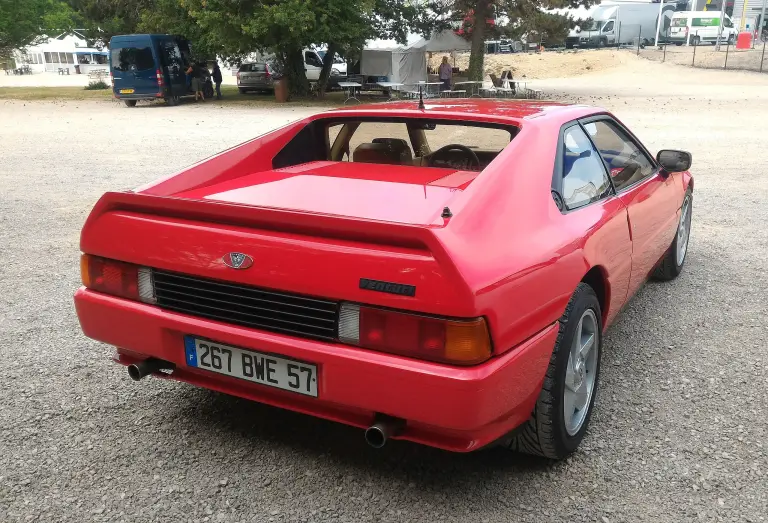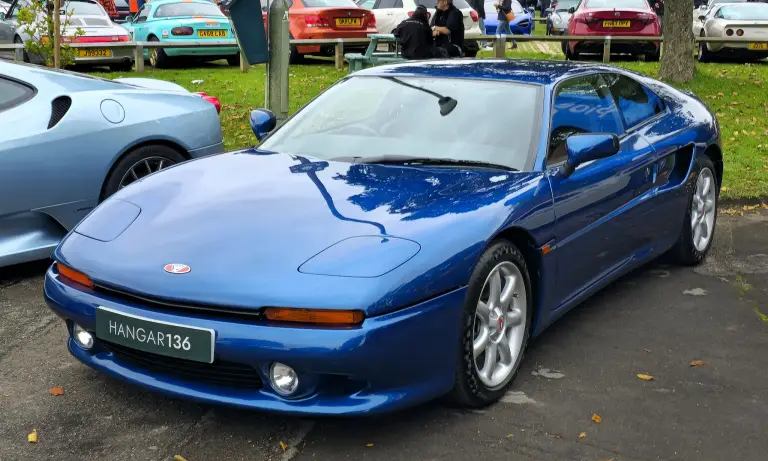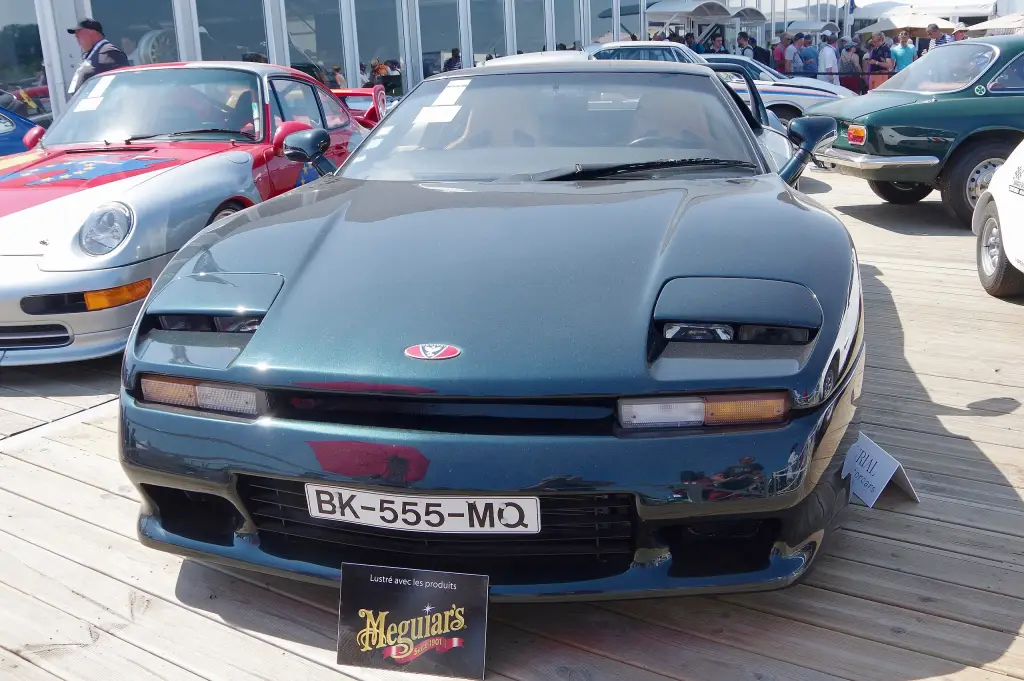
The Venturi 400 GT was the road-going version of the 400 Trophy racing car, built by the French manufacturer Venturi from 1994. With a 408 hp twin-turbo V6, carbon brakes and a body closely related to the racer’s, it was quickly nicknamed “the French F40”.
Venturi 400 GT at a glance
| Maker | Venturi, Couëron, France |
|---|---|
| Production | 1994–1997 |
| Based on | Venturi 400 Trophy racing car |
| Engine | 2,975 cc twin-turbo V6, derived from the PRV/EIA unit |
| Power | 408 PS (402 hp) |
| Torque | 530 N·m |
| Gearbox | five-speed manual |
| 0–100 km/h | 4.7 seconds |
| Top speed | 290 km/h |
| Brakes | carbon discs, standard |
| Road cars built | about 15, plus 73 racing cars |
| Series 2 | 3 cars, steel disc brakes |
History of the Venturi 400 GT
The 400 GT grew out of a one-make racing series. The 400 Trophy was built in 1992 for the Gentlemen Drivers Trophy organised by Stéphane Ratel, then head of Venturi’s competition department. The idea was simple: besides the car, owners bought a complete season of racing, with the factory transporting and maintaining every entry. The cars were prepared identically, which kept the chances equal and limited the cost of escalation.

400 Trophy
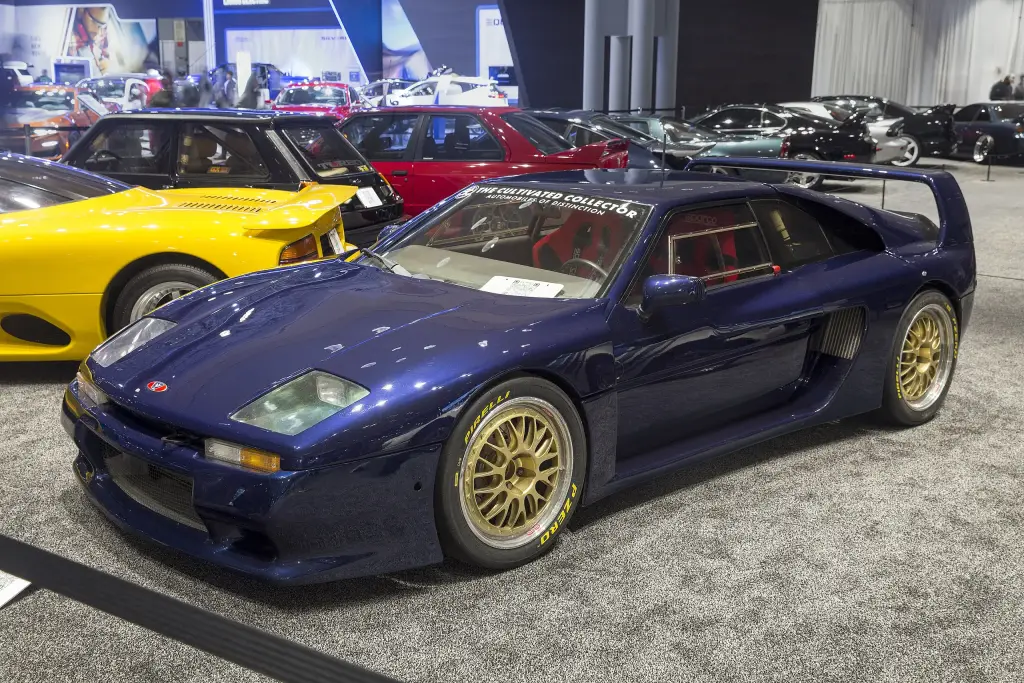
The Trophy used a 2,975 cc multi-valve V6 with two turbochargers developed by E.I.A., producing 408 hp and 530 N·m. The chassis was reinforced, the running gear was redefined, and the car was the first of its kind to use all-carbon brakes developed by Carbone Industrie. The first season had six races, at Le Mans, Pau, Paul Ricard, Nürburgring, Magny-Cours and Dijon, and the trophy ran for four seasons in total. Seventy-three cars were built.
400 GT
The road model was presented by the racing driver Henri Pescarolo on 8 June 1994 at Venturi’s headquarters in Couëron. It was directly derived from the Trophy, with a series of small changes for road homologation: the mirrors were raised, a pair of catalytic converters was added and the headlights became pop-up units. The engine stayed the same, mated to a five-speed manual gearbox, and the top speed was 290 km/h. The cabin was far more luxurious and took its layout from the Venturi 260, with a choice of leather and of carbon or wood veneer for the dashboard.
Only about fifteen road cars were made. At the end of its life the 400 GT received a Series 2 with a new front bumper, new rear lights and steel disc brakes in place of the carbon ones; just three were built. Because of its resemblance to the Ferrari F40, enthusiasts soon called the 400 GT “the French F40”.
Design and features
- Racing engine: the 2,975 cc twin-turbo V6 of the Trophy, 408 hp and 530 N·m.
- Carbon brakes: the 400 GT is credited as the first production car to have them as standard equipment.
- Road conversion: catalytic converters, raised mirrors and pop-up headlights for homologation.
- Luxurious cabin: the interior followed the Venturi 260, with a choice of leather and veneer.
- Rarity: about fifteen road cars against seventy-three racing cars.
Venturi 400 GT versions
- 400 Trophy (1992): the competition car for the Gentlemen Drivers Trophy, 73 built.
- 400 GT (1994): the road version, about 15 built.
- 400 GT Series 2: new bumpers and lights, steel brakes, 3 built.
The 400 GT shared its chassis with the Venturi Atlantique 300, and the road-car interior came from the earlier Venturi 260 and Coupé. More cars are in the Venturi collection.
Video: Lap Time: Venturi 400 Trophy route (Motorsport)
Video on YouTube.
Sources
- Venturi 400, English Wikipedia: Trophy, Gentlemen Drivers Trophy, 400 GT
- Venturi 400, French Wikipedia: road conversion, Series 2, production numbers