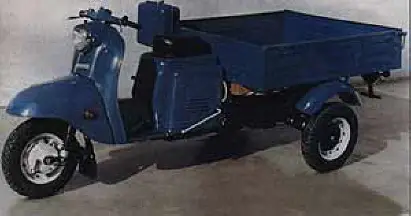
The Tula Muravey was a Soviet three-wheeled cargo scooter built by the Tula Machine-Building Plant from 1959 to 1995. Built on the passenger scooters of the plant, it became the most accessible small truck in the country and remained in use long after production ended.
Tula Muravey at a glance
| Maker | Tula Machine-Building Plant (TMZ), Tula, USSR |
|---|---|
| Production | 1959–1995 |
| Type | three-wheeled cargo scooter |
| Engine | 199 cc single-cylinder two-stroke, forced air cooling |
| Power | 11 hp at 4,600 rpm |
| Torque | 16.3 N·m at 4,900 rpm |
| Gearbox | four-speed with reverse |
| Length | 2,880 mm |
| Wheelbase | 1,840 mm |
| Dry weight | 258 kg (platform), 285 kg (van) |
| Payload | 340 kg (platform), 375 kg (van) |
| Top speed | 60 km/h |
Based on one source: the Russian Wikipedia article on the Muravey cargo scooter.
History of the Tula Muravey
The Muravey was not a single machine but a family of cargo tricycles built on the plant’s passenger scooters between 1959 and 1995. The first, the TG200, was based on the T-200 Tula and did not yet carry the Muravey name; it was followed by the TGA200 on the T-200M, the TGA200-01 and TGA200-01P on the Turist, and the Muravey-2 01, 02 and 03 on the Tulitsa, the last model listed for 1991. A GTS-1 was also built. For the series 5.402 the engine was a 199 cc single-cylinder two-stroke with forced air cooling, 11 hp at 4,600 rpm and 16.3 N·m at 4,900 rpm. The four-speed gearbox had a reverse in the differential housing, and drive reached the rear wheels through swinging shafts with universal joints.
The dimensions were compact: 2,880 mm long, a 1,840 mm wheelbase and 115 mm of ground clearance. Dry weight was 258 kg for the open-platform 5.402-03 and 5.402-03K, or 285 kg for the 5.403-03F van; payload was 340 kg or 375 kg respectively. The top speed was 60 km/h and fuel consumption 5.5–7.5 litres per 100 km from a 10-litre tank, filled with a petrol-oil mixture. In the early 1990s a diesel engine, the TMZ-450D, was developed for the Muravey.
The Muravey was popular already in Soviet times because it was effectively the only affordable small truck, and in the countryside it was widely used for small household deliveries. It remained popular in 2020, a quarter of a century after production ended, thanks to its high payload, strength and off-road ability, especially with tractor or quadbike tyres fitted. Spare parts continued to be made by various firms, including in China. The tricycle was also a favourite base for home-built vehicles, and its reversing gearbox is sought after by builders of low-pressure-tyre all-terrain vehicles. Muraveys appeared in Soviet and post-Soviet films such as Mama Vyšla Zamuzh, Ochkarik, Cheburashka and the television series Uchastok. In 2016 the plant discussed reviving cargo scooter production, a prototype was assembled in 2017, and in May 2020 sales began of the VTS-01 with a diesel-generator set and the battery-powered VTS-02 at a starting price of 1.25 million roubles.
Design and features
- Small truck: the only affordable light cargo vehicle for many Soviet users.
- Strong and simple: high payload, robust construction and good off-road ability.
- Reverse gear: a reversing gearbox in the differential made tight deliveries easier.
- Long service life: spare parts and home-built derivatives kept Muraveys working for decades.
Tula Muravey versions
- TG200: first cargo version, based on the T-200, before the Muravey name.
- TGA200 and TGA200-01/01P: versions on the T-200M and Turist scooters.
- Muravey-2 01, 02 and 03: models on the Tulitsa, the last listed in 1991.
- GTS-1: another cargo variant of the family.
- VTS-01 and VTS-02 (2020): modern diesel-generator and battery models.
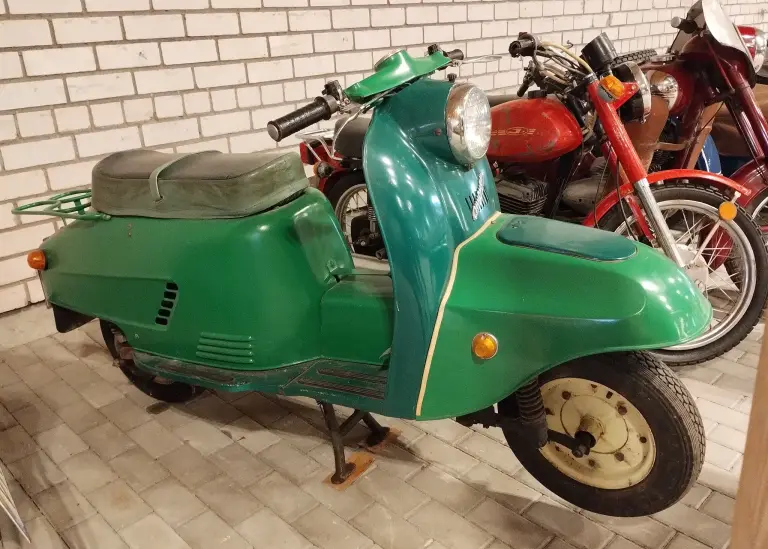
The Muravey was built on the Tula T-200 and Tula Turist scooters, and its engine family also served the Tula 5.952 motorcycle. More vehicles are in the Tula collection.
Sources
- Муравей (мотороллер), Russian Wikipedia: models, specifications, use and revival