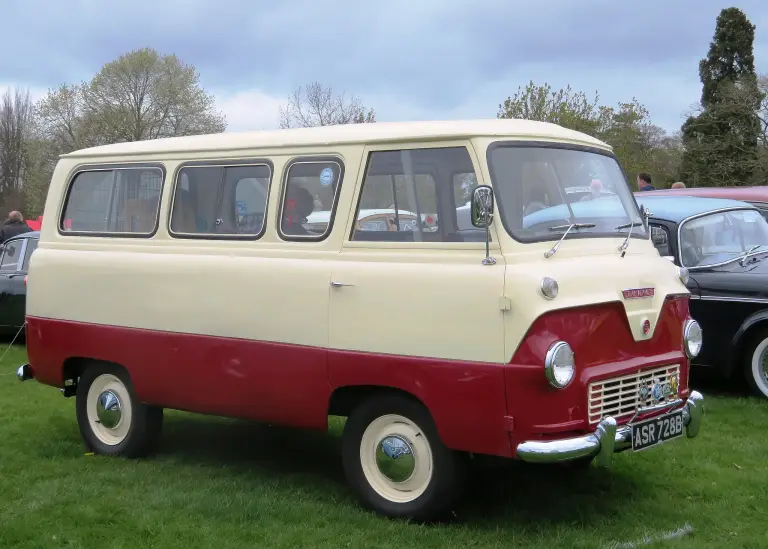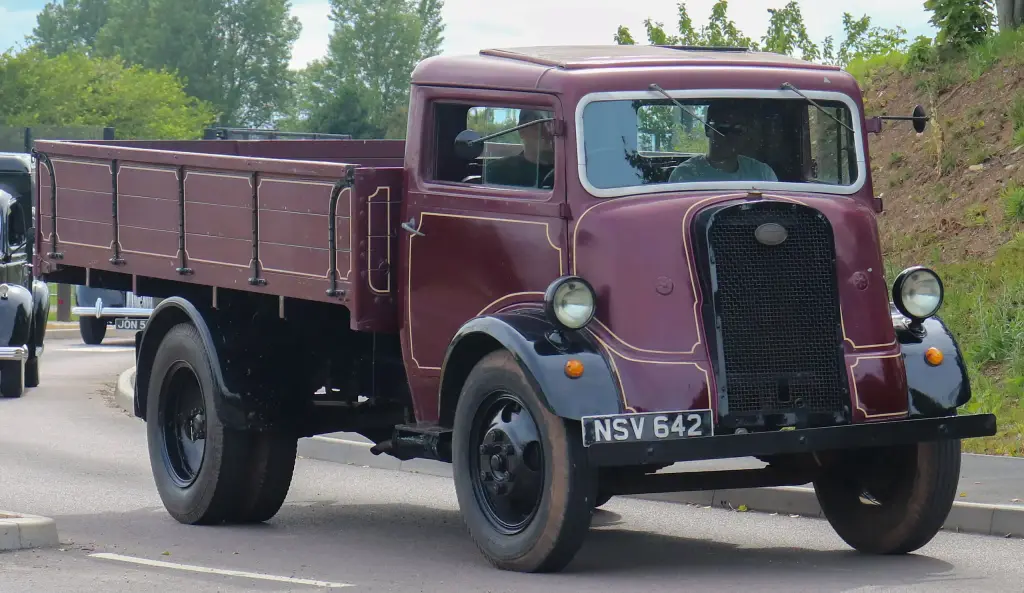
The Thames ET was the post-war commercial range that Ford of Britain presented in 1949 under the Fordson Thames name, with ET standing for English Truck. It replaced the Fordson 7V, kept the Ford V8 flathead engine, and stayed in production at Dagenham until 1957, when the Thames Trader took over.
Thames ET at a glance
| Maker | Ford of Britain, Dagenham |
|---|---|
| Brand | Fordson Thames, later Thames |
| Production | 1949–1957 |
| Name | ET stands for English Truck |
| Predecessor | Fordson 7V |
| Successor | Thames Trader |
| Engines | Ford V8 flathead; Perkins diesel option; 3.6-litre four from 1953; 3.61-litre diesel from 1954 |
| Payload | up to eight tons |
| Bodies | truck, chassis, panel van, bus |
| Cab | conventional, built by Briggs Motor Bodies |
| Drive | rear-wheel drive, optional all-wheel drive |
| Licence production | Ebro B series in Spain, 1956–1963 |
The ET range has no article of its own on Wikipedia; this page uses the section on the Fordson Thames ET in the English article on the Thames marque, so it is shorter than the other articles on the site.
History of the Thames ET
In 1949 Ford of Britain presented its new post-war truck range, this time under the Fordson Thames brand only rather than offering the same vehicles separately as Fordson and Thames. The ET replaced the Fordson 7V models but kept the same chassis and the Ford V8 flathead engine. Along with the Commonwealth it was offered in continental Europe, though not in Germany, where the similar Ford Rhein and Ruhr models were sold instead. The range was available not only as a truck and chassis but also as a panel van and a bus.
The cab and chassis
The conventional cab, with a bonnet and a split windscreen, had more space than the cramped cab of the 7V it replaced. It was built by the coachbuilder Briggs Motor Bodies and was supplied in almost the same form for the Dodge 100 and the Leyland Comet. The chassis used semi-elliptical leaf springs and now had hydraulically operated brakes with a vacuum brake booster. Payloads of up to eight tons and optional all-wheel drive were also possible.
Four-wheel drive and new engines
A four-wheel-drive three-ton variant, the ETF6, used the Canadian V8 engine with vertical valves and a cab-over-engine cab from British Light Steel Pressings; the same cab was also used by Commer. Because the outdated V8 consumed a great deal of fuel, Ford launched the newly developed Cost Cutter in 1953 for payload variants of up to three tons, a 3.6-litre four-cylinder engine with overhead valves. That engine was also the basis for Ford’s first self-developed diesel, a 3.61-litre unit of 70 hp (55 kW) offered from 1954 as the 4D or 6D.
The end of the ET
Production in Dagenham ended in 1957 and the range’s successor was the Thames Trader, an entirely new design. Abroad the ET lived on: Ebro built the Fordson-Thames ET models under licence in Spain from 1956 to 1963 as the Ebro B series.
Design and features
- Conventional cab: bonnet and split windscreen, with more room than the cab of the previous 7V and a body supplied by Briggs Motor Bodies.
- Modern brakes: hydraulically operated with a vacuum booster, where the 7V had to make do with an older system.
- Wide range: truck, chassis, panel van and bus bodies, payloads up to eight tons and optional all-wheel drive.
- Own diesel: Ford’s first self-developed diesel engine, a 3.61-litre unit of 70 hp, joined the range in 1954 as the 4D or 6D.
- Export and licence production: built in Spain by Ebro as the B series until 1963.
Thames ET versions
- Truck and chassis (1949–1957): the standard range with the Ford V8 flathead engine.
- Panel van and bus: the same model series was also sold with enclosed bodywork.
- ETF6: a three-ton four-wheel-drive variant with the Canadian V8 and a cab-over-engine cab.
- Cost Cutter (from 1953): a 3.6-litre overhead-valve four-cylinder for payloads of up to three tons.
- 4D and 6D (from 1954): diesel versions with Ford’s own 3.61-litre engine of 70 hp.
- Ebro B series (1956–1963): Spanish licence-built versions of the ET.
The ET was replaced by the Thames Trader, and its light-van successor of 1957 was the Ford Thames 400E. More British commercial vehicles are in the Thames collection.
Video: 1950 Fordson Thames ET6 with its original V8 sidevalve engine
Video on YouTube.
Sources
- Thames (commercial vehicles), English Wikipedia: history, engines, variants, production