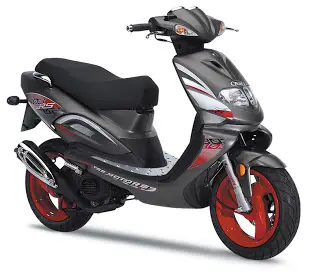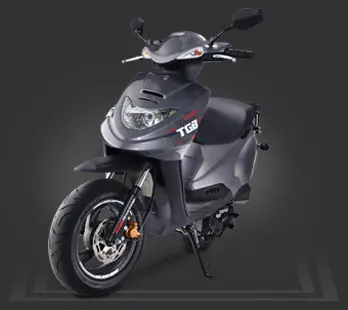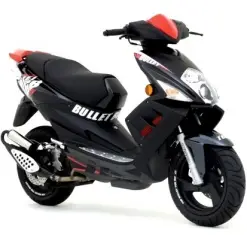
The TGB Bullet is the scooter line on which Taiwan Golden Bee has rung the most changes: the manufacturer lists it as the Bullet Basic, Bullet RR, Bullet RS, Bullet 2.0 and Bullet NEW. Few small manufacturers keep five designations of one scooter alive at once, and the list is a fair summary of how the company works, adding versions rather than replacing them.
TGB Bullet at a glance
| Maker | Taiwan Golden Bee Co., Ltd. (TGB), Taiwan |
|---|---|
| Model | TGB Bullet |
| Listed versions | Bullet Basic, Bullet RR, Bullet RS, Bullet 2.0, Bullet NEW |
| Place in the range | scooter line, in the two-wheel part of the programme |
| Engines | mainly Morini units, licence-built Moto Franco Morini designs |
| Assembly | Taiwan: Youn-An and Ping-Tung plants |
| Company capital | NT$190 million, about €4 million |
| German distribution | ZEG from 2001; Leeb of Austria from 2008 |
| Technical data in the source | none: only the five model names are given |
No Wikipedia page exists for this model in any language. The page is built from the German, English and Polish articles on the manufacturer, Taiwan Golden Bee, and from the model list they give; the source publishes no technical data for the Bullet itself.
History of the TGB Bullet
Taiwan Golden Bee grew out of scooter work: the company was registered in 1965 as Taiwan Vespa Co. Ltd. and produced Piaggio scooters for Taiwan under Italian licence, and it took its present name in 1978 when it began building vehicles to its own designs. The scooter has remained in the programme ever since, alongside the quads and all-terrain vehicles that later carried the marque into Europe.
The Bullet is the line where the company’s habit of layering versions shows most clearly. Five names appear in the manufacturer’s list: Bullet Basic, Bullet RR, Bullet RS, Bullet 2.0 and Bullet NEW. The order suggests a progression from a plain model through sportier RR and RS forms to a second-generation 2.0 and a renewed NEW, but the source does not date any of them, and the sequence is not stated as a chronology. Nor does it give engine size, power, weight or equipment for any version, so the designations are all there is to go on.
No encyclopaedia has an article on the Bullet in any language, which is why this page describes the line rather than a single machine. What the sources do establish is the manufacturing background: bodywork is largely made in-house by TGB, while cockpits, handlebar switches and engines are bought mainly from Morini, whose units are licence-built Moto Franco Morini designs, and TGB also supplies complete continuously variable transmission systems to Piaggio, Rotax/Can-Am, Peugeot, Polaris, Minarelli, Morini and SYM.
For German buyers the Bullet belongs to the period after the marque was put on a single import channel. From 2001 the Cologne cooperative ZEG held the exclusive import, having sold TGB vehicles as Pegasus since 1997, and since 2008 scooters and quads have come through the Austrian importer Leeb. TGB’s two Taiwanese plants, Youn-An with 270 employees and Ping-Tung with 170, produce the scooters and the quads together.
Design and features
- Five designations: Basic, RR, RS, 2.0 and NEW are all listed as current names.
- Long-running line: the Bullet has been extended rather than replaced over the years.
- Morini engines: the company fits mainly Morini units, licence-built Moto Franco Morini designs.
- Own bodywork: most panels are made by TGB itself.
TGB Bullet versions
- Bullet Basic: the plain version in the list.
- Bullet RR: the RR designation, set alongside the RS.
- Bullet RS: the sport-looking version, the one most often modified by owners.
- Bullet 2.0: a second-generation designation.
- Bullet NEW: the most recent name in the list.
The TGB Tapo is the other scooter line with RR and RS versions, and the TGB Bellavita is the best known of the company’s scooters. More machines are in the TGB collection.
Video: TGB Bullet RS Tuning Story Part 1
Video by Max S on YouTube.
Sources
- Taiwan Golden Bee, German Wikipedia: Bullet model list, company history, importers
- Taiwan Golden Bee, English Wikipedia: founder, origins, transmission supply
- Taiwan Golden Bee, Polish Wikipedia: company profile and model names