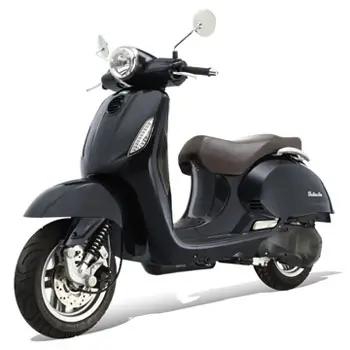
The TGB Bellavita is the best-known of the Taiwanese company’s scooters and is listed in two sizes, 125 and 300. It comes from a maker whose whole scooter business grew out of building Vespa scooters under Italian licence, which is why the Bellavita’s rounded bodywork reads as a deliberate nod to that inheritance.
TGB Bellavita at a glance
| Maker | Taiwan Golden Bee Co., Ltd. (TGB), Taiwan |
|---|---|
| Model | TGB Bellavita |
| Listed versions | Bellavita 125 and Bellavita 300 |
| Place in the range | scooter, among the company’s known and current models |
| Engines | mainly Morini units, licence-built Moto Franco Morini designs |
| Assembly | Taiwan: Youn-An and Ping-Tung plants |
| Company founded | 1965 as Taiwan Vespa Co. Ltd.; renamed Taiwan Golden Bee in 1978 |
| German distribution | ZEG from 2001; Leeb of Austria from 2008 |
| Technical data in the source | none: the two model names are all the source gives |
No Wikipedia page exists for this model in any language. The page is built from the English, German and Polish articles on the manufacturer, Taiwan Golden Bee, and from the model list they give; the source publishes no technical data for the Bellavita itself.
History of the TGB Bellavita
Taiwan Golden Bee started in 1965 as Taiwan Vespa Co. Ltd., producing Piaggio scooters under Italian licence for Taiwanese buyers. Its founder, Chi-Fu Chang, had run the Taiwanese division of Vespa before setting up on his own, and the manufacturing methods he brought with him shaped the company. In 1978 the firm was renamed Taiwan Golden Bee and began building vehicles of its own design, but the scooter remained the centre of the programme.
The Bellavita is the clearest expression of that continuity. The model list gives it in two displacements, 125 and 300, and it is one of the few TGB scooters that European buyers recognise by name; the larger version in particular is the machine most often filmed and written about. Beyond the two designations the sources stop: no encyclopaedia has an article on the Bellavita in any language, and the manufacturer’s list gives no power figure, weight, dimensions or production period.
The company behind the scooter is larger than its European reputation suggests. It runs two plants in Taiwan, Youn-An with 270 employees on 31,260 square metres and Ping-Tung with 170 employees on 21,623 square metres, on capital of NT$190 million, about four million euros. Most body panels are made in-house; cockpits, handlebar switches and engines are bought mainly from Morini, whose engines are licence-built Moto Franco Morini designs. TGB also supplies complete continuously variable transmission systems to Piaggio, Rotax/Can-Am, Peugeot, Polaris, Minarelli, Morini and SYM.
In Germany the Bellavita has been sold through two arrangements: the Cologne cooperative ZEG held the exclusive import from 2001, having used the Pegasus name since 1997, and since 2008 scooters and quads have been distributed by the Austrian importer Leeb. The maker describes its product philosophy as “Play Different”, and its scooter range is presented as covering both the two- and the four-wheel side of the business.
Design and features
- Two displacements: the Bellavita is listed as a 125 and as a 300.
- Vespa inheritance: the company built Piaggio scooters under licence before launching its own designs.
- Retro bodywork: most panels are made in-house by TGB, with bought-in cockpits and switchgear.
- Recognised model: it is among the TGB scooters best known to European buyers.
TGB Bellavita versions
- Bellavita 125: the smaller of the two listed versions.
- Bellavita 300: the larger version, the one most often filmed and discussed.
- Earlier 125-class scooters: the 101S Orion, 101R Tryton and Laser RS 50, which precede it in the model list.
The TGB 101 and TGB Tapo are its closest relatives in the range; the TGB Blade shows the other side of the company’s work. More machines are in the TGB collection.
Video: TGB Bellavita 300
Video by scootersales on YouTube.
Sources
- Taiwan Golden Bee, German Wikipedia: model list with Bellavita 125 and 300, company facts, importers
- Taiwan Golden Bee, English Wikipedia: founder, origins, transmission supply
- Taiwan Golden Bee, Polish Wikipedia: company profile and model names