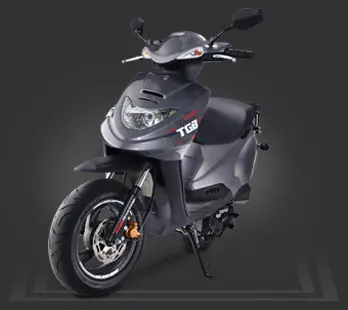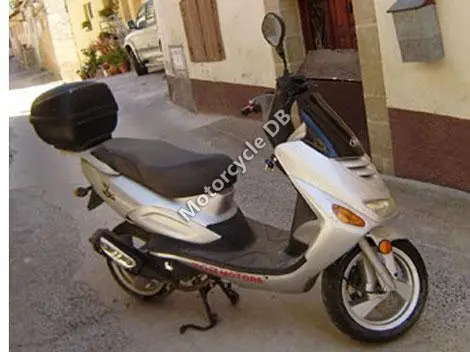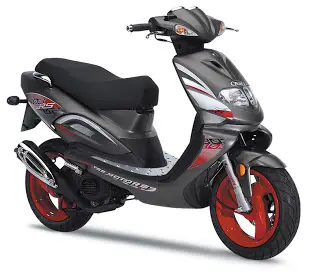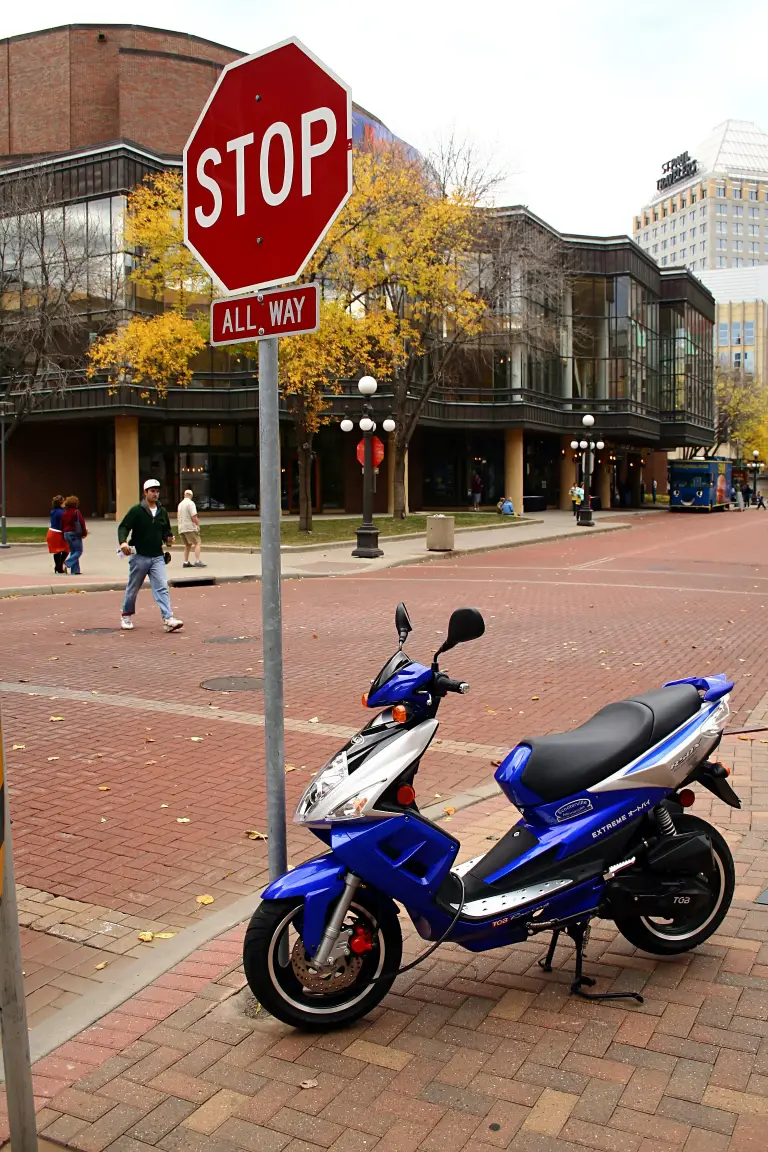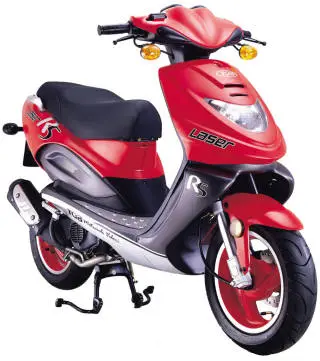
The TGB Laser RS 50 is the smallest sort of machine the Taiwanese company makes. It stands in the manufacturer’s model list next to the Ergon EMR 50 and the Octane 50, and like them it belongs to the light end of a range that otherwise runs to large four-wheel-drive quads.
TGB Laser at a glance
| Maker | Taiwan Golden Bee Co., Ltd. (TGB), Taiwan |
|---|---|
| Model | TGB Laser |
| Listed version | Laser RS 50 |
| Small-capacity neighbours | Ergon EMR 50, Octane 50, AS 50 |
| Engines | mainly Morini units, licence-built Moto Franco Morini designs |
| Assembly | Taiwan: Youn-An and Ping-Tung plants |
| Company founded | 1965 as Taiwan Vespa Co. Ltd.; renamed Taiwan Golden Bee in 1978 |
| German distribution | ZEG from 2001; Leeb of Austria from 2008 |
| Technical data in the source | none: only the model name is given |
No Wikipedia page exists for this model in any language. The page is built from the Polish, German and English articles on the manufacturer, Taiwan Golden Bee; the source gives no technical data for the Laser itself.
History of the TGB Laser
Taiwan Golden Bee built its first vehicles under someone else’s badge. Registered in 1965 as Taiwan Vespa Co. Ltd., the company produced Piaggio scooters for Taiwan under Italian licence, and its founder Chi-Fu Chang had run the Taiwanese Vespa division before that. The switch to the Taiwan Golden Bee name came in 1978, together with the beginning of production of the company’s own designs.
The Laser RS 50 belongs to the light end of the range that grew out of those beginnings. The maker lists it beside other small-capacity machines, the Ergon EMR 50, the Octane 50 and the AS 50, while the rest of the programme is taken up by scooters of 125 to 300 cc, such as the Bellavita, and by quads and all-terrain vehicles up to 1000 cc. The source stops at the name: no engine output, weight, frame or production period is given for the Laser, and there is no article on it in any language of Wikipedia.
The picture of the company behind the model is much fuller. TGB makes most of its bodywork in-house; cockpits, handlebar switches and engines are bought mainly from Morini, and those engines are licence-built Moto Franco Morini designs, used as well in scooters of several other, less-known makers. The firm also supplies complete continuously variable transmission systems to Piaggio, Rotax/Can-Am, Peugeot, Polaris, Minarelli, Morini and SYM, a business that runs alongside its own vehicle production.
Manufacturing is concentrated in two Taiwanese plants, Youn-An with 270 employees on 31,260 square metres and Ping-Tung with 170 employees on 21,623 square metres, on capital of NT$190 million, about four million euros. In Germany the small scooters were the first TGB products to arrive, with the Ergon 50 and Akros 50 imported by Auto-Teile-Unger between 1995 and 2001 and sold there until 2003; the marque then passed to the ZEG cooperative in Cologne from 2001 and, since 2008, to the Austrian importer Leeb.
Design and features
- Smallest class: the Laser is listed as a 50, among the lightest models TGB makes.
- RS designation: the maker names it the Laser RS 50.
- Morini engines: the company fits mainly Morini units, licence-built Moto Franco Morini designs.
- Long scooter tradition: light scooters have been the company’s core product since the Vespa licence years.
TGB Laser versions
- Laser RS 50: the version named in the manufacturer’s list.
- Ergon EMR 50: another 50cc model listed beside it.
- Octane 50 and AS 50: further small-capacity machines in the same list.
The TGB 101 and TGB Tapo are the scooters nearest to it in size. More machines are in the TGB collection.
Video: Tgb laser r5 bogging on take off
Video by JoonBalloon1 on YouTube.
Sources
- Taiwan Golden Bee, Polish Wikipedia: model list with Laser RS 50 and the other small models
- Taiwan Golden Bee, German Wikipedia: company history, plants, engines, importers
- Taiwan Golden Bee, English Wikipedia: origins and transmission supply