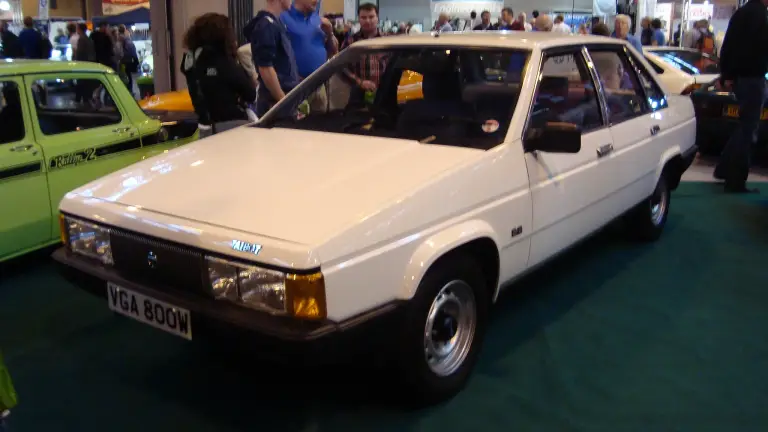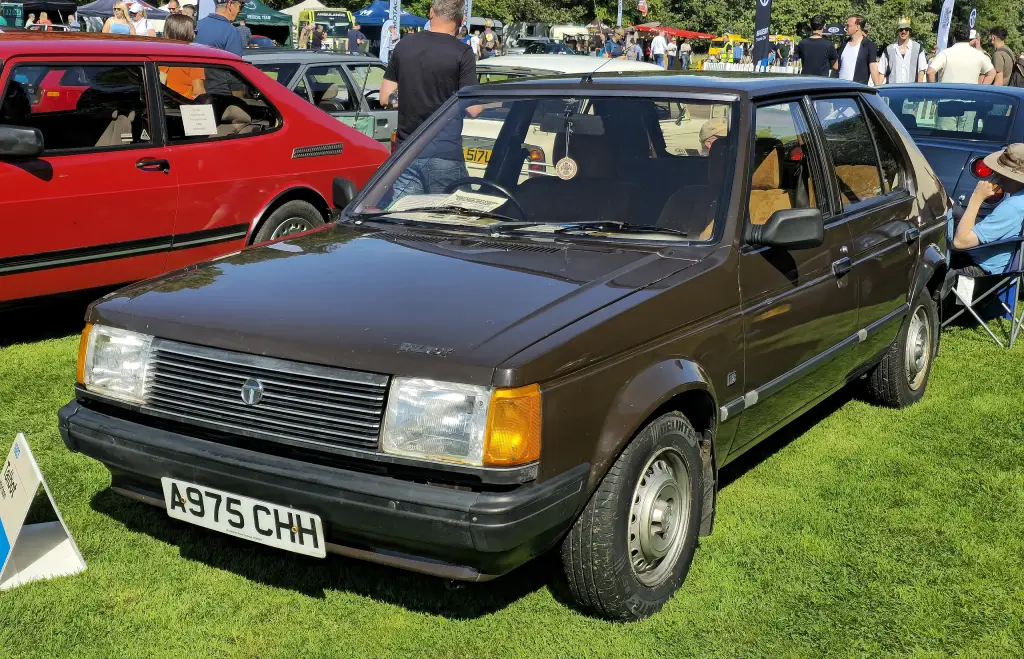
The Talbot Horizon was a small family hatchback designed by Chrysler Europe and sold between the 1978 and 1987 model years as a Simca, a Chrysler and, for most of its life, a Talbot. It was voted European Car of the Year in 1979 and was built in four countries.
Talbot Horizon at a glance
| Maker | Chrysler Europe; Talbot from 1979 |
|---|---|
| Production | 1978–1987 |
| Class | small family car (C-segment) |
| Body | five-door hatchback only |
| Layout | front-wheel drive, transverse engine |
| Engines | 1.1, 1.3 and 1.5-litre Poissy overhead-valve fours |
| Gearbox | four-speed, five-speed from the 1982 Series II |
| Suspension | torsion bars |
| Project code | C2 |
| Award | European Car of the Year 1979 |
| Built at | Poissy, Ryton, Spain and Finland |
| Total built | 1,070,222 hatchbacks in Europe |
based on one source (English Wikipedia).
History of the Talbot Horizon
The Horizon was developed by Chrysler Europe under the code C2 at the Whitley design studio in Britain, styled by Roy Axe and engineered at Poissy in France by Simca. It was meant to replace both the ageing Simca 1100 and the Hillman Avenger and was part of a “world car” programme shared in concept with the American Dodge Omni and Plymouth Horizon, though the European and American cars differed substantially. Introduced in summer 1978, it was sold in France as a Simca and elsewhere as a Chrysler; after PSA bought Chrysler’s European division, both names were dropped and the car became a Talbot in all its European markets.
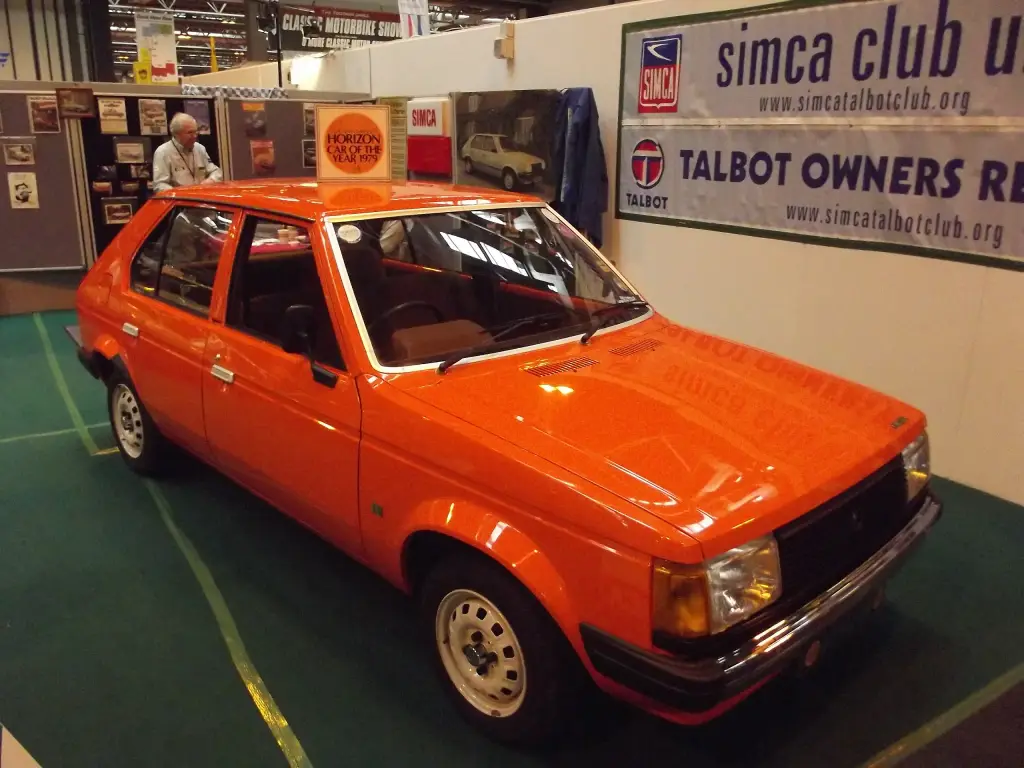
The Horizon was essentially a shortened version of the larger Alpine, which gave it an unusually wide track for its length. It used transversely mounted Simca-designed 1.1, 1.3 and 1.5-litre Poissy overhead-valve engines, four-speed gearboxes and torsion-bar suspension, and was praised for crisp styling, a supple ride and competent handling. It was sold only as a five-door hatchback: there was never a three-door version, and the older Simca 1100 and the rear-wheel-drive Chrysler Sunbeam stayed on sale to cover those niches.
The SX version, added for the Paris Motor Show in October 1978, attracted attention for its trip computer. It took information from a clock, a fuel-flow meter on the feed to the carburettor and the odometer feed, and reported current fuel consumption, average speeds, distances and times in metric or imperial units. The computer later became an option on lesser models such as the GLS.
The Horizon was voted European Car of the Year in 1979. Initially offered in LS and GL trim, it replaced the rear-engined Simca 1000 at launch; the Simca 1100 remained in production in France until 1981 as a cheaper alternative. The Series II of July 1982 brought a five-speed gearbox, black-painted bumpers, a smaller rear window because the parcel shelf was raised, and on some models an electronic LED econometer or an LED tachometer above the steering column. Production ran in France, Britain, Spain and Finland; the final Horizon was made by Saab-Valmet in Finland in 1987 and was the last Talbot-badged passenger car before Peugeot replaced it with the 309.
Design and features
- Five-door only: a practical hatchback with no three-door variant.
- Trip computer: the 1978 SX offered fuel consumption and average speed readouts.
- Wide track: a shortened Alpine platform gave stable handling.
- Series II: five-speed gearbox and LED econometer from 1982.
Talbot Horizon versions
- Simca Horizon: the French-market name at launch.
- Chrysler Horizon: the name used elsewhere in Europe until 1979.
- Talbot Horizon: the name used for most of the production run.
- SX: the top model with the trip computer.
- Series II: the 1982 update with five speeds and revised trim.
The Horizon replaced the Talbot 1100 and shared its engines with the Talbot Alpine and Talbot Sunbeam. More cars are in the Talbot collection.
Sources
- Chrysler Horizon, English Wikipedia: development, engines, models, production