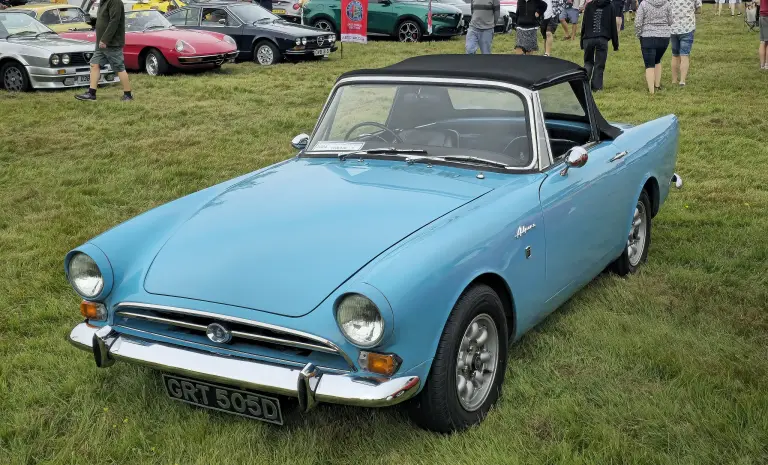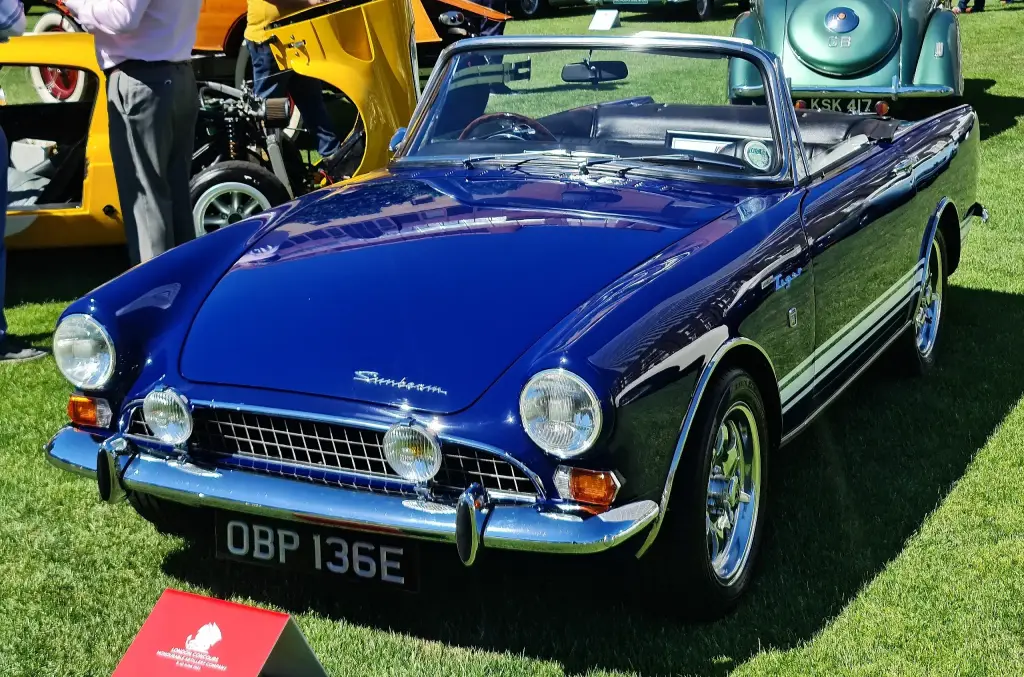
The Sunbeam Tiger is a high-performance V8 version of the British Rootes Group’s Sunbeam Alpine roadster, designed in part by the American car designer and racing driver Carroll Shelby and produced from 1964 until 1967. Shelby had carried out a similar V8 conversion on the AC Cobra.
Sunbeam Tiger at a glance
| Produced | 1964 to 1967; the last car was assembled on 27 June 1967 |
|---|---|
| Built | 7,128 in three series (English Wikipedia); German Wikipedia gives 7,085 |
| Base car | Sunbeam Alpine roadster, introduced in 1959 |
| Assembled by | Jensen, in West Bromwich |
| Mark I engine | 260 cu in (4.3 L) Ford V8, 164 bhp at 4400 rpm |
| Mark II engine | 289 cu in (4.7 L) Ford V8 |
| Mark I performance | 0–60 mph in 8.6 seconds, top speed 120 mph (190 km/h) |
| Mark II performance | 0–60 mph in 7.5 seconds, top speed 122 mph (196 km/h) |
| Kerb weight | 2,653 lb (1,203 kg), against 2,220 lb (1,010 kg) for the Alpine |
| US price, 1964 | $3,499 |
| UK sales began | March 1965, at £1,446 |
History of the Sunbeam Tiger
The Tiger grew out of the Sunbeam Alpine, which Rootes introduced in 1959. Rootes realised that the Alpine needed more power to compete in world markets but lacked a suitable engine and the resources to develop one. It approached Ferrari to redesign the standard four-cylinder engine, but the negotiations failed. In 1962 the racing driver and Formula 1 champion Jack Brabham suggested fitting a Ford V8 to the competition manager Norman Garrad, who passed the idea to his son Ian, then the West Coast sales manager of Rootes in America. Ian Garrad lived near Carroll Shelby’s workshop, which had done a similar V8 conversion for the AC Cobra.
Two prototypes
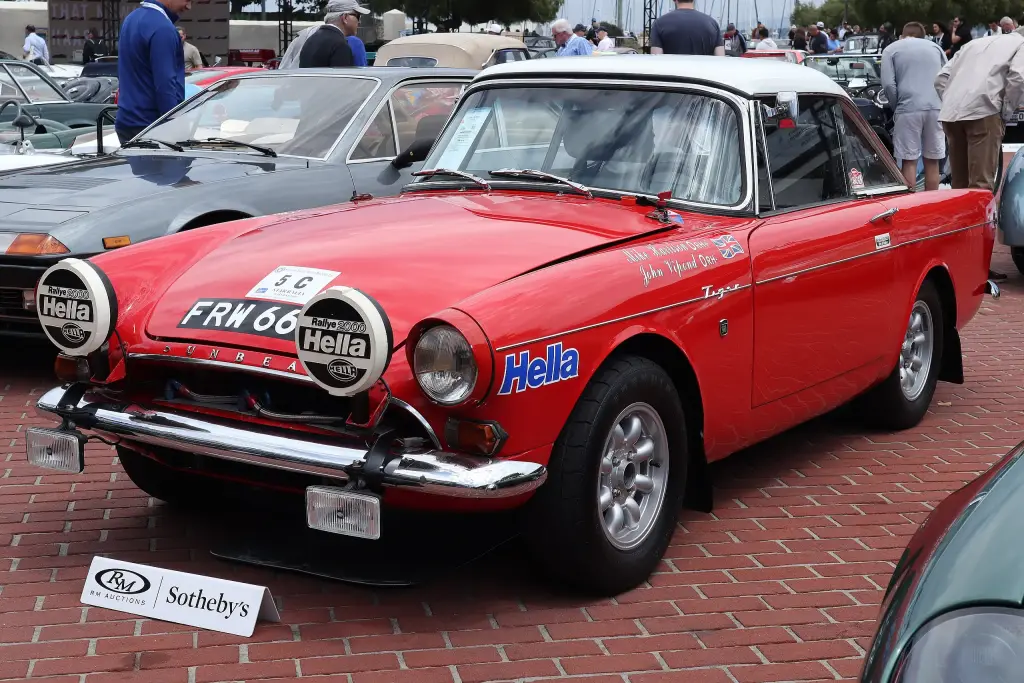
Garrad asked Shelby for a prototype, which Shelby estimated at eight weeks and $10,000, and also commissioned the driver and fabricator Ken Miles to build one as quickly as possible. Miles had a budget of $800, a Series II Alpine, a Ford V8 and a two-speed automatic gearbox, and in about a week he had a running car, proving the concept. Shelby began work in April 1963 and by the end of the month his car was ready for trials around Los Angeles. Provisionally known as the Thunderbolt, it used a Ford four-speed manual gearbox. The V8 was only 3.5 inches longer than the Alpine engine it replaced, so the main concern was its width.
Lord Rootes was reportedly “very grumpy” when he learned of the work done without his knowledge. He had the Shelby prototype shipped from America in July 1963, insisted on driving it himself and, impressed, contacted Henry Ford II directly to negotiate a supply of engines. Rootes placed an initial order for 3,000, the largest single order Ford had ever received for its engines from a car maker, and decided that the car would be launched at the 1964 New York Motor Show, only eight months away. Shortly before the unveiling in April 1964 it was renamed from Thunderbolt to Tiger, after the Sunbeam that held the land speed record in 1925.
Built by Jensen
Shelby had hoped to build the Tiger in America, but Rootes was uneasy about his closeness to Ford and chose to build it in England. The Rootes factory at Ryton lacked the capacity, so the work went to Jensen in West Bromwich, whose assembly contract for the Volvo P1800 had recently been cancelled. Shelby was offered a royalty on every Tiger built. Production began in June 1964, less than a year after the Shelby prototype, and Jensen could assemble up to 300 a month. Fitting the engine took some unusual methods, including using a sledgehammer to bash in part of the already painted bulkhead so the engine could be slid into place. Chassis changes included a rack-and-pinion steering system in place of the Burman recirculating-ball unit, a Panhard rod to locate the rear axle and stiffer front springs.
Mark I and Mark II
In 1964, all but 56 of the 1,649 Mark I Tigers assembled were shipped to North America, where the car cost $3,499 and carried “Powered by Ford 260” badges on the front wings. It reached Britain only in March 1965. The factory designated two versions, but because Mark I production spanned the change from Series IV to Series V Alpine panels, enthusiasts call the later cars Mark IA. The Mark II, with the larger 289 cu in engine, was intended for export to America and was never marketed in the UK, although six right-hand-drive cars were sold to the Metropolitan Police for traffic patrols and high-speed pursuits. By then Chrysler was in charge of Rootes, so the Ford badges were replaced by “Sunbeam V-8” ones.
Racing and the end
Three racing Tigers with fastback coupé bodies by Lister were built for the 1964 24 Hours of Le Mans, a prototype and two entries costing $45,000 each; neither entry finished. Rootes also entered the Tiger in European rallies with some success. Chrysler paid £12.3 million for a stake in Rootes in 1964 and gained control in 1967. A car powered by a competitor’s engine was unacceptable to the new owner, and Chrysler’s own V8s would not fit: its small-block had the distributor at the rear, unlike the front-mounted distributor of the Ford V8, and its big-block was too large. Chrysler ordered production to end once the stock of Ford engines was used up, and Jensen assembled the last Tiger on 27 June 1967.
Design and features
- Engine: a Ford V8 in a car about 20% heavier than the four-cylinder Alpine it came from.
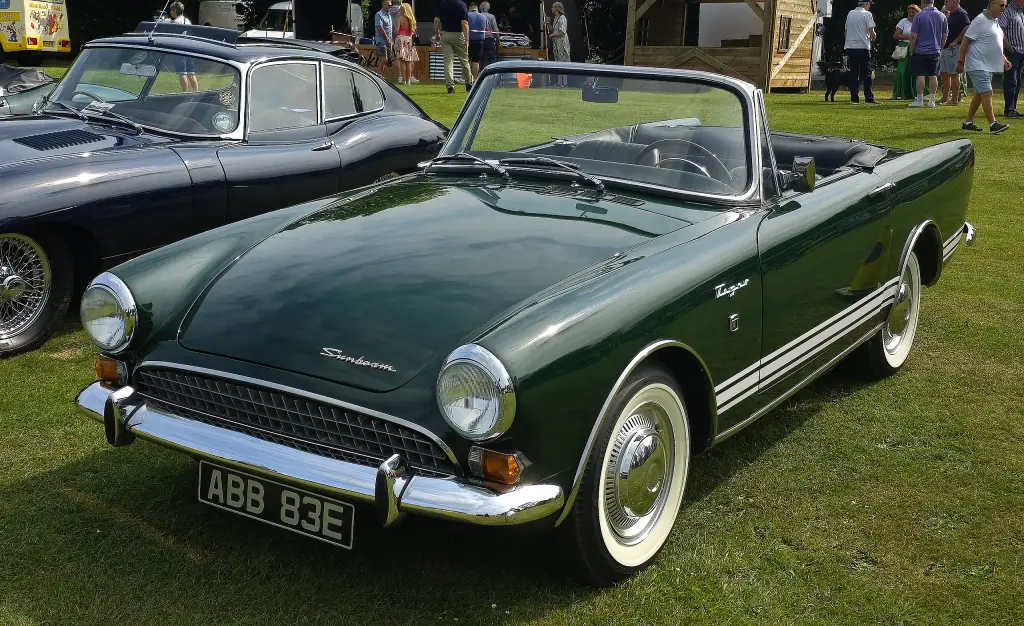
- Look: the Alpine shape, with a chrome strip along the sides as the quick way to tell a Tiger.
- Access: the tight engine bay put one bank of spark plugs behind a hole in the firewall.
Sunbeam Tiger versions
- Mark I (1964–1967): the 260 cu in car, later cars called Mark IA.
- Mark II (1967): the 289 cu in car, built for America.
- Le Mans cars (1964): three fastback racers with Lister bodies.
The Tiger was a rival to the car it copied in spirit, the Shelby Cobra, and it was built on the Sunbeam Alpine. More cars are in our Sunbeam collection.
Sources
- Sunbeam Tiger, English Wikipedia: background, prototypes, production, versions, Chrysler takeover, racing
- Sunbeam Tiger, German Wikipedia: cross-check of production and prototypes