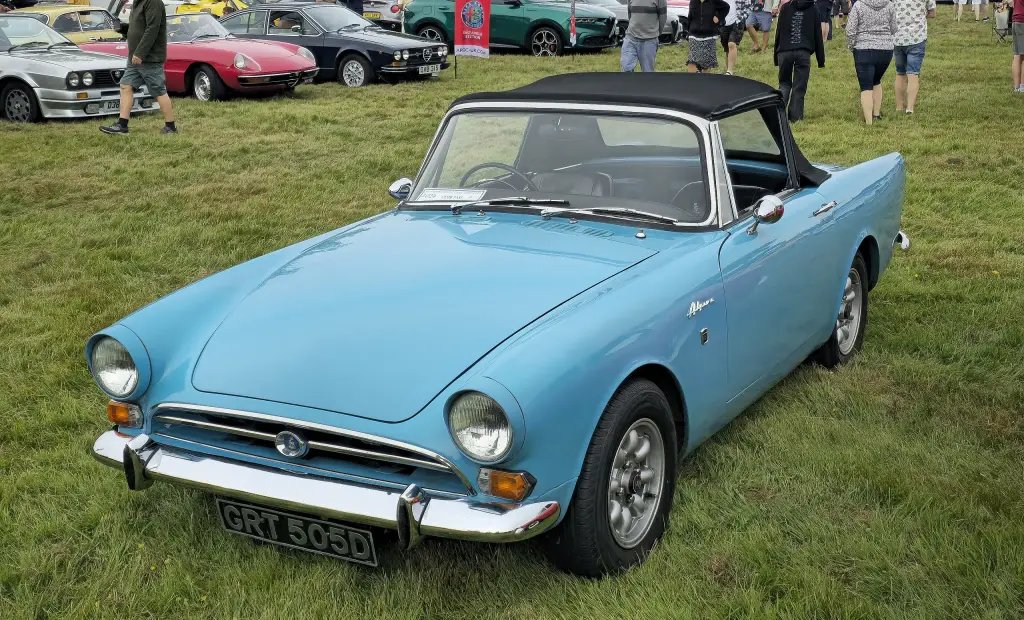
The Sunbeam Alpine is the two-seater sports roadster and drophead coupé that Rootes built from 1953 to 1955 and again from 1959 to 1968; the name later went to a two-door fastback coupé. The original was the first Sunbeam-Talbot product to carry the Sunbeam name alone after Rootes bought Clément-Talbot and, later, the moribund Sunbeam in 1935.
Sunbeam Alpine at a glance
| Maker | Rootes Group |
|---|---|
| First series | 1953–1955, hand-built by Thrupp & Maberly |
| Second series | 1959–1968, Series I to V |
| Bodies | two-seater roadster and drophead coupé; fastback coupé from 1969 |
| Mk I and III engine | 2,267 cc four-cylinder |
| Series I engine | 1,494 cc four-cylinder |
| Series I performance | 99.5 mph, 0–60 mph in 13.6 seconds |
| Mk I and III built | 1,582, of which 961 went to the US and Canada |
| Series I built | 11,904 |
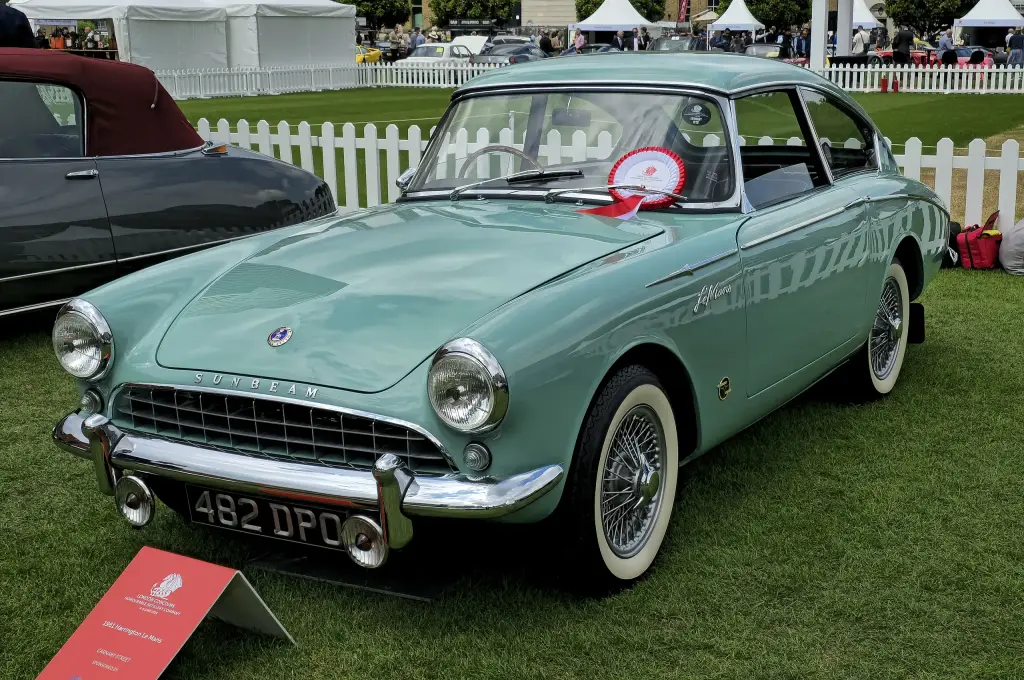
| Harrington coupés | built by Thomas Harrington Ltd, 104 hp Harrington Le Mans |
Based on one source, the English Wikipedia article on the Sunbeam Alpine.
History of the Sunbeam Alpine
Mark I and Mark III (1953–1955)
The original Alpine was derived from the Sunbeam-Talbot 90 saloon and became known as the “Talbot” Alpine. It began as a 1952 Sunbeam-Talbot drophead coupé and was developed for a one-off rally car by the Bournemouth Sunbeam-Talbot dealer George Hartwell. Announced in March 1953, it took its name from the Sunbeam-Talbot saloons’ successes in the Alpine Rally. On its first competitive outing, the July 1953 Coupe des Alpes, the new car won the Coupe des Dames with Sheila van Damm and four Coupes des Alpes with Stirling Moss, John Fitch, G Murray-Frame and Sheila van Damm, without losing any marks. The 2,267 cc engine came from the saloon with a raised compression ratio, the gearbox ratios were changed and overdrive became standard in 1954. The gear lever was column-mounted and there were no external door handles or wind-up windows. The Mark I and Mark III, no Mark II was made, were hand-built by Thrupp & Maberly at Cricklewood in London from 1953 to 1955. Of 1,582 cars, 961 were exported to the United States and Canada, 445 stayed in Britain and 175 went to other markets.
Series I to V (1959–1968)
The first open two-seaters had been based on the Hillman 14 and its successor the Humber Hawk. Rootes replaced them with a smaller two-seater convertible coupé based on the Hillman Minx, redesigned in 1956 by Kenneth Howes and Jeff Crompton with the American market chiefly in mind; Howes did some 80 percent of the design. The Series I of 1959 used a modified Hillman Husky floorpan and a 1,494 cc engine, with running gear largely from the Sunbeam Rapier but front disc brakes in place of drums. Suspension was independent at the front on coil springs, with a live axle and semi-elliptic springs at the rear. There were dual downdraft carburettors, and the car offered the first wind-up side windows on a British sports car of the time. A test by The Motor in 1959 recorded 99.5 mph, 0–60 mph in 13.6 seconds and 31.4 miles per imperial gallon; the test car cost £1,031 including taxes. The Alpine was produced in four further revisions until 1968, with total production of around 70,000.
The Harrington coupés
Coupé versions of the post-1959 Alpine were built by Thomas Harrington Ltd. After the Le Mans Index of Efficiency success of 1961, Harrington sold replicas as the “Harrington Le Mans”, using a fastback body and an engine tuned to 104 hp. Unlike the Le Mans racers, these cars had a more integrated rear roofline and were without the tail fins of the roadsters. Until 1962 the car was assembled for Rootes by Armstrong Siddeley. The Alpine also appeared on screen: a sapphire blue car featured in Alfred Hitchcock’s 1955 film To Catch a Thief.
Design and features
- Rally pedigree: named after the Alpine Rally and a winner on its first outing in the 1953 Coupe des Alpes.
- Two-seater layout: no external door handles and no wind-up windows on the original.
- Hand-built bodies: the Mark I and III were built by Thrupp & Maberly.
- Harrington Le Mans: a fastback coupé with a 104 hp engine.
- US-market design: the 1959 Series was shaped largely for American buyers.
Sunbeam Alpine versions
- Mark I and Mark III (1953–1955): the original 2,267 cc two-seater.
- Mark I Special: about 97.5 bhp with a twin-choke Solex carburettor.
- Series I to V (1959–1968): the smaller 1,494 cc sports car.
- Harrington Le Mans: the fastback coupé by Thomas Harrington Ltd, 104 hp.
- Fastback coupé (1969–1975): the later two-door model that reused the Alpine name.
The Alpine shared its running gear with the Sunbeam Rapier and was derived from the Sunbeam-Talbot 90. More cars are in the Sunbeam collection.
Video: SOLD: 1955 Sunbeam Alpine Series One Roadster, CA
Video on YouTube.
Sources
- Sunbeam Alpine, English Wikipedia: development, series, Harrington coupés, production