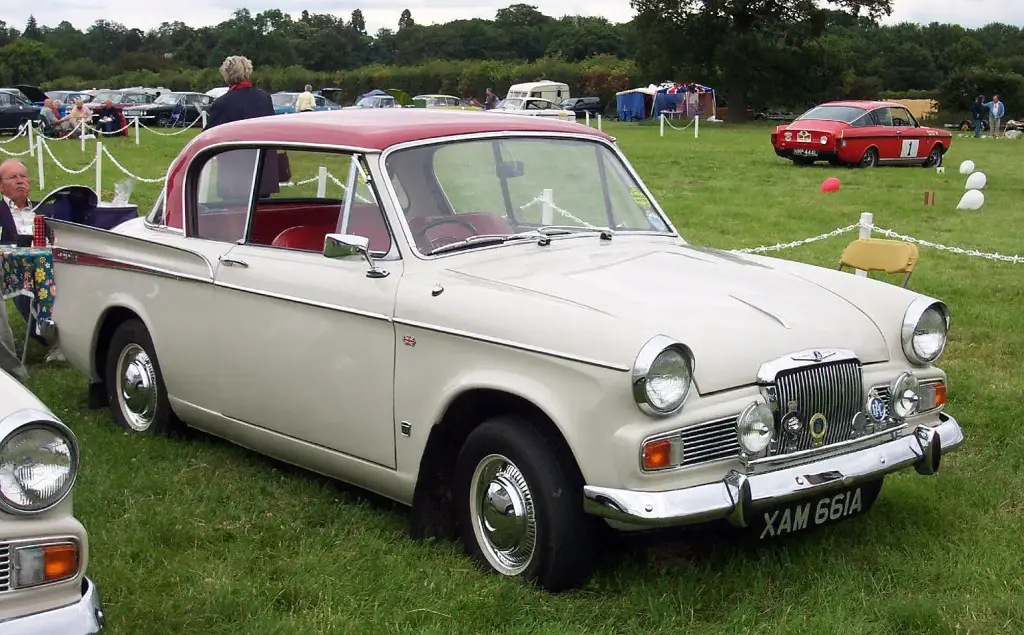
The Sunbeam Rapier was produced by the Rootes Group from 1955 until 1976 in two different generations: the “Series” cars, which went through several revisions, and the later fastback of 1967 to 1976, part of the Arrow range. The first generation was the first of the Rootes Audax light cars to appear, under the Sunbeam marque.
Sunbeam Rapier at a glance
| Maker | Rootes Group |
|---|---|
| Production | 1955–1976 |
| Generations | Series I–V (1955–1967) and the Arrow fastback (1967–1976) |
| Body | four-seat, two-door hardtop coupé |
| Series I engine | 1,390 cc four-cylinder, 62.5 bhp |
| From October 1956 | 67.5 bhp with twin Zenith carburettors |
| Series II engine | 1,494 cc Rallymaster, 73 bhp |
| Gearbox | four-speed manual with overdrive |
| Designer | Raymond Loewy Associates |
| Series I built | 7,477 |
| Series II built | 15,151 |
Based on one source, the English Wikipedia article on the Sunbeam Rapier.
History of the Sunbeam Rapier
Series I (1955–1958)
The Rapier was announced at the London Motor Show in October 1955, ahead of its Hillman Minx and Singer Gazelle counterparts, which did not appear until 1956. It was a four-seat, two-door hardtop coupé and was different from the Sunbeam Mark III, the car it would eventually replace. Although designed in house by Rootes, it was inspired, through the Raymond Loewy design organisation, by the new-generation Studebaker coupés of 1953, and the Series I showed a great deal of influence from Loewy’s 1953 Studebaker Starliner and the Hawk. It came in two-tone colour schemes typical of the period, with a steering column gear change, two-tone Kangaroo leather trim and a Laycock de Normanville overdrive as standard; vinyl trim was an option in Britain and standard in some export territories. Bodies were built by Pressed Steel, shipped to Thrupp & Maberly in north London to be painted and trimmed, then shipped again to Ryton-on-Dunsmore, where the engines, transmission and running gear were fitted. The 1,390 cc engine was essentially the Hillman Minx unit with a raised compression ratio of 8:1, a Zenith DIF 36 carburettor and revised manifolds, giving 62.5 bhp at 5,000 rpm. From October 1956 the updated R67 engine with twin Zenith 36 WIP carburettors raised output to 67.5 bhp, cutting the 0–60 mph time by almost a second. A test by The Motor in 1957 recorded 85.7 mph and 0–60 mph in 20.9 seconds; the car cost £1,043 including £348 of tax. In competition a Rapier driven by Peter Harper finished fifth in the 1958 Monte Carlo Rally. In total 7,477 Series I cars were built.
Series II (1958–1959)
The Series II was announced on 6 February 1958 and was available as a hardtop and a convertible. Rootes arranged for nine of the new cars to be in Monte Carlo for the press at the end of the 1958 Monte Carlo Rally. The traditional Sunbeam radiator grille returned, shortened and widened, with horizontal side grilles, the two-tone lower body scheme gave way to a full-length flash in the roof colour, and pronounced fins appeared on the rear wings. Inside, a floor gear change replaced the column change, a modification developed on the works rally cars, and leather upholstery was dropped in favour of vinyl to keep costs down; overdrive became an extra. The Rallymaster engine grew to 1,494 cc, with a compression ratio of 8.5:1 and larger valves, producing 73 bhp at 5,200 rpm. Autocar quoted 91 mph and 0–60 mph in 20.2 seconds. The Series II also received larger front brakes and recirculating ball steering. It was replaced by the Series III in 1959 after 15,151 hardtops and convertibles had been built.
Series III and the fastback (1959–1976)
The Series III arrived in September 1959 with subtle body changes that together altered its appearance: the side grilles gained a fourth horizontal bar, the boot lid received an oblong number plate recess, the side flash became narrower and lower, and thinner windscreen pillars combined with a lowered scuttle to increase the glass area by 20 percent. Inside, the seats and panels were redesigned and trimmed in single-colour vinyl with contrasting piping, and deep-pile carpets became standard in the footwells. The Series cars continued through further revisions until 1967, when the Rapier name moved to the fastback coupé of the Arrow range. That car shared its platform with the Hillman Hunter and was built until 1976.
Design and features
- Loewy-inspired styling: the Series I drew on the 1953 Studebaker Starliner.
- Overdrive as standard: a Laycock de Normanville unit on the early cars.
- Rally development: works cars raced at Monte Carlo and shaped the Series II floor change.
- Two generations: the Audax-based Series cars and the Arrow-based fastback.
Sunbeam Rapier versions
- Series I (1955–1958): 1,390 cc, column gear change, two-tone paint.
- Series II (1958–1959): 1,494 cc Rallymaster, floor change, fins.
- Series III (1959–): revised body and interior, larger glass area.
- Later Series cars: further revisions up to 1967, including the Series IV.
- Arrow fastback (1967–1976): the second-generation Rapier.
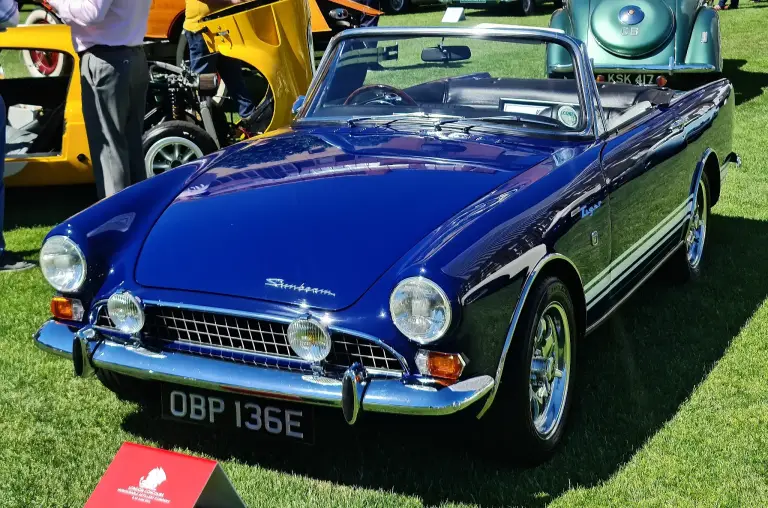
The Rapier supplied much of the running gear for the Sunbeam Alpine, and the later fastback shared its platform with the Sunbeam Arrow. More cars are in the Sunbeam collection.
Video: Classic British Cars – Sunbeam Rapier and Hillman Super Minx
Video on YouTube.
Sources
- Sunbeam Rapier, English Wikipedia: series history, engines, production