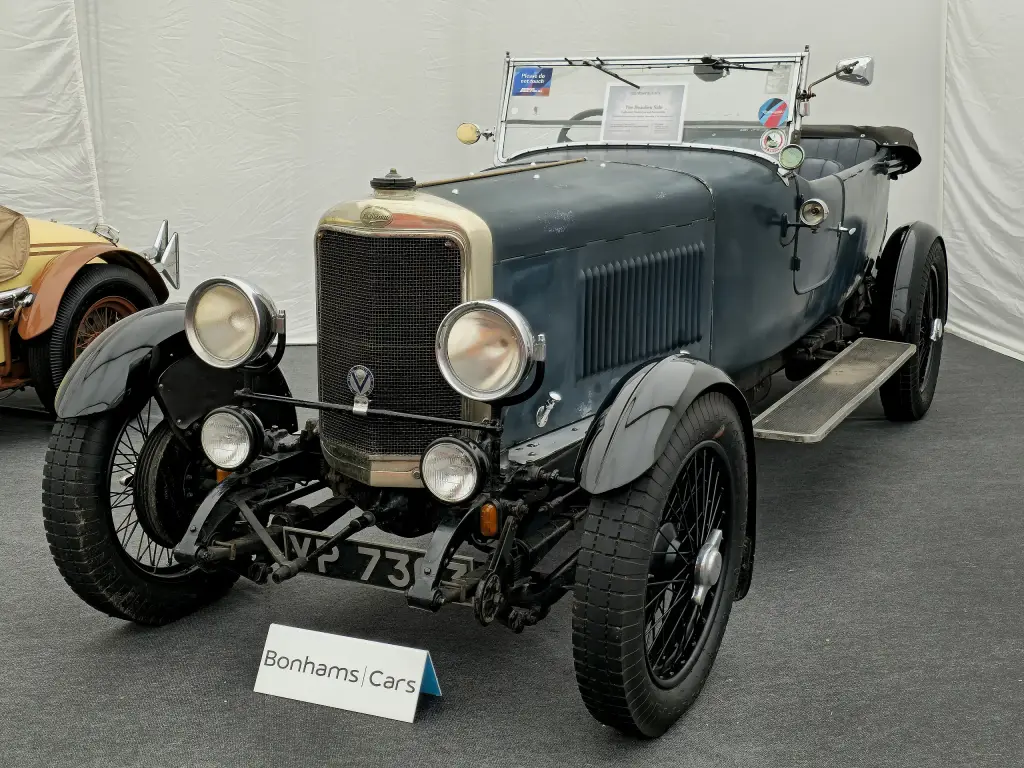
The Sunbeam 3-litre was introduced at the London Motor Show in October 1925 and built from 1926 to 1930. It was the retort of Louis Hervé Coatalen, Sunbeam’s chief engineer, to the Bentley 3 Litre, which had just won at Le Mans, and it used an advanced twin-cam six with dry-sump lubrication.
Sunbeam 3-litre at a glance
| Maker | Sunbeam, Wolverhampton |
|---|---|
| Introduced | October 1925, London Motor Show |
| Production | 1926–1930 |
| Engine | 2,920 cc six-cylinder, twin overhead camshafts |
| Valves | inclined, with easily adjustable tappet levers |
| Lubrication | dry sump, oil drawn from a tank beside the engine |
| Supercharger | added in 1929, raising output to 135 bhp |
| Weight | 26 long cwt (1,321 kg) |
| Tax rating | 20.9 hp, road tax of £21 a year |
| Le Mans 1925 | second place for Chassagne and Davis |
Based on one source, the English Wikipedia article on the Sunbeam 3-litre.
History of the Sunbeam 3-litre
An answer to Bentley
By 1925 the Bentley 3 Litre was beginning to make its mark, having won at Le Mans earlier that year. Sunbeam, whose racing engines were gathering plaudits on European circuits, replied with a sports car of its own. The new car was shown at the London Motor Show in October 1925 and offered from 1926 until 1930. At 26 long cwt it weighed 2,912 lb, or 1,321 kg.
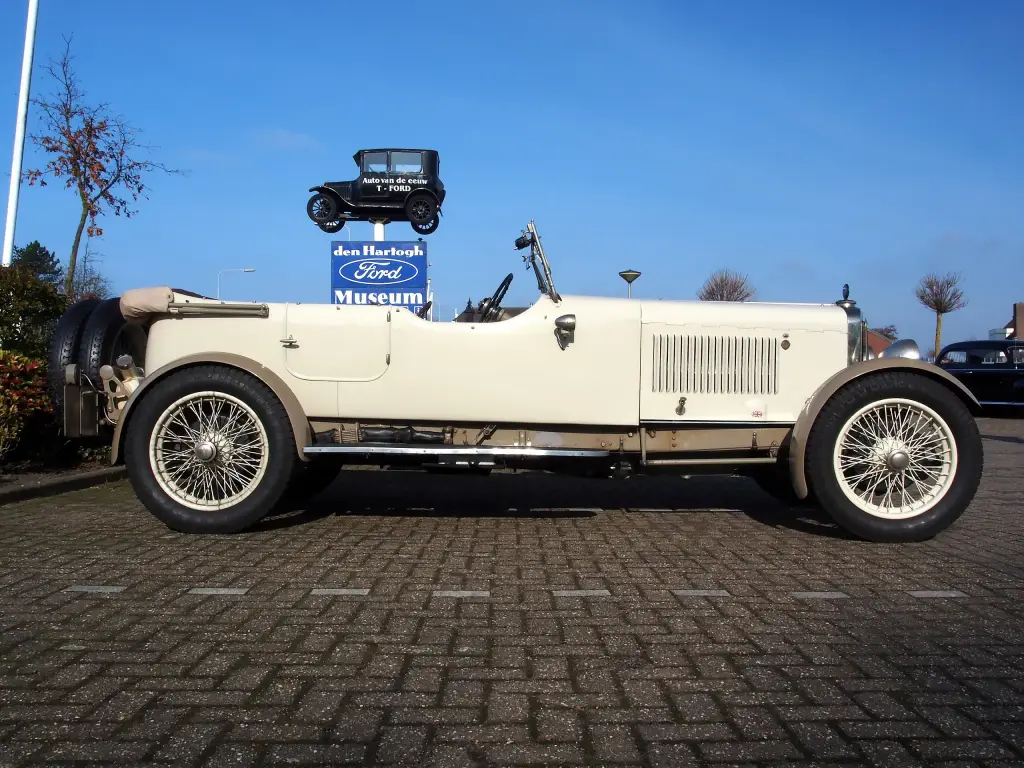
Engine and chassis
The engine displaced 2,920 cc in six cylinders. Its inclined valves were operated through easily adjustable tappet levers by two overhead camshafts, an important innovation at the time, and the detailed design followed the principles of Sunbeam’s racing engines. Cylinder head and block were formed from a single casting, then considered normal for high-performance engines, and the engine used dry-sump lubrication with oil drawn from a tank beside it. The cylinder bores gave a fiscal rating of 20.9 hp, which attracted annual road tax of £21; the larger four-cylinder Bentleys paid £16. The difference of £5 was more than the average weekly wage in Britain at the time. In 1929 a supercharger was added, raising output to 135 bhp. The chassis was based on earlier Sunbeams, but the semi-elliptical rear springs were replaced by cantilever springs, which became a Sunbeam hallmark in the second half of the decade.
Racing
Two Sunbeams were entered at Le Mans in 1925. The car of Henry Segrave and George Duller retired, but Jean Chassagne and Sammy Davis finished second, beaten only by the Lorraine-Dietrich of Rossignol and de Courcelles. The Bentley gained a reputation as the more robust of the two cars, although in standard form the Sunbeam was reported to be marginally quicker. In retrospect the Sunbeam’s result was eclipsed by the way Bentleys dominated the race in the second half of the decade.
Design and features
- Twin overhead camshafts: inclined valves with easily adjustable tappet levers, rare in 1925.
- Monobloc six: cylinder head and block cast as one piece.
- Dry-sump lubrication: oil carried in a separate tank beside the engine.
- Supercharged option: from 1929, 135 bhp.
Sunbeam 3-litre versions
- Standard 3-litre (1926–1930): the normally aspirated twin-cam six.
- Supercharged 3-litre (1929): 135 bhp with a blower.
- 1925 Le Mans team cars: the works entries of Segrave/Duller and Chassagne/Davis.
Sunbeam’s later sporting cars include the Sunbeam Alpine and the Sunbeam Rapier. More cars are in the Sunbeam collection.
Sources
- Sunbeam 3-litre, English Wikipedia: design, engine, racing, tax rating