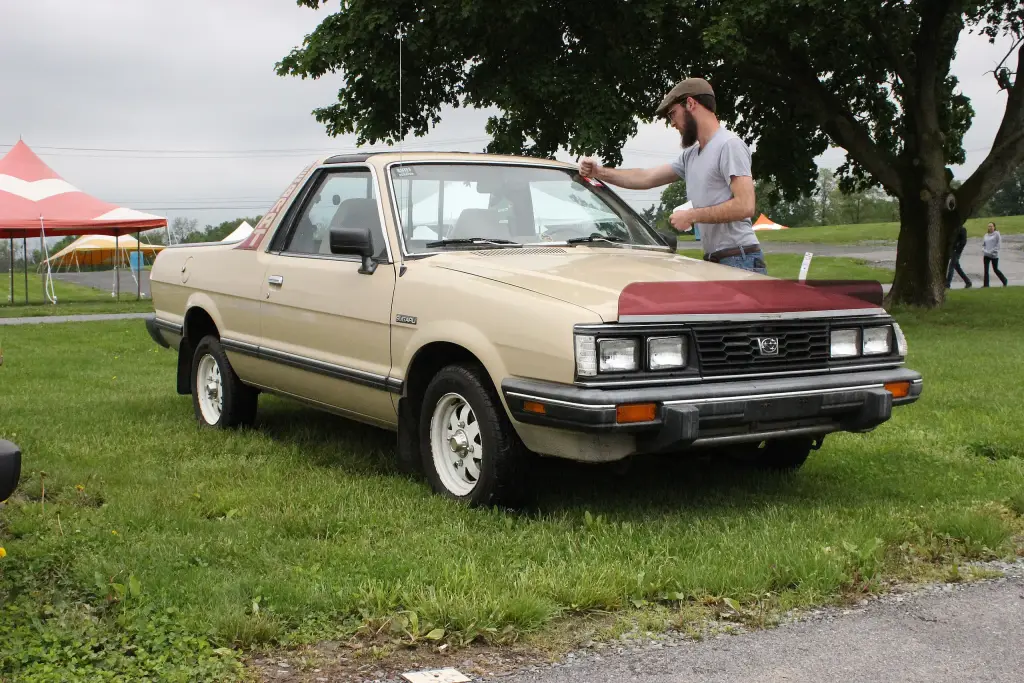
The Subaru BRAT was a four-wheel-drive coupé utility made from 1978 to 1994 and based on the Leone. In Australia and New Zealand it was sold as the Brumby, and in Britain as the MV Pickup or Shifter. Its most famous feature was a pair of plastic seats in the load bed.
Subaru BRAT at a glance
| Maker | Subaru, Japan |
|---|---|
| Production | 1978–1994 |
| Based on | Subaru Leone |
| Layout | front engine, four-wheel drive |
| Engine 1978 | 1.6-litre EA-71 flat-four |
| Engine 1981 | 1.8-litre EA-81 flat-four |
| Turbo | 94 hp (70 kW) option in 1983 and 1984 |
| Gearbox | manual as standard; three-speed automatic on turbo cars |
| Transfer case | single range to 1980, dual range on 1981 and later GL |
| Other names | Brumby, MV Pickup, Shifter |
| Not sold in | Japan, the home market |
| Bed seats | rear-facing jump seats to 1985 |
Based on one source, the English Wikipedia article on the Subaru BRAT.
History of the Subaru BRAT
The BRAT was developed in Japan in 1977 at the request of the president of Subaru of America, to answer American demand for small pickups and to compete with Toyota, Nissan and Mazda. Because it was developed from the Leone station wagon, every BRAT had four-wheel drive. When the Leone was redesigned for 1980, the BRAT kept the original body until 1982.
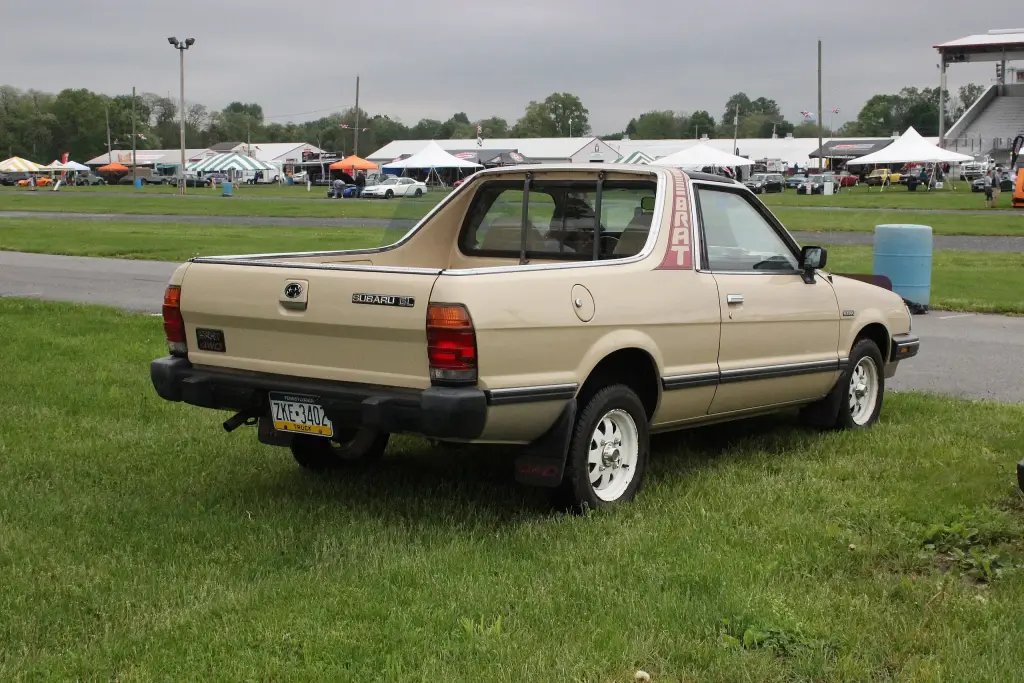
The jump seats
North American and Canadian cars came with carpeting and two welded-in, rear-facing plastic jump seats in the cargo area. They existed to get around the American “Chicken Tax”: as a passenger car the BRAT paid a 2.5 per cent import tariff, while a light truck paid 25 per cent. The seats were dropped after the 1986 model year.
Second generation
The BRAT was restyled in 1981, moving to the 1.8-litre EA-81 engine; 1983 and 1984 cars could be ordered with a 94 hp turbocharged engine and a three-speed automatic. Early 1980s cars introduced a targa-top version, a spring-loaded hidden door for a side step into the bed and a spare wheel mounted under the bonnet. Australian cars could be had with an Ag-quip package of graphics, a roo bar, a sump guard and a rear step bar, and wagon wheels were optional.
Export only
The BRAT was never officially sold in Japan, where demand for pickups had fallen as buyers moved to station wagons, and it became a popular grey import there. Exports to North America ended in 1987, but cars went to Europe, Australia, Latin America and New Zealand until February 1994. Subaru showed a two-door pickup concept, the Suiren, in 1993, and in 2002 launched the four-door Baja, which many see as the BRAT’s successor.
Design and features
- Standard four-wheel drive: no two-wheel-drive version was offered.
- Jump seats: rear-facing plastic seats that let the BRAT count as a passenger car in the United States.
- Targa top: a removable roof panel arrived in the early 1980s.
- Side step door: a spring-loaded hidden door in the body side.
- Under-bonnet spare: the spare wheel sat under the bonnet instead of in the bed.
Subaru BRAT versions
- First generation (1978–1981): 1.6-litre engine and single-range transfer case.
- Second generation (1981–1994): new front, 1.8-litre engine, dual-range transfer case on GL models.
- Turbo (1983–1984): 94 hp with a three-speed automatic.
- Brumby: the Australian and New Zealand name.
- MV Pickup / Shifter: the British name.
The BRAT was built on the Leone, and its later equivalent was the Baja. More Subarus are in the Subaru collection.
Video: MotorWeek Retro Review: 1982 Subaru Brat
Video by MotorWeek on YouTube.
Sources
- Subaru BRAT, English Wikipedia: development, engines, jump seats, markets, production