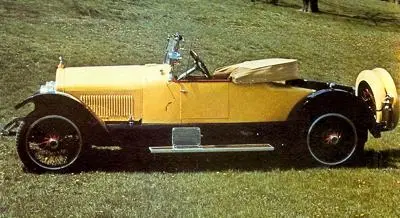
The Stutz straight-eight, also called the Vertical Eight engine, was the inline-eight family that powered every Stutz car from 1926 until production ended in 1935. Designed by the chief engineer Charles Greuter, it used an overhead camshaft at a time when most American luxury cars still relied on flathead engines.
Stutz straight-eight at a glance
| Maker | Stutz Motor Car Company, Indianapolis |
|---|---|
| Production | 1926–1935 |
| Designer | Charles “Pop” Greuter |
| Layout | inline eight, overhead camshaft, rear-wheel drive |
| First version | 287 cu in (4.7 L), 92 hp at 3,200 rpm |
| Developed SOHC | 298–299 cu in, 95–115 hp |
| SV-16 | 322 cu in (5.28 L), 115–130 hp |
| DV-32 | DOHC, four valves per cylinder, 156–161 hp at 3,900 rpm |
| DV-32 torque | 300 lb·ft at 2,400 rpm |
| Supercharged | up to 185 hp in racing tune |
| Cars | Vertical Eight, Black Hawk Speedster, Bearcat, Super Bearcat |
Based on one source, the English Wikipedia article on the Stutz straight-8 engine. No free photograph of the engine alone was found, so the page keeps the earlier thumbnail.
History of the Stutz straight-eight
A new engine for a new Stutz
After Harry C. Stutz left the company in 1919, new management under Frederick E. Moskovics set out to modernise the marque with an emphasis on safety and performance. The Vertical Eight, introduced for 1926 as the Safety Stutz, was the company’s first inline-eight production car. Greuter’s engine was built for smoothness and high revs and was paired with the underslung Safety Stutz chassis, which had a low centre of gravity, hydraulic four-wheel brakes and safety glass.
Design
The core engine was a water-cooled straight-eight with a cast-iron block, aluminium components where they saved weight and an optional supercharger. Early versions had a single overhead camshaft driven by an unusual link-belt chain, two valves per cylinder, dual ignition with twin spark plugs on many examples and a nine-main-bearing crankshaft for smoothness and durability. Fuel came from twin Zenith or Stromberg carburettors. The long stroke gave strong low-speed torque, while the overhead camshaft allowed better breathing and higher revs than contemporary flatheads. The engine was mounted longitudinally at the front and drove through a three- or four-speed manual gearbox, some with a Noback hill-holder. Central lubrication and oil filtration such as the Wall Oil Rectifier were standard.
From AA to DV-32
The first engines of 1926–1928, fitted to the AA and BB series, displaced 287 cu in (4.7 L) with an 81 mm bore and 114 mm stroke and produced 92 hp at 3,200 rpm. By 1927–1928 the bore grew to 83 mm, raising capacity to about 298–299 cu in and output to 95–115 hp. The SV-16 of 1930–1935 enlarged the single-cam, sixteen-valve engine to 322 cu in (5.28 L) and 115–130 hp.
The DV-32 of 1931 was the most advanced version: double overhead camshafts, four valves per cylinder, hemispherical combustion chambers, 322.1 cu in and 156–161 hp at 3,900 rpm with about 300 lb·ft at 2,400 rpm. Specific output reached almost 30 bhp per litre, exceptional for the time. A front-mounted centrifugal supercharger was offered on some 1929 Model M cars and on competition engines, lifting output to as much as 185 hp for the factory Le Mans entries.
What it powered, and the end
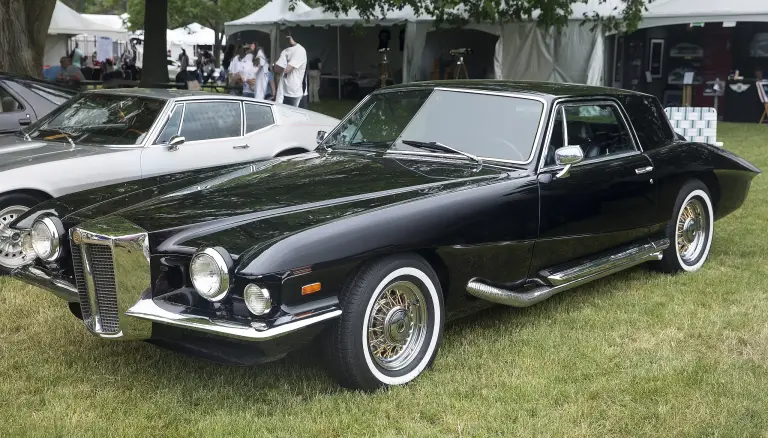
The engine was used only in Stutz cars, mainly the Vertical Eight series, whose bodies ranged from Weymann fabric saloons and coupes to custom coachwork by LeBaron, Rollston and Brewster. Sporting models included the Black Hawk Speedster and the revived Bearcat and Super Bearcat, which carried the DV-32 on a shorter 116-inch wheelbase. The engine stayed in production until Stutz car manufacture ended in 1935, when the Depression forced the company to turn to commercial vehicles.
Design and features
- Overhead camshaft: advanced breathing in an era of side-valve American luxury cars.
- Nine-bearing crankshaft: smoothness and durability at high engine speeds.
- Dual ignition: twin spark plugs on many examples.
- Link-belt camshaft drive: an unusual chain arrangement on the early engines.
- DV-32 head: twin camshafts, four valves per cylinder and hemispherical chambers.
Stutz straight-eight versions
- AA/BB (1926–1928): 4.7 to 4.9 litres, 92–115 hp, SOHC.
- SV-16 (1930–1935): 5.28 litres, sixteen valves, 115–130 hp.
- DV-32 (1931–1935): DOHC four-valve, 156–161 hp.
- Supercharged: up to 185 hp for Model M and racing use.
The engine powered the Stutz Vertical Eight and the 1930s Bearcat. The later V8 cars are described under the Stutz Blackhawk, and more cars are in the Stutz collection.
Video: 1932 Stutz DV-32 engine start
Video on YouTube.
Sources
- Stutz straight-8 engine, English Wikipedia: design, versions, specifications