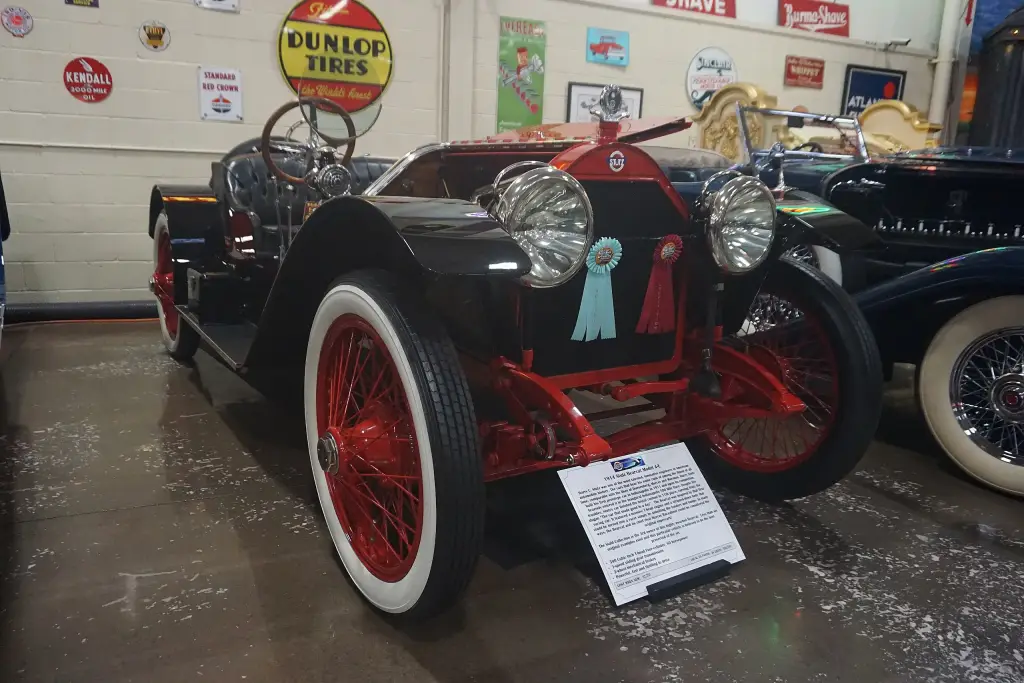
The Stutz Bearcat was an American sports car of the years before and after the First World War. It was a shorter, lighter version of the standard Stutz passenger chassis, and its open bodywork and racing success made it the car later generations associated with the 1920s.
Stutz Bearcat at a glance
| Maker | Stutz Motor Car Company, Indianapolis |
|---|---|
| Production | 1912–1924, revived 1931–1933 |
| Wheelbase | 120 in, against 130 in for the standard Stutz |
| First engine | 390 cu in (6.39 L) Wisconsin straight-four, 60 hp |
| Body | “dog house” bonnet, bucket seats, monocle windscreen, cylindrical fuel tank |
| 1913 (Series E) | electric lights and starter; six-cylinder option $250; wire wheels $125 |
| 1917 (Series S) | new Stutz sixteen-valve four, cast in one block |
| 1920 price (Series K) | $3,900 |
| 1931 revival | DV-32 eight, each car certified as tested at 100 mph |
| 1933 Super Bearcat | Weymann fabric body, 116 in wheelbase |
| Production end | Stutz car production stopped in 1934 |
Based on one source, the English Wikipedia article on the Stutz Bearcat.
History of the Stutz Bearcat
Series A to E (1912–1916)
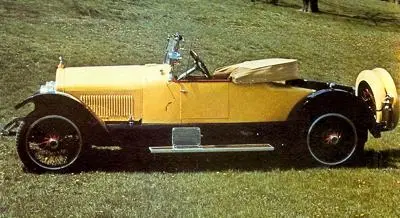
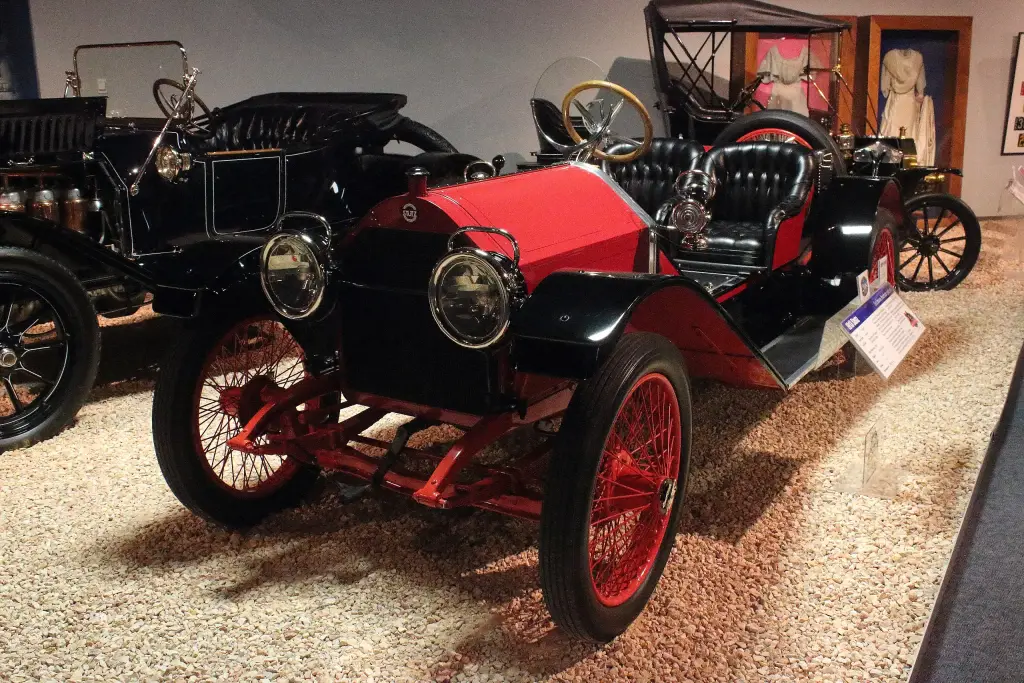
The first production Bearcat appeared in the Series A of 1912. It used a shortened version of the standard Stutz chassis, 120 inches instead of 130, and carried minimal bodywork: a “dog house” bonnet, open bucket seats, a tiny monocle windscreen in front of the driver and a cylindrical fuel tank on a short rear deck. Production cars differed from the factory White Squadron racers by having wings, lamps and a trunk.
The name was first used in public in an advertisement in the 1912 Indianapolis 500 programme, which also introduced the slogan “The Car that made good in a day”, a reference to the Stutz racer’s eleventh place at Indianapolis in 1911. Factory literature of 1913 described the Bearcat as a car for the customer who wanted something built along the lines of a racing car, with a slightly higher gear ratio than the normal torpedo roadster. The Series E of 1913 brought electric lights and a starter; a six-cylinder engine cost an extra $250 and wire wheels $125, and a sales catalogue offered vermillion, monitor gray and Mercedes red. The doorless body lasted through 1916.
Series S to K and the end of the first Bearcat (1917–1924)
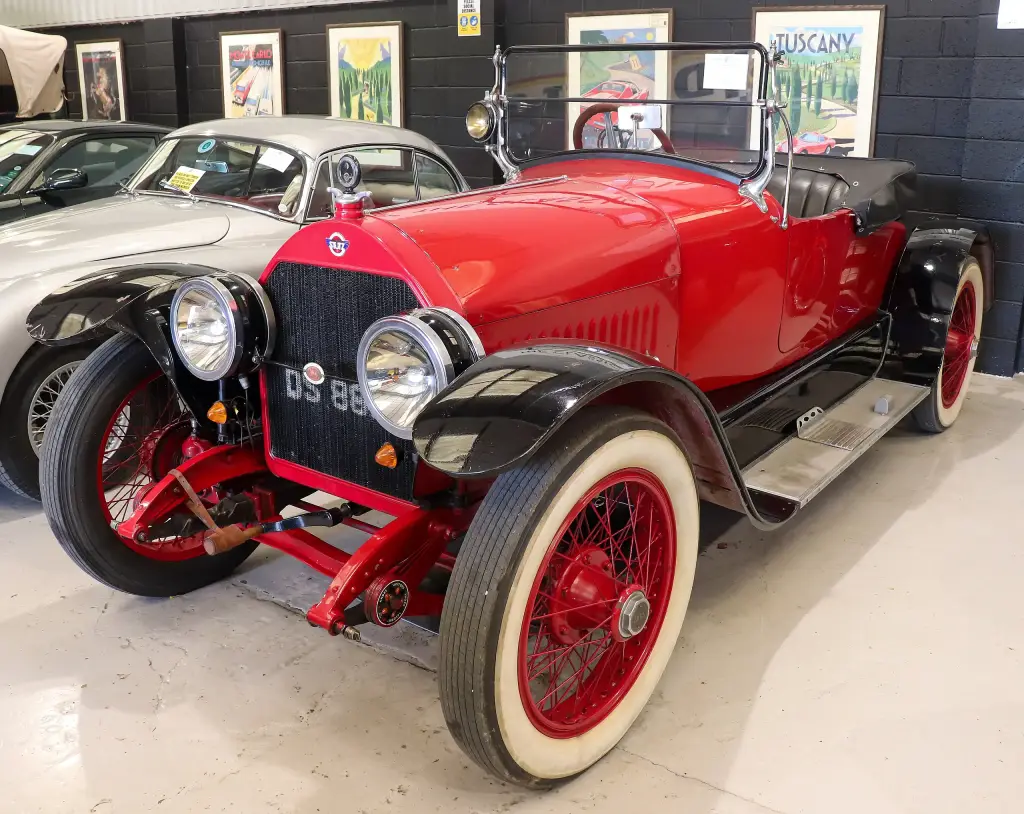
The 1917 Series S kept the 120-inch wheelbase but gained an enclosed cockpit with step-over sides. It stayed right-hand drive with external gear and brake levers, and its main change was a new Stutz-designed 390 cu in sixteen-valve four, cast in a single block with a heat-treated nickel crankshaft and camshafts. The 1919 Series G was similar, while the mid-1919 Series H cut down the body sides for easier entry and added yellow, royal red and elephant gray.
By the end of 1919 a Bearcat cost $3,250, the same as the roadster; the 1920 Series K rose to $3,900 as the postwar boom lifted sales. The 1921 cars introduced a “DH” engine with a detachable head. Its successor, the KLDH, moved the steering to the left, and the narrow front seat and cockpit left no room for centrally placed gear and brake levers. By 1922 the name was missing from model lists; the roadster was renamed Bearcat for 1923 and the name vanished again in 1924.
Revival and the Super Bearcat (1931–1934)
The Depression had not been kind to Stutz, and in 1931 the company brought the Bearcat name back to boost sales. The new car was a small coupe with dual side-mounted spare wheels and a rakish dip in the doors, powered by the DV-32 thirty-two-valve eight. Each car came with an affidavit stating that it had been tested at 100 mph. The model lasted through 1933, and in the same year the range gained the Super Bearcat, which offered full weather protection and higher performance. It sat on a 116-inch wheelbase and used a lightweight fabric body built by Weymann. Stutz production ended in 1934.
Racing and reputation
Its low weight, balance and power made the Bearcat an excellent racer: in 1912 the cars won 25 of the 30 races in which they were entered, and the White Squadron factory team took the championships of 1913 and 1915. In 1915 a standard Bearcat driven by Erwin “Cannon Ball” Baker crossed from California to New York in eleven days, seven hours and fifteen minutes, breaking the record and inspiring the later Cannonball Run races and films.
Owning a Bearcat became a status symbol. In 1914 it cost $2,000, almost four times the price of a basic Ford Model T. The car was later remembered with the trappings of the Roaring Twenties, raccoon coats and bathtub gin, and it was still quoted in advertisements by Nash and Triumph in the 1950s and 1960s. In the late 1960s a fiberglass replica was built in Oklahoma City on an International Scout chassis.
Design and features
- Short chassis: ten inches less wheelbase than the standard Stutz, which made the Bearcat lighter and quicker.
- Open bodywork: dog-house bonnet, bucket seats, monocle windscreen and a cylindrical tank on the rear deck.
- Four-cylinder power: a Wisconsin engine at first, then Stutz’s own sixteen-valve four from 1917.
- Racing record: 25 wins from 30 starts in 1912 and two factory championships before the war.
Stutz Bearcat versions
- Series A (1912): the first production Bearcat.
- Series E (1913–1916): electric lights and starter, optional six-cylinder engine.
- Series S (1917): enclosed cockpit and the new Stutz sixteen-valve four.
- Series K and KLDH (1920–1921): DH engine with detachable head, then left-hand drive.
- Bearcat (1931–1933): DV-32 coupe with dual side-mounted spares.
- Super Bearcat (1933): Weymann fabric body on a 116-inch wheelbase.
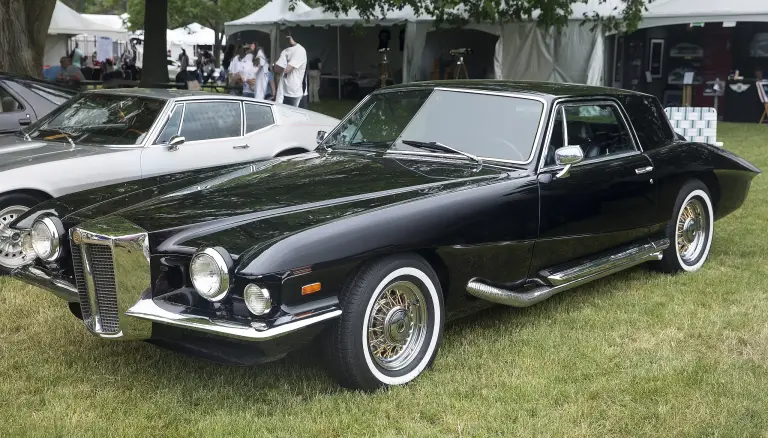
The Bearcat’s 1930s successor used the Stutz Vertical Eight chassis and the straight-eight engine. The later, unrelated luxury coupe is the Stutz Blackhawk; more cars are in the Stutz collection.
Video: 1912 STUTZ BEARCAT RIDES AGAIN!!
Video on YouTube.
Sources
- Stutz Bearcat, English Wikipedia: model history, prices, racing, reputation