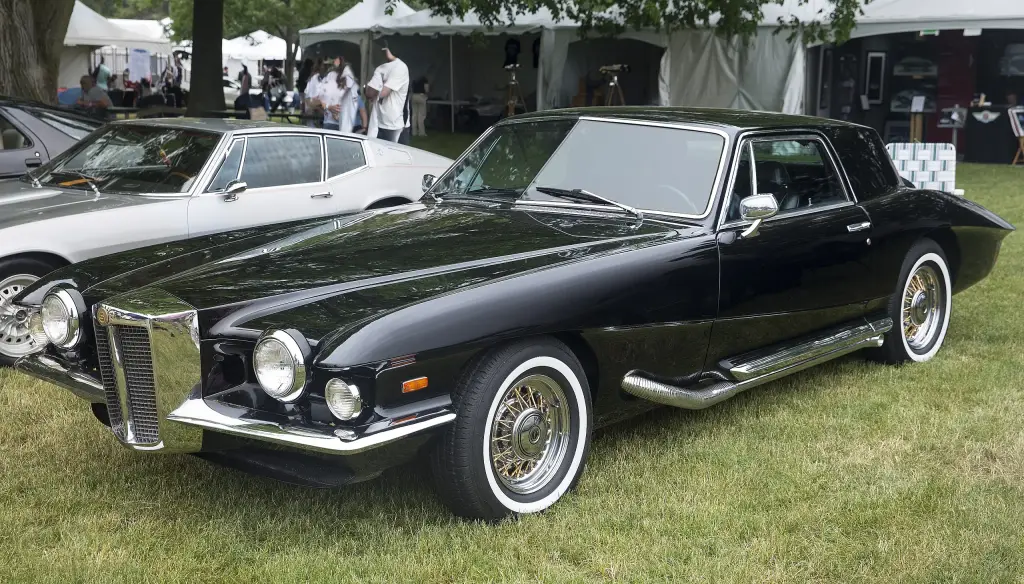
The Stutz Blackhawk is the luxury coupe with which the Stutz name returned in 1970 after more than three decades. Styled by Virgil Exner and assembled by hand in Italy on General Motors running gear, it was priced from $22,500 to $84,500 and about 500 to 600 cars were built before production ended in 1987.
Stutz Blackhawk at a glance
| Maker | Stutz Motor Car Company of America |
|---|---|
| Production | 1971–1987, Series I to VIII |
| Designer | Virgil Exner, with James O’Donnell |
| Prototype | built by Ghia, cost over $300,000 |
| Body | Officine Padane, Modena, then Carrozzeria Saturn near Turin |
| Chassis | Pontiac Grand Prix; Bonneville and Parisienne from 1980 |
| Engine | Pontiac 7.5 L V8, 425 hp; later 403 and 350 cu in |
| Gearbox | GM TH400 three-speed automatic, rear-wheel drive |
| Performance | 0–60 mph in 8.4 s, 130 mph, about 8 mpg |
| Length | over 19 ft (5.8 m) |
| Price | $22,500 in 1971, $84,500 for the 1981 coupe |
| Built | about 500–600 |
Based on one source, the English Wikipedia article on the Stutz Blackhawk.
History of the Stutz Blackhawk
Reviving the name (1968–1970)
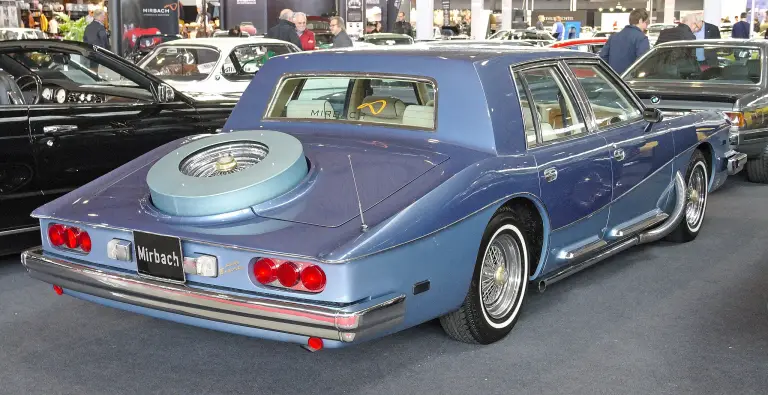
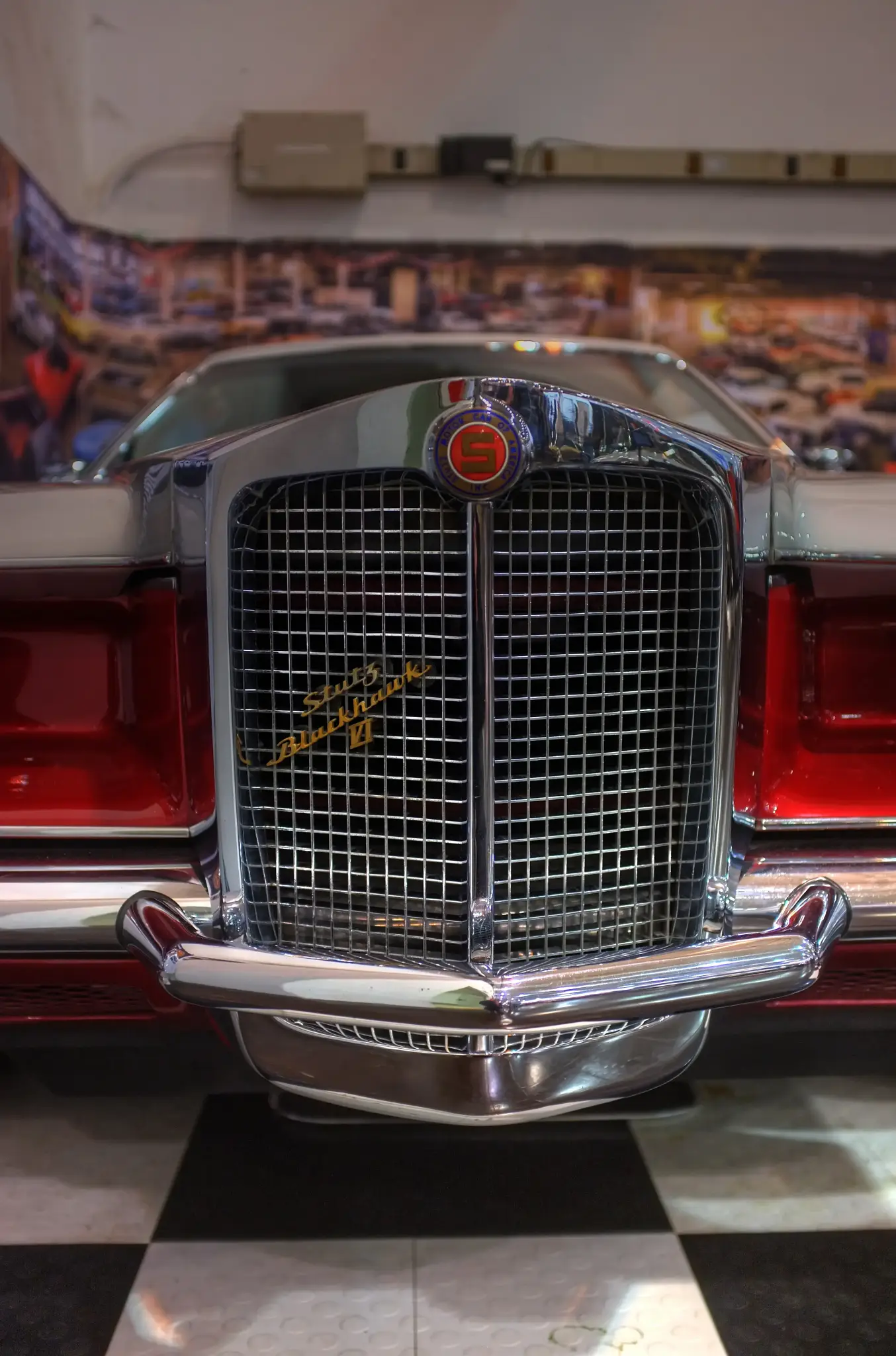
The Stutz Motor Company was revived in August 1968 by the New York banker James O’Donnell. He worked with the retired Chrysler stylist Virgil Exner, who designed the new Blackhawk with a spare wheel protruding through the boot lid, a chrome grille shaped like a radiator shell and free-standing headlamps. The car was prototyped by Ghia in Italy at a cost of more than $300,000. To keep servicing easy in America, a General Motors platform and engine were used under the custom Italian body. The Blackhawk was shown in January 1970 at the Waldorf Astoria in New York, and series production began that year.
Series I to VII (1970–1979)
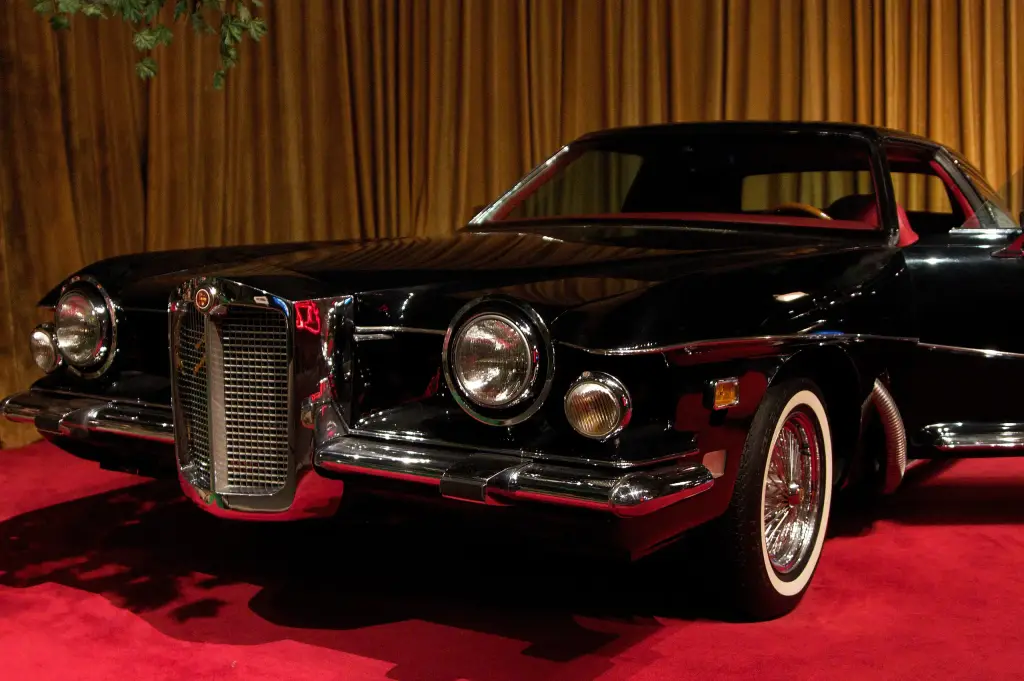
The original Series I had a split windscreen and was made by hand at Officine Padane in Modena. From 1972, with the Series II, production moved to Carrozzeria Saturn in Cavallermaggiore near Turin. The Series III arrived in 1973 and stayed in production until 1979. New series numbers were issued almost every year up to the Blackhawk VII, but there were no serious differences between them until the smaller Blackhawk VIII. Mechanical changes followed those of the Pontiac Grand Prix and the tail lamps were altered from time to time.
For 1978 Pontiac downsized the Grand Prix, but Stutz did not want to follow and had no new design ready. The company bought up a large stock of 1977 Grand Prix cars and kept building the Blackhawk for two more years.
Blackhawk VIII and the end (1980–1987)
The Blackhawk VIII of 1980 was reworked around the Pontiac Bonneville chassis, later the Parisienne, whose wheelbase was almost identical to that of the earlier Grand Prix. In 1985 Stutz moved to the Oldsmobile Delta 88 and Buick LeSabre versions of the same GM B platform, which Pontiac no longer offered. By 1976, 205 Blackhawks had been sold, about six a month, hand-built in Italy and shipped to the United States. By April 1980 the figure had reached 350, and by 1987 roughly 500 to 600 cars had been made.
Design and equipment
The Blackhawk had an extra-heavy-gauge steel body more than 19 feet long and weighed about 5,000 pounds. Early cars used Pontiac’s 7.5-litre V8 with 425 hp and 420 lb·ft, a three-speed automatic and rear-wheel drive, enough for 60 mph in 8.4 seconds and a top speed of 130 mph at about eight miles per gallon. Later cars used the 403 and 350 engines, and Ford, Chevrolet and Cadillac engines were also fitted. Each body received 18 to 22 coats of hand-rubbed lacquer taking six weeks to apply, and total build time was over 1,500 man-hours.
The interior had 24-carat gold-plated trim, bird’s-eye maple, burled walnut or redwood, Connolly leather, instrument markings in English and Italian, wool or mink carpeting, a cigar lighter and a liquor cabinet in the back. Some later cars had a clock in the steering wheel hub. Equipment included headlamps with a twilight sensor, cornering lamps, bi-level automatic air conditioning, Superlift air-adjustable shock absorbers, a limited-slip differential, an electric sunroof, cruise control, central locking, an alarm, non-functional side exhaust pipes and a Lear Jet eight-track quadraphonic radio. The first cars rode on 17-inch Firestone LXX run-flat tyres, which were withdrawn as unsafe.
Owners
The first Blackhawk sold went to Elvis Presley on 9 October 1970 for $26,500; it was the second prototype, built by Officine Padane. Frank Sinatra had also wanted the car but declined the distributor’s conditions. Presley had it customised by George Barris and in January 1971 paid $1,467.50 for a mobile telephone; in July 1971 a hired driver destroyed the car, and the wreck went into storage until it was restored. Wilson Pickett’s 1974 Blackhawk was auctioned in 2007 for $50,600.
Design and features
- Trunk-lid spare: the spare wheel protrudes through the boot lid, with the fuel filler inside it on early cars.
- Free-standing headlamps: Exner’s 1930s-style lamps in front of a fake radiator shell.
- Hand-finished body: 18 to 22 coats of hand-rubbed lacquer and over 1,500 man-hours per car.
- Gold and rare wood: 24-carat plating, bird’s-eye maple and Connolly leather inside.
- American muscle: Pontiac V8 power and a GM automatic in an Italian body.
Stutz Blackhawk versions
- Series I (1970–1971): split windscreen, built by Officine Padane in Modena.
- Series II to VII (1972–1979): built by Carrozzeria Saturn near Turin, with yearly detail changes.
- Blackhawk VIII (1980–1987): smaller body on the Bonneville, later Parisienne, chassis.
- D’Italia and Bearcat: the convertible versions, the D’Italia advertised at $129,500.
- Sedans: rare four-door cars produced later in the run.
The four-door member of the same family is the Stutz IV-Porte, and the pre-war car that lent its name is described under the Stutz Vertical Eight. More cars are in the Stutz collection.
Video: 1972 Stutz Blackhawk
Video on YouTube.
Sources
- Stutz Blackhawk, English Wikipedia: history, production, equipment, prices, owners