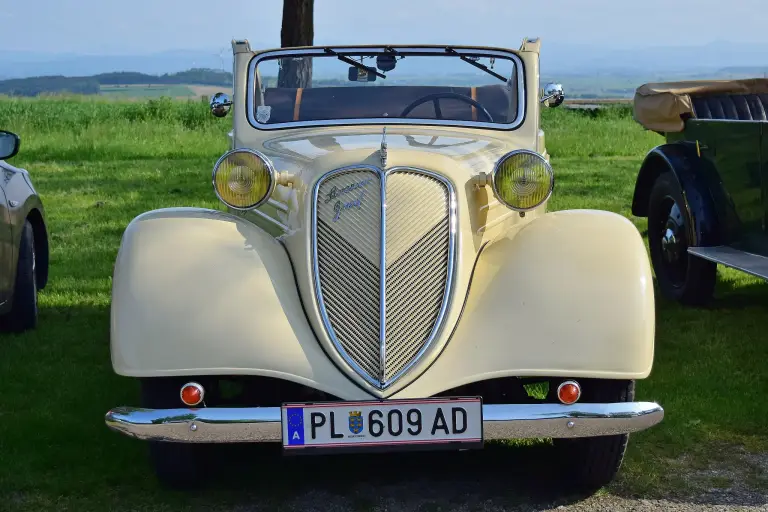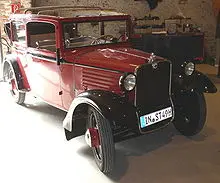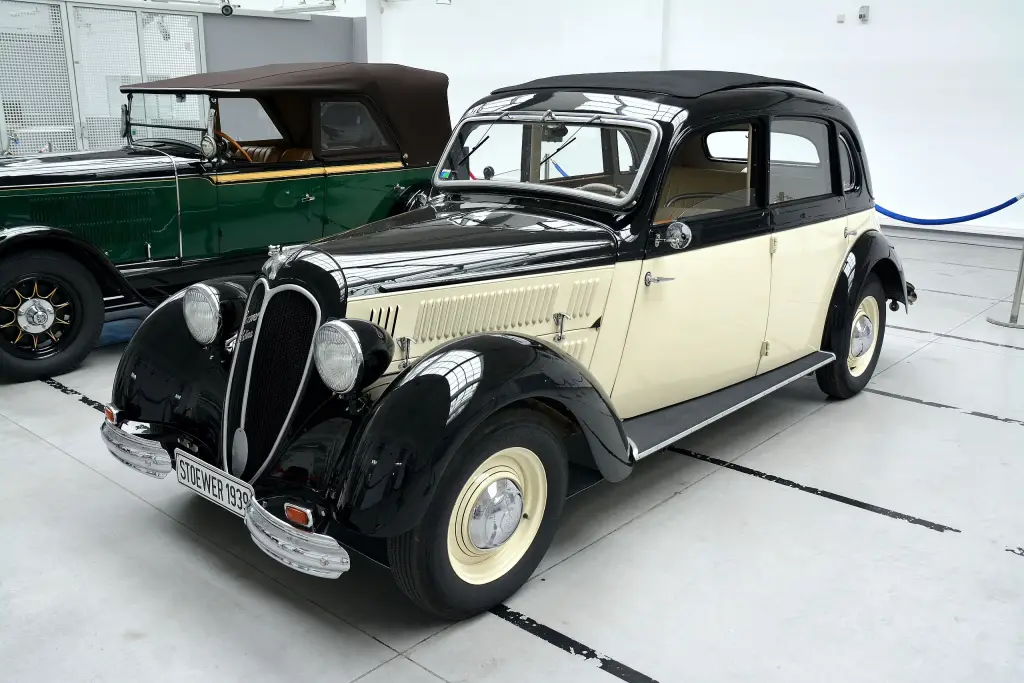
The Stoewer Sedina was a saloon of the upper middle class built in Stettin from 1937 to 1940. It was the sister model of the larger Arkona and, together with it, the last civilian car the company made before it switched to military production.
Stoewer Sedina at a glance
| Maker | Stoewer-Werke AG, Stettin (now Szczecin, Poland) |
|---|---|
| Production | 1937–1940 |
| Class | upper middle class |
| Engine | 2,406 cc four-cylinder, overhead valves, side camshaft |
| Power | 55 PS (40 kW) |
| Drive | rear-wheel drive, beam rear axle |
| Gearbox | four-speed |
| Body styles | 4-door saloon, 4-door Pullman saloon, 2-door cabriolet |
| Top speed | 110 km/h |
| Dimensions | 4,600 × 1,720 × 1,600 mm, wheelbase 2,900 mm |
| Weight | 1,360 kg |
| Built | 924 |
The Sedina is covered by short articles in English and German Wikipedia; the two differ on the gearbox, and this page follows the German article.
History of the Stoewer Sedina
A new direction for Stoewer
The Sedina appeared in 1937 alongside the larger Arkona. Unlike their predecessors, both cars had rear-wheel drive and beam axles instead of the front-wheel drive and independent suspension that had been a Stoewer trademark since the V 5. The Sedina was named after Sedina, the fictional woman who personifies the city of Szczecin, and its bonnet ornament took the form of the griffin from the city’s coat of arms.
Body and chassis
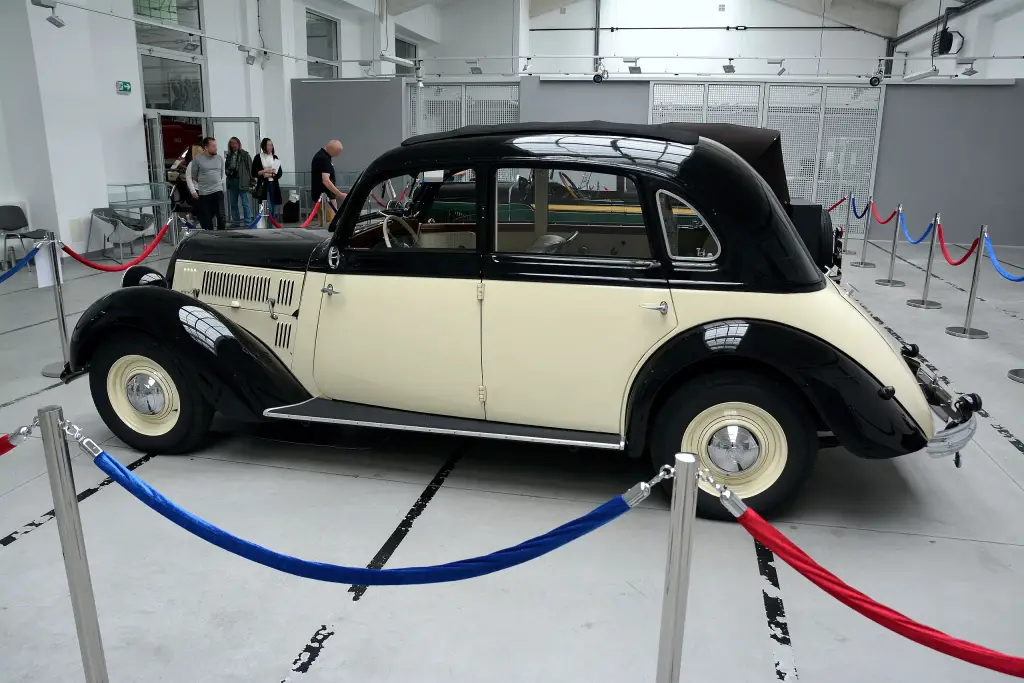
The car was offered as a four-door saloon, a four-door Pullman-type saloon and a two-door cabriolet. The front wheels were independently suspended on two transverse leaf springs, while the rear beam axle sat on semi-elliptical leaf springs. The body was more conservative in style than that of earlier Stoewer models. The engine was a 2.4-litre four-cylinder with overhead valves and a side camshaft, driving through a four-speed gearbox; the electrical system was 6 volt and fuel consumption was about 15 litres per 100 km.
The end of civilian production
In 1939, 480 Sedinas were produced, and by 1940 the total had reached 924 cars. That year Stoewer stopped building civilian automobiles and concentrated on the Einheits-PKW, the standardised light off-road car for the Wehrmacht, which the company had developed in 1936; the type was also built by BMW and Hanomag. With the Arkona, the Sedina was therefore the last civilian car to leave the Stettin works.
Design and features
- Rear-wheel drive: a break with the front-wheel-drive layout of the V 5 and the R-series cars.
- 2.4-litre four: overhead valves with a side camshaft, 55 PS, four-speed gearbox.
- Three body styles: four-door saloon, four-door Pullman saloon and two-door cabriolet.
- City emblem: the bonnet ornament was the griffin of Szczecin, and the name honoured the city’s personification, Sedina.
Stoewer Sedina versions
- L4 saloon: the standard four-door saloon.
- PL4 Pullman saloon: the long four-door body.
- Cb2 cabriolet: the two-door convertible.
The Sedina was the sister model of the larger Greif, and its rear-wheel-drive layout replaced the front-driven R 180. More cars are in the Stoewer collection.
Sources
- Stoewer Sedina, English Wikipedia: history, production figures, specifications
- Stoewer Sedina, German Wikipedia: class, chassis, body styles, end of production