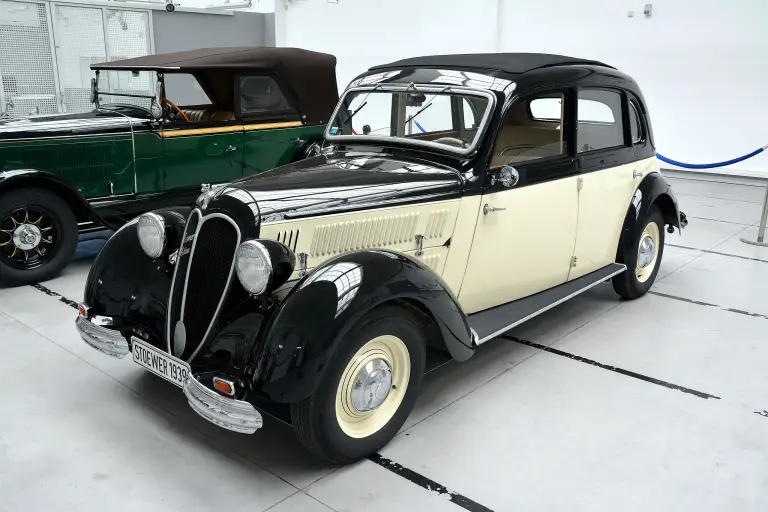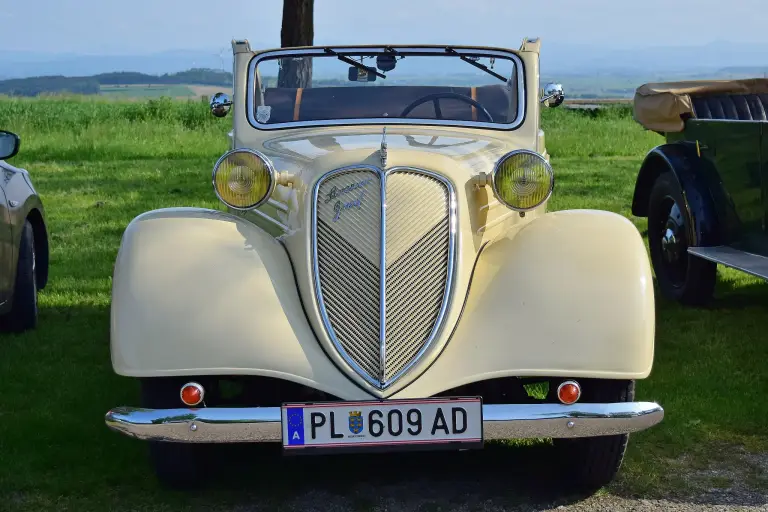
The Stoewer R 180 was the last and largest version of the R-series small car that Stoewer built in Stettin. It appeared in 1935 with a longer body, a 1.8-litre engine and fully skirted front wings, and it was replaced the following year by the Greif Junior.
Stoewer R 180 at a glance
| Maker | Stoewer-Werke AG, Stettin (now Szczecin, Poland) |
|---|---|
| Production | 1935 only |
| Class | small car, lower middle class |
| Engine | 1,769 cc four-cylinder, side valves |
| Bore × stroke | 80 × 88 mm |
| Power | 45 PS (33 kW) |
| Drive | front-wheel drive |
| Body styles | two- and four-door saloons, cabriolet; no roadster |
| Recognition | fully skirted front wings |
| Built | 300 |
The R 180 has no article of its own; it is described in the English and German articles on the R 140 family, which this page follows.
History of the Stoewer R 180
From R 140 to R 180
The R 140 of 1932 replaced the V 5 and kept its front-wheel drive, but used a conventional inline four instead of the V 4 that buyers had resisted. About 1,100 cars of the original design were built in 1932 and 1933, with a 1,355 cc engine of 30 PS. During 1933 the engine grew to 1,466 cc with the same power, and the two-door saloon gave way to a four-door pillarless body with doors opening away from the centre. In 1934 a more powerful 35 PS engine brought the name R 150, of which 1,150 were made.
The 1935 revision
For 1935 the car was revised once more: the body became longer, the engine was enlarged to 1,769 cc by boring it out to 80 mm while keeping the 88 mm stroke, and power rose to 45 PS. The name changed to R 180 to match the displacement. The wheelbase was longer than before and the roadster was dropped, so the range consisted of saloons and a cabriolet. The R 180 could be recognised from outside by its fully skirted front wings.
A short life
Production ended before the end of 1935 after only 300 cars. In the same year Stoewer took over the licence and tools of the Röhr Junior, a small car derived from Tatra design, and continued it as the Greif Junior; the company’s own small cars were dropped, and the Greif Junior replaced the R-types in 1936. The R-series was a developmental dead end, yet it helped keep Stoewer going through the Depression years.
Design and features
- 1.8-litre engine: 1,769 cc, 45 PS, the most powerful version of the R-series four.
- Longer body: a longer wheelbase than the R 140 and R 150, with no roadster in the range.
- Skirted wings: fully enclosed front wings made the R 180 easy to tell from its predecessors.
- Front-wheel drive: swing axles front and rear, continuing the layout introduced with the V 5.
- Small output: only 300 cars in a single year of production.
Stoewer R 180 versions
- Two-door saloon: the closed two-door body.
- Four-door saloon: the four-door body introduced during the R 140’s life.
- Cabriolet: the two-door convertible.
- R 180: the 1935 1.8-litre version, without a roadster.
The R 180 was replaced by the Greif Junior, and its rear-wheel-drive successor in the range was the Sedina. More cars are in the Stoewer collection.
Sources
- Stoewer R 140, English Wikipedia: R 180 engine, body, production, replacement
- Stoewer R 140, German Wikipedia: revision, dimensions, end of production