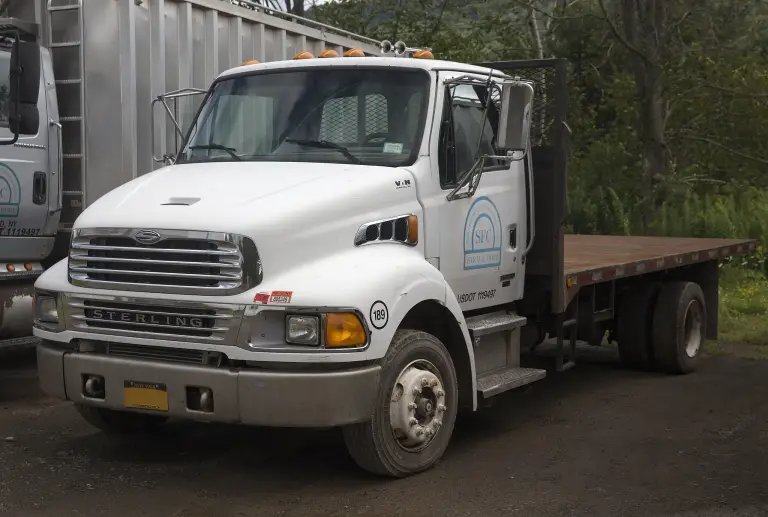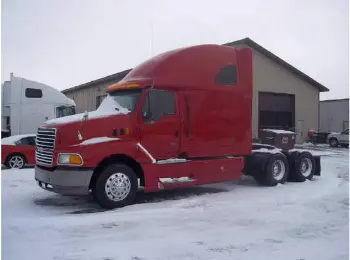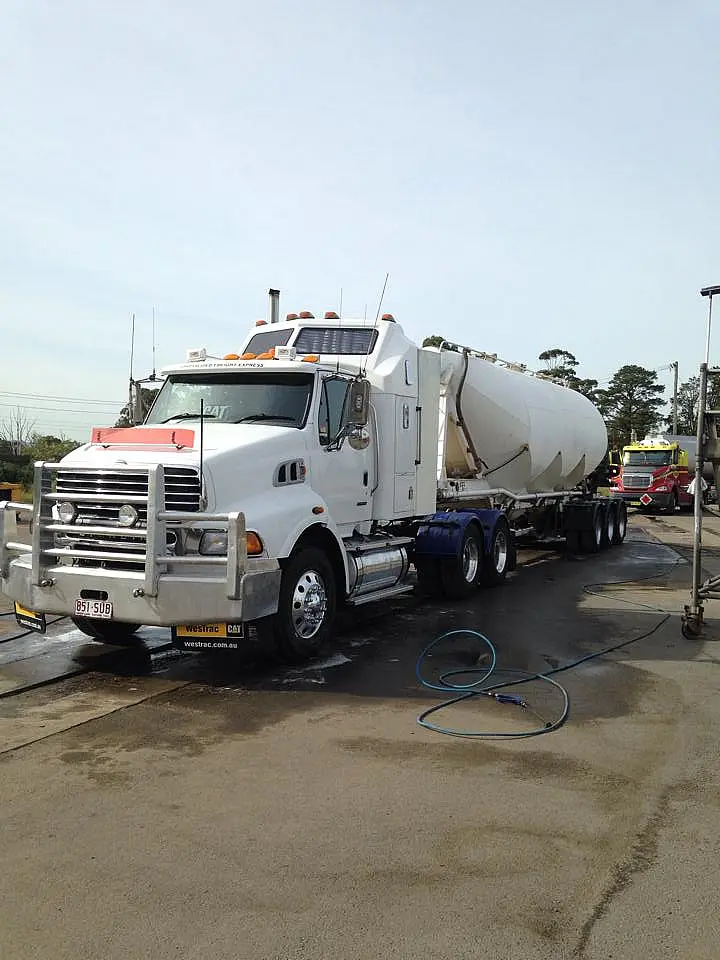
The Sterling L-Line was the conventional-cab heavy truck that kept the Ford Louisville and AeroMax line alive after Daimler took over Ford’s heavy-truck business. It was the core of the Sterling range from 1997 to 2009 and was offered with both set-back and set-forward front axles.
Sterling L-Line at a glance
| Maker | Sterling Trucks Corporation (Daimler, through Freightliner) |
|---|---|
| Production | 1997–2009 |
| Class | heavy-duty, Class 8 tractors |
| Cab | conventional, second-generation Ford Louisville/AeroMax |
| Front axle | set back and set forward |
| Series | L7500, L8500, L9500, LT |
| Assembly | St. Thomas, Ontario; Portland, Oregon |
| Markets | United States, Canada, Mexico, Australia, New Zealand |
| Predecessor in effect | Ford L-Series (Louisville) |
| Brand discontinued | 2009 |
No separate Wikipedia article exists for the L-Line; this page uses the model section of the English article on Sterling Trucks together with the German article on the marque. The L7500, L8500, L9500 and LT designations come from the model records of this collection.
History of the Sterling L-Line
The Ford inheritance (1997)
The Sterling L-Line did not begin as a Sterling at all. In 1997 Freightliner, then part of Daimler-Benz, bought the heavy-truck product lines of Ford Motor Company, and the following year the name Sterling was revived for the trucks that came with the deal. For much of its production the L-Line continued the second-generation Ford Louisville/AeroMax conventional cab introduced in 1996, The Sterling oval with its sterling-silver “S” took the place of the Ford Blue Oval.
Set-back and set-forward
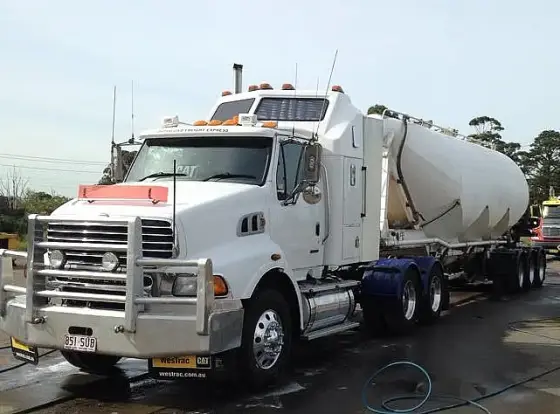
The L-Line was built in two basic arrangements: set back and set forward. The range covered the L7500, L8500 and L9500 designations as well as the LT tractors. All were conventional-cab trucks, and all were supplied as cab/chassis for third-party body builders, so the same truck could leave the factory as a tractor unit, a dump truck, a snow plough or a refuse vehicle.
Assembly and the end
Sterling was headquartered in Redford Township, Michigan, and assembled its conventional-cab vehicles in St. Thomas, Ontario and Portland, Oregon. The trucks were sold in the United States, Canada, Mexico, Australia and New Zealand. On 14 October 2008 Daimler announced that the Sterling line would be discontinued to consolidate its North American truck building under Freightliner and Western Star; orders stopped in January 2009 and the St. Thomas plant closed in March 2009.
Design and features
- Ford L-Series cab: the second-generation Louisville/AeroMax conventional cab of 1996, carried over almost unchanged.
- Two axle positions: set-back and set-forward versions for different weight and body requirements.
- Cab/chassis basis: sold to body builders for tractors, tippers, snow ploughs and refuse bodies.
- Sterling identity: an oval badge with a silver “S” replacing the Ford Blue Oval.
Sterling L-Line versions
- L7500: the lighter end of the conventional L-Line.
- L8500: mid-range conventional.
- L9500: the heavy conventional, widely used as a tractor and for vocational bodies.
- LT: the tractor versions of the L-Line.
The L-Line sat below the A-Line in the Sterling range, and its medium-duty relative was the Acterra. More trucks are in the Sterling collection.
Sources
- Sterling Trucks, English Wikipedia: history, model lines, plants, discontinuation
- Sterling (Nutzfahrzeugmarke), German Wikipedia: Daimler takeover, closure dates, production sites