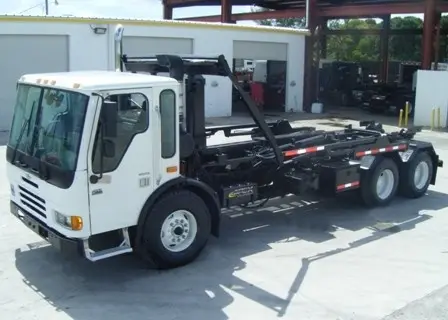
The Sterling Condor was the member of the Sterling range that borrowed most openly from its Freightliner parent. It used a Freightliner cab and was most often seen under a refuse body, which made it one of the more visible Sterling trucks in American cities.
Sterling Condor at a glance
| Maker | Sterling Trucks Corporation (Daimler, through Freightliner) |
|---|---|
| Production | 1998–2009 |
| Class | heavy conventional cab |
| Cab | rebadged Freightliner cab |
| Best known as | refuse and garbage truck |
| Body | cab/chassis for third-party body builders |
| Assembly | St. Thomas, Ontario; Portland, Oregon |
| Markets | United States, Canada, Mexico, Australia, New Zealand |
| Headquarters | Redford Township, Michigan |
| Brand discontinued | 2009 |
There is no separate Wikipedia article on the Condor; this page uses the model section of the English article on Sterling Trucks and the German article on the marque.
History of the Sterling Condor
A badge from within the group
Sterling was created by Freightliner in 1997 from the heavy-truck lines it had bought from Ford, and the brand traded on its own American history: the original Sterling Motor Truck Company had built trucks in Milwaukee from 1906 until White Motor Corporation retired the name in 1953. Not every Sterling was Ford-derived, however. The Condor used a cab taken from Freightliner, which made it a Daimler product under a revived American badge.
An urban speciality
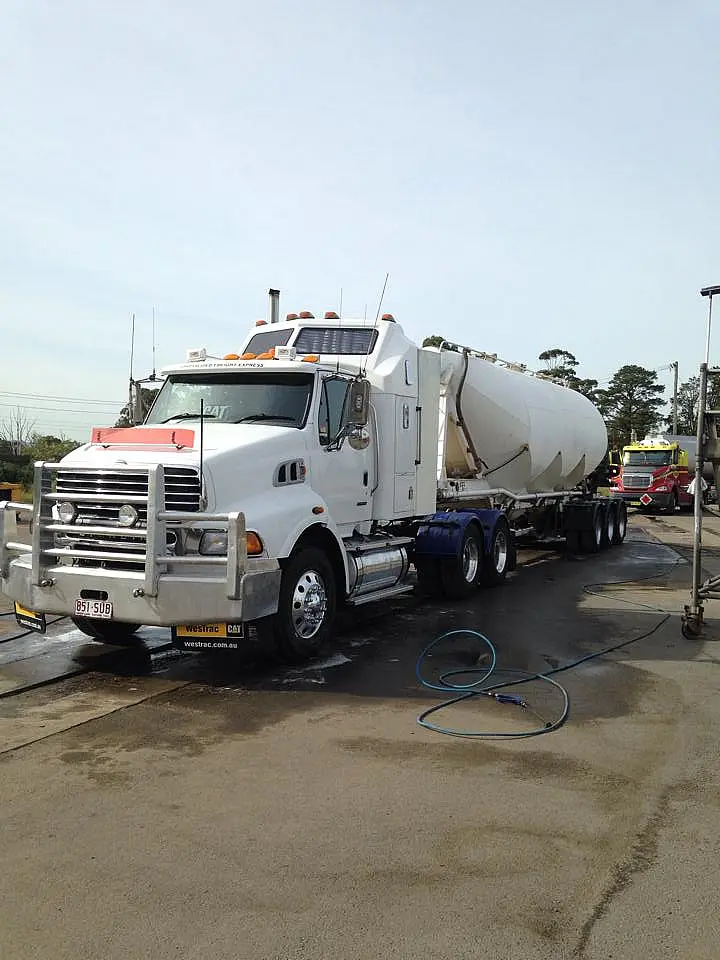
The Condor came into its own with refuse bodies, and refuse trucks were the most common use of the model in the United States. Like the rest of the range it was sold as a cab/chassis, with the body supplied by a specialist builder and fitted afterwards; the same approach let Sterling trucks serve freight distribution and heavy vocational work such as construction, snow ploughing and tanker duty. Within the Freightliner organisation Sterling was positioned between Freightliner itself and Western Star.
End of the model
Daimler announced on 14 October 2008 that the Sterling brand would be discontinued, with production consolidated under Freightliner and Western Star. Orders were taken until January 2009, the Canadian plant at St. Thomas closed in March 2009 and the Portland, Oregon plant followed in June 2010. The Condor thus disappeared with the brand it belonged to, after roughly a decade on the market.
Design and features
- Freightliner cab: a group cab rather than the Ford-derived L-line cab.
- Refuse work: most Condors were built with garbage-compactor bodies.
- Cab/chassis supply: delivered to body builders, not sold as a complete truck.
- Daimler range position: Sterling sat between Freightliner and Western Star.
Sterling Condor versions
- Condor (1998–2009): the standard conventional heavy truck.
- Refuse chassis: the version most often ordered, with a rear-loader body.
- Vocational chassis: construction, snow-plough and tanker bodies fitted by upfitters.
The Ford-derived heavy trucks of the same range were the L-Line and A-Line, and the medium-duty option was the Acterra. More trucks are in the Sterling collection.
Video: Sterling Condor McNeilus AutoReach Garbage Truck
Video on YouTube.
Sources
- Sterling Trucks, English Wikipedia: Condor cab source and refuse use, brand history
- Sterling (Nutzfahrzeugmarke), German Wikipedia: founding, Daimler takeover, closure dates