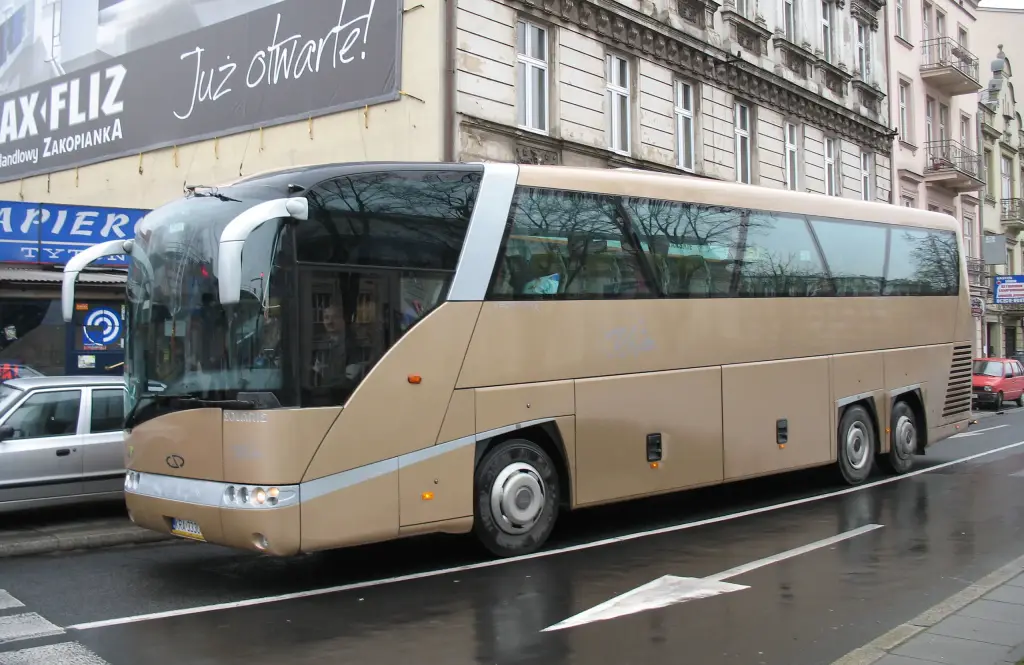
The Solaris Vacanza is a high-deck tourist coach produced by Solaris Bus & Coach in Bolechowo near Poznań between 2001 and 2010. Two models were offered, the two-axle Vacanza 12 and the three-axle Vacanza 13, and the range was replaced in 2010 by the Solaris InterUrbino.
Solaris Vacanza at a glance
| Maker | Solaris Bus & Coach, Bolechowo near Poznań, Poland |
|---|---|
| Production | 2002–2010 |
| Models | Vacanza 12 (two axles, 12 m), Vacanza 13 (three axles, 12.9 m) |
| Vacanza 12 | built 2002–2008, two generations |
| Vacanza 13 | built 2004–2010 |
| Engine | DAF XE 315C, Euro III; DAF MX 300, Euro 4, from 2006 |
| Gearbox | ZF 8S180 |
| Body | stainless steel and glass-fibre-reinforced laminate panels |
| Designer | IFS Designatelier, Berlin |
| Brand symbol | a kangaroo |
| Replaced by | Solaris InterUrbino, 2010 |
| Bloodmobiles built | 12 |
History of the Solaris Vacanza
First generation (2001–2003)
The Vacanza 12 was presented at the Busworld trade fair in Kortrijk, Belgium, in October 2001 and shown in Poland at the Tour Salon fair in Poznań. The coach was designed from scratch by Solaris with the Berlin studio IFS Designatelier and used a DAF engine with a ZF gearbox. Two prototypes were tested on proving grounds in Poland, Slovakia and the Netherlands, and series production began in spring 2002. The first customer was the Kraków operator Jarema Bus, and in 2003 the first two coaches went abroad, one to a German travel company and one to the operator in Daugavpils, Lithuania. In July 2003 the Vacanza 12 took part in the Coach Euro Test 2003 and finished joint second with Volvo for the Coach of the Year 2004 title.
Second generation (2003–2010)
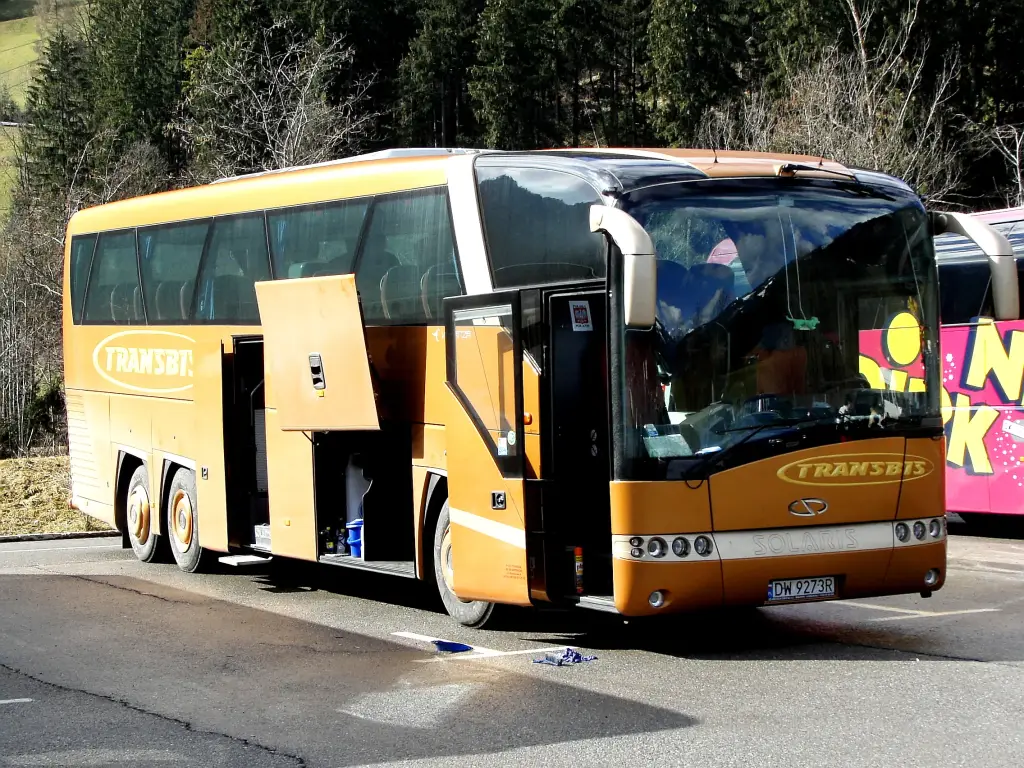
In 2003 Solaris added the three-axle Vacanza 13, 12.9 metres long, shown at Kortrijk in October 2003 and in Warsaw that December. With it came a revised Vacanza 12, which entered production in 2004 as the second generation. The upper edge of the windscreen was raised, a third windscreen wiper was fitted, the front lamps changed diameter, and the side hatches and luggage compartments were rearranged. The first customers for the longer coach were Schmetterling Reisen of Germany and Imex of Jastrzębie-Zdrój in Poland. A Vacanza 14 was planned but never built.
A niche model and the end of production
Sales never approached those of the Urbino city buses or of rival coaches: the factory turned out at most a dozen or so Vacanza coaches a year, and most stayed in Poland, with single vehicles going to Germany, Estonia and Latvia. Interest fell further towards the end of the decade, and production ended in 2010. Solaris has not returned to tourist coaches since. The whole family was styled by IFS Designatelier, and its brand symbol was a kangaroo.
Bloodmobiles
On the basis of the first-generation Vacanza 12 a blood donation vehicle, known as the Vampirebus, was built in 2002 for the Regional Blood Centre in Katowice. Second-generation coaches followed in 2004 for Bydgoszcz and in 2007 for Poznań, and pairs of Vacanza 13 bloodmobiles were delivered to Warsaw, Katowice, Gdańsk and Racibórz. Each had a doctor’s office, a laboratory, a donor registration area, four or five collection positions, a kitchenette and an additional generator. Twelve such vehicles were built in all.
Design and features
- Modern coach styling: the asymmetric windscreen line of the Urbino buses, trapezoid side windows and a wedge-shaped profile.
- Stainless steel body: panels in stainless steel and glass-fibre-reinforced laminate.
- DAF power: the XE 315C Euro III engine at first, replaced from 2006 by the Euro 4 DAF MX 300.
- Two layouts: a two-axle 12-metre coach and a three-axle 12.9-metre coach.
- Special conversions: twelve blood donation vehicles on the Vacanza base.
Solaris Vacanza versions
- Vacanza 12, first generation (2002–2003): the original two-axle coach.
- Vacanza 12, second generation (2004–2008): raised windscreen line, third wiper, revised lamps and lockers.
- Vacanza 13 (2004–2010): the three-axle, 12.9-metre version.
- Bloodmobiles: twelve donor collection vehicles, the first in 2002.
- Vacanza 14: a planned longer model that was never built.
The coach was built alongside the city buses of the Solaris Urbino family and the midibus Solaris Alpino. More vehicles from Bolechowo are in the Solaris collection.
Video: SOLARIS VACANZA Prezentacja Video
Video on YouTube.
Sources
- Solaris Vacanza, English Wikipedia: models, engines, bloodmobiles
- Solaris Vacanza, Polish Wikipedia: generations, sales, production years, design changes