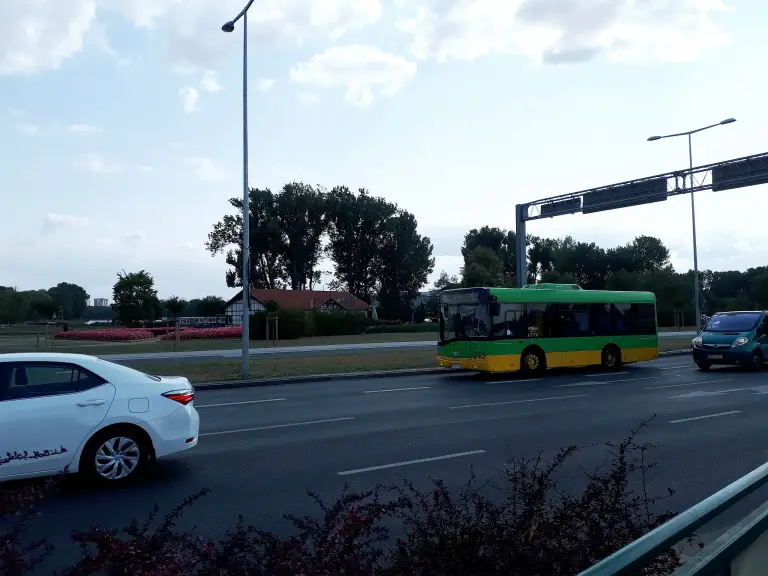
The Solaris Urbino is a family of low-floor city and low-entry intercity buses produced by Solaris Bus & Coach in Bolechowo near Poznań since 1999. It grew from a single 12-metre model into a range from 9 to 18 metres and more, with diesel, gas, hybrid, electric and hydrogen drives, and became one of the most popular city bus families in Europe.
Solaris Urbino at a glance
| Maker | Solaris Bus & Coach, Bolechowo near Poznań, Poland |
|---|---|
| Production | since 1999 |
| Type | low-floor city buses and low-entry intercity buses |
| Lengths | 9, 10, 12, 12.9, 15, 18 and 18.75 metres |
| Generations | I from 1999, II from 2001/02, III from 2005, IV from 2014/15 |
| Design | Solaris and IFS Designatelier, Berlin |
| Drives | diesel, CNG and biogas, hybrid, electric, hydrogen |
| Body | corrosion-resistant steel frame, stainless steel and aluminium panels |
| Market | built only for left-hand-drive markets |
| First model | Solaris Urbino 12, mid-1999 |
| Electric debut | Urbino 8.9 LE electric, 2011 |
History of the Solaris Urbino
From Neoplan Polska to Solaris
The company behind the Urbino began in 1994 as Neoplan Polska, founded by Krzysztof Olszewski in Bolechowo near Poznań after winning a tender for 72 low-floor city buses for MPK Poznań. The factory opened in 1996 and at first built Neoplan models under licence. In 1999 the company started producing buses under its own Solaris brand, and the first prototype, the Solaris Urbino 12, was presented that year.
First generation (1999–2001)
The first Urbino 12 left the production line in mid-1999, followed in the second half of the year by the 15-metre and 18-metre versions, and in 2000 by the 9-metre Urbino 9. The buses were designed by Neoplan Polska with the Berlin styling studio IFS Designatelier, which also shaped the later generations. Their distinctive asymmetric windscreen line improved the driver’s view when pulling in at a stop. The first exports went to the Czech Republic and Slovakia in 2000 and to Germany in 2001.
Second generation (2001–2004)
The second generation arrived at the turn of 2001 and 2002 with small cosmetic changes, including a revised shape of the headlamps and a repositioned fuel tank. The 9-metre model was replaced by the slightly longer Urbino 10. In 2004 Solaris added the low-entry Urbino 12 LE and the gas-powered Urbino 15 CNG, and a second-generation Urbino 12 took second place in the Bus Euro Test 2004.
Third generation (2005–2018)
The third generation, on sale from 2005 to 2018, brought larger changes: the rounded roofline was dropped, the windscreen and lamp shapes changed, the side destination display moved above the window line and the engine tower was redesigned. The range widened with the low-floor compact models Alpino 8.6 and Alpino 8.9 LE, the low-entry Urbino 12 LE and Urbino 15 LE, and in 2006 the Urbino 18 Hybrid, the first series-production hybrid bus in the world, developed with Allison Transmission. An updated Urbino 12 New Edition, known as generation 3.5, appeared in 2008. In 2011 came the first fully electric Solaris bus, the Urbino 8.9 LE electric, and in 2012 the Urbino 12.9 and Urbino 18.75 joined the range.
Fourth generation (from 2014)
The fourth generation was unveiled at the IAA in Hanover and at Transexpo in Kielce in 2014 and entered production in 2015. The Urbino 12 electric was named Bus of the Year 2017, the first Polish bus to win the title, and hydrogen-powered versions have since joined the electric and hybrid models. Today the Urbino is the best-selling city bus in Poland and one of the most popular in Europe.
Design and features
- Full low-floor layout: easy boarding along the whole length of the city versions.
- Wide range of lengths: from the 9-metre Urbino 9 to the 18-metre articulated Urbino 18 and the 24-metre electric.
- Alternative drives: CNG and biogas, hybrid, battery-electric and hydrogen versions alongside the diesel models.
- Distinctive styling: the asymmetric windscreen line and the deep front bow of the third generation.
- Left-hand drive only: the whole family was built for left-hand-drive markets.
Solaris Urbino versions
- Urbino 9 (2000): the shortest of the first generation, replaced by the Urbino 10.
- Urbino 10 (2002): the 10-metre midibus of the second and third generations.
- Urbino 12 (1999): the original model, later also as 12 LE, 12 Ü, hybrid, electric and hydrogen.
- Urbino 15 (1999): the long two-axle bus, with a 15 LE low-entry version from 2008.
- Urbino 18 (1999): the articulated bus, including the 18 Hybrid of 2006 and 18.75 of 2012.
- Urbino 24 electric: the longest member of the family, a 24-metre bi-articulated electric bus.
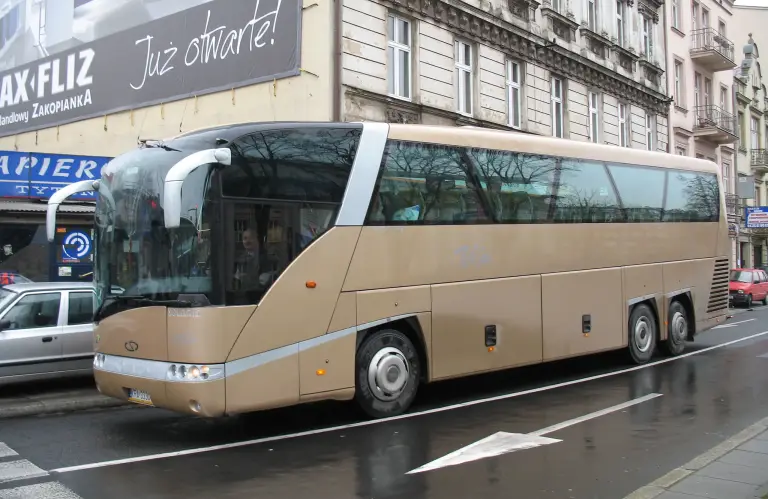
The compact member of the family is the Solaris Alpino, and Solaris also built the tourist coach Solaris Vacanza. More buses from Bolechowo are in the Solaris collection.
Video: City-Verkehr.TV Folge “Der neue Solaris Urbino”
Video on YouTube.
Sources
- Solaris Urbino, English Wikipedia: history, models, generations
- Solaris Urbino, Polish Wikipedia: origins, generations, drives, awards