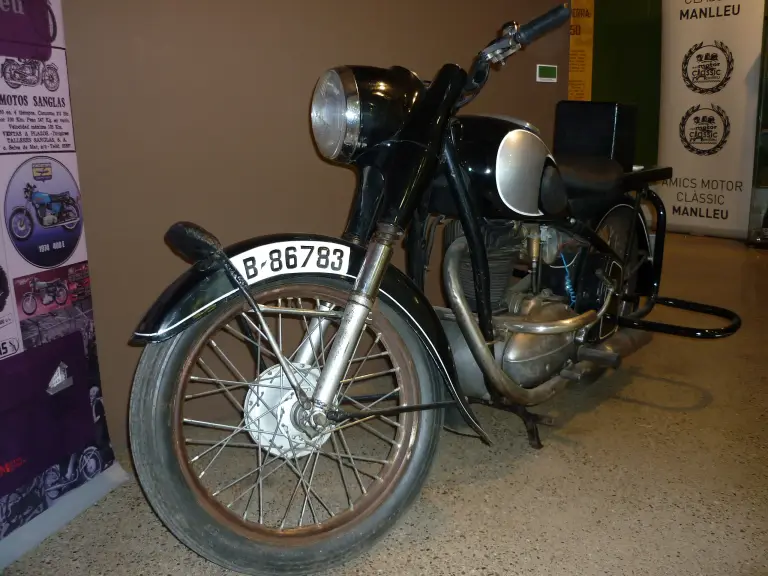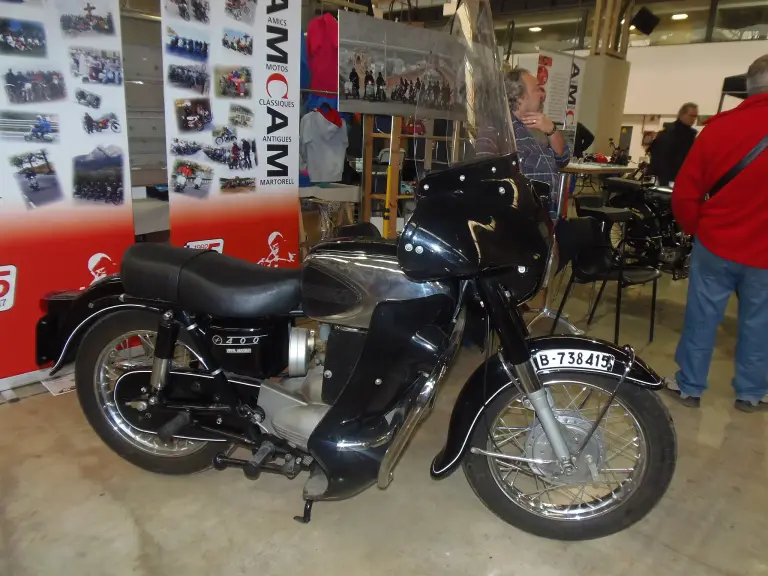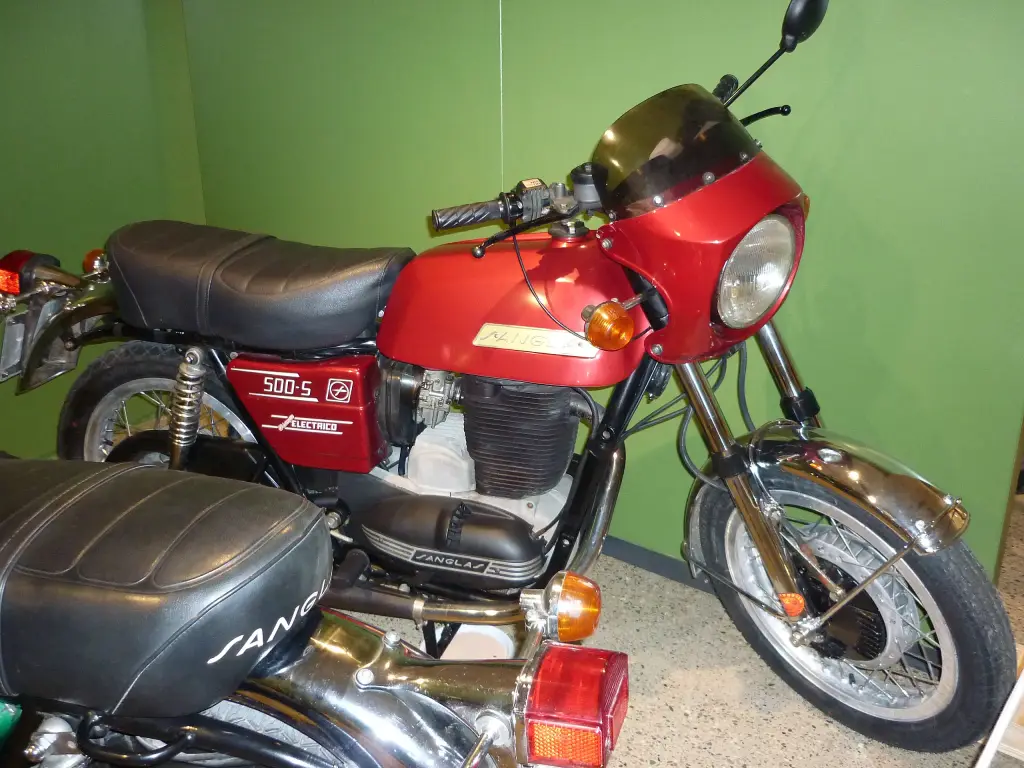
The Sanglas 500 was the biggest motorcycle the Barcelona company built. The first one appeared in October 1952 with a revised rear frame to take a swinging arm and two spring-and-hydraulic dampers, and the line continued until 1981, when the 500 S2 V5 — the last Sanglas with its own engine — went out of production.
Sanglas 500 at a glance
| Maker | Sanglas, Barcelona and L’Hospitalet, Spain |
|---|---|
| First 500 launched | October 1952 |
| Rear suspension of the first 500 | swinging arm, two spring/hydraulic dampers |
| Uprated version | 500/3, with more power and light-alloy brake drums |
| Military model | 500 cc, launched 1967 |
| 500 S | 1976, Sanglas on-board disc brake, 32 hp at 6,700 rpm |
| Disc brake patent | 1971 |
| 500 S2 | 1977 |
| 500 S2 V5 | 1979, five-speed gearbox |
| End of production | 1981 |
Sanglas has no separate Wikipedia pages for its models; this article is based on the articles about the company in English and Spanish Wikipedia.
History of the Sanglas 500
The Sanglas 500 appeared in October 1952. It was the first model of the young Barcelona firm in the half-litre class, and its rear frame was revised to take a swinging arm with two spring and hydraulic damper units — a modern arrangement for a Spanish motorcycle of the period. Like every Sanglas, it was designed as a touring machine able to hold considerable speeds and cover long distances.
The model was steadily improved. The 500/3, together with the 350/4, received an engine of increased power, an improved silencer and light-alloy brake drums among other changes. These were the years when the firm supplied official agencies, but also the years when the Seat 600 car, only slightly dearer than a Sanglas, began to take away the market for large motorcycles.
A second 500 cc model was launched in 1967, intended for military use, but it did not receive much demand. The real revival came in 1976 with the 500 S. It introduced an on-board disc brake of Sanglas’s own concept — in appearance close to a drum brake, but working as a disc — protected by a Spanish patent of 1971. The 500 S produced 32 hp at 6,700 rpm, and buyers in the British Isles praised the brake for its behaviour in the rain. With the financial help of Prodinsa, which also held shares in the Ducati licensee Mototrans, the 500 S allowed Sanglas to increase sales abroad.
The 500 S2 followed in 1977, and two years later came the 500 S2 V5 with a five-speed gearbox. It was the last Sanglas with its own engine, and it was discontinued in 1981, the year the SEMSA company was formed with Yamaha, Banesto and the Catalan banks. Sanglas technology did not stop with the bikes: the firm also patented a system for balancing inertial vibrations in combustion engines in 1974 and a method of building brake drums in 1954.
Design and features
- Sanglas disc brake: a disc working inside a drum-like housing, patented in 1971 and fitted to the 500 S; British riders rated it in wet weather.
- Large single: the half-litre engine made the 500 the biggest Sanglas, built for long-distance touring.
- 500/3 improvements: more power, a better silencer and light-alloy brake drums over the first 500.
- Five-speed gearbox: the 500 S2 V5 of 1979 was the most developed version.
- Export push: backing from Prodinsa helped the 500 S sell outside Spain.
Sanglas 500 versions
- Sanglas 500 (1952): the first half-litre model, with swinging-arm rear suspension.
- Sanglas 500/3: uprated engine, improved silencer and light-alloy brake drums.
- Sanglas 500 (1967): military model with little demand.
- Sanglas 500 S (1976): 32 hp at 6,700 rpm and Sanglas disc brakes.
- Sanglas 500 S2 (1977): the developed 500 S.
- Sanglas 500 S2 V5 (1979–81): five-speed gearbox; the last Sanglas with its own engine.
The 500 was the largest model of the range, above the Sanglas 350 and the Sanglas 400. More machines are in the Sanglas collection.
Video: sanglas 500.mpg
Video on YouTube.
Sources
- Sanglas, English Wikipedia: 1952 model, 500/3, 500 S, 500 S2 V5
- Sanglas, Spanish Wikipedia: disc brake patent, Prodinsa, patents of 1954 and 1974