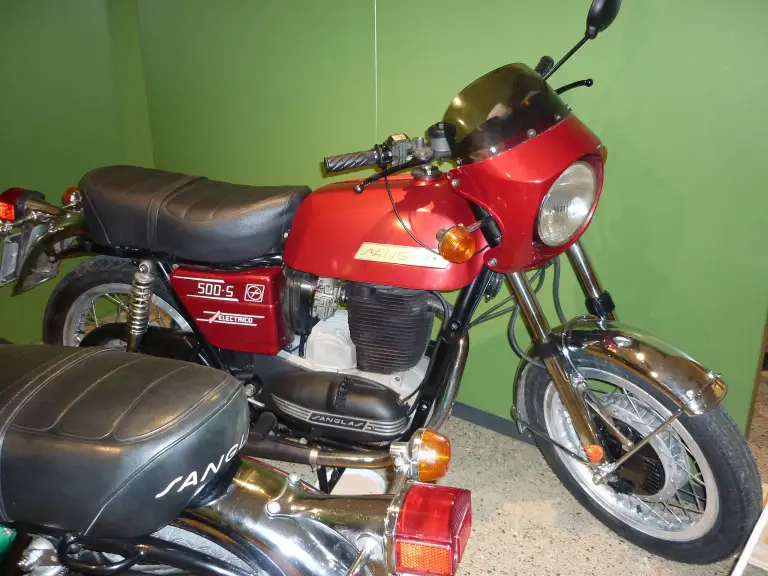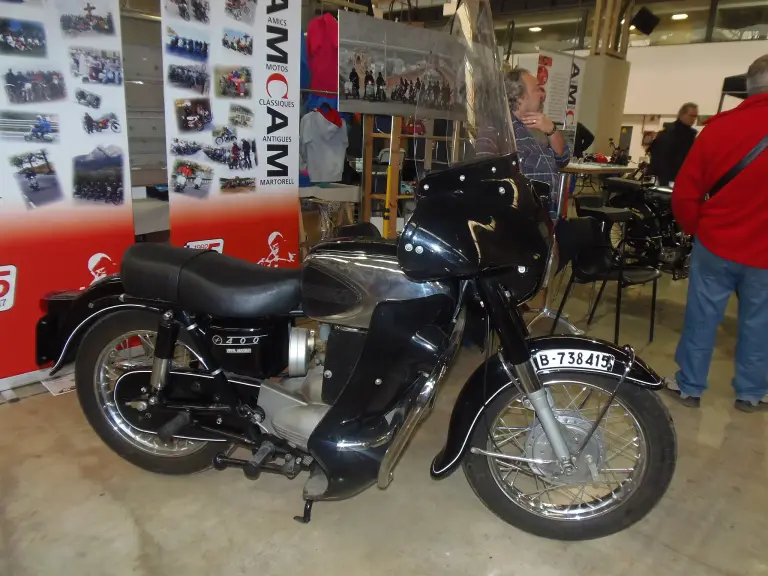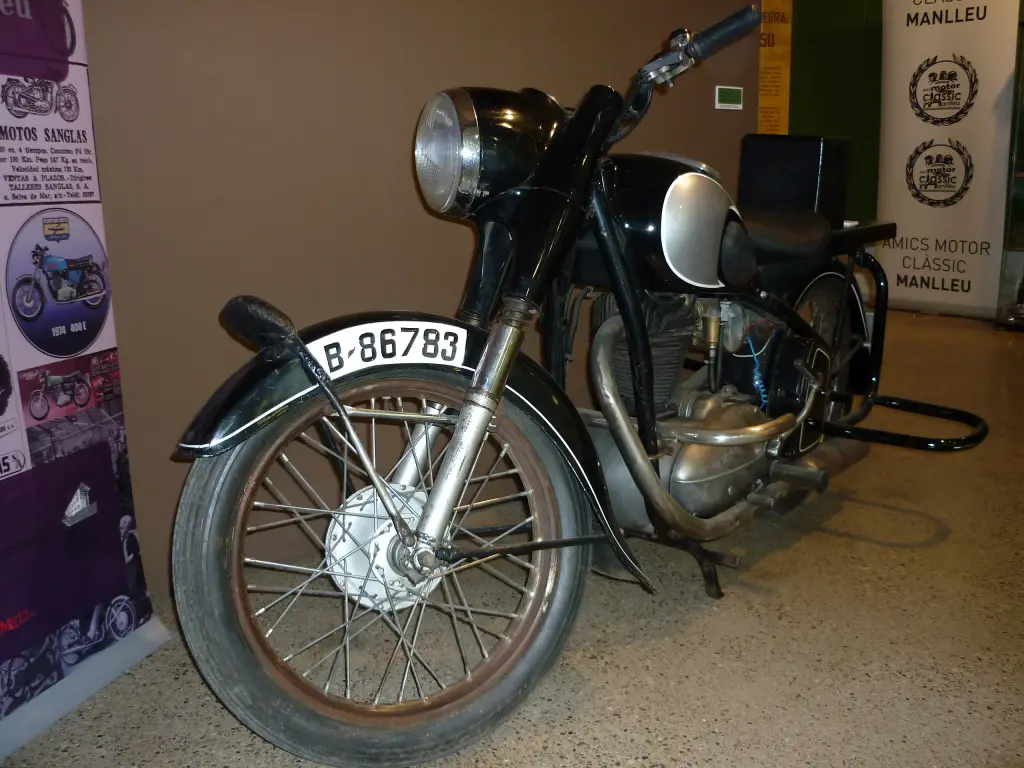
The Sanglas 350 was the model that made the Barcelona firm of Sanglas a supplier of official agencies in Spain. Its engine was a four-stroke single of 347.75 cc, inspired by DKW, in a frame laid out on BMW lines — a mixture of German and English practice that defined every Sanglas motorcycle.
Sanglas 350 at a glance
| Maker | Sanglas, Barcelona (Poble Nou), Spain |
|---|---|
| Production years | 1947–1981 (the company as a whole) |
| Engine | four-stroke single, OHV, 347.75 cc |
| Power of the first model | 14.4 hp at 4,800 rpm |
| Frame | steel, based on BMW practice |
| Uprated version | Sanglas 350/4 |
| 350/4 changes | more power, improved silencer, light-alloy brake drums |
| Role | touring; supply to official agencies |
| Employees, end of 1948 | 100 |
| Units built by end of 1948 | 200 |
| Annual output, 1958 | about 500 units |
| Annual output, late 1960s | about 2,500 units |
Sanglas has no separate Wikipedia pages for its models; this article is based on the articles about the company in English and Spanish Wikipedia and covers the 350 and its 350/4 version together.
History of the Sanglas 350
Sanglas was founded in Barcelona in 1942, three years after the Spanish Civil War, by two engineering students, the brothers Javier and Martin Sanglas, with money from their father, a textile manufacturer. The first documents recording formal sales of motorcycles date from 1947. The company set out to be a Spanish alternative to BMW, Zündapp and DKW in supplying motor vehicles to official agencies, and its first motorcycle had a displacement of 347.75 cc with 14.4 hp at 4,800 rpm.
The layout of that first model set the pattern for the 350 line. The chassis followed the concept of BMW, while the engine — a four-stroke single of OHV type — was inspired by DKW. Sanglas motorcycles were built as touring machines: they could reach considerable speeds and cover long distances, which suited the government departments and police forces that bought them.
The 350/4 was the uprated development of the 350. Together with the 500/3 it received an engine of increased power, an improved silencer and light-alloy brake drums, among other improvements. These changes kept the single competitive in the years when the Spanish market was still protected, although the arrival of the Seat 600 car, only marginally more expensive than a Sanglas, steadily reduced the market for large motorcycles.
The company grew quickly at first: by the end of 1948 it already had 100 employees and had built 200 motorcycles, and in 1958 annual production reached 500 units, which led to a move from Poble Nou to a more modern factory in L’Hospitalet de Llobregat. By the end of the 1960s output had reached about 2,500 units a year, built by 40 workers on the assembly line out of a total workforce of fewer than 100 people.
Design and features
- Four-stroke single: an OHV engine of 347.75 cc, inspired by DKW, in a period when many small Spanish machines were two-strokes.
- BMW-style frame: the chassis followed German practice, part of the English–German hybrid character of every Sanglas.
- 350/4 improvements: more power, a better silencer and light-alloy brake drums over the standard 350.
- Touring ability: designed to hold considerable speeds and cover long distances, which is why official agencies bought them.
- Long service life: the 350 stayed in the range while the company passed from a family firm to part of the Yamaha-backed SEMSA group.
Sanglas 350 versions
- Sanglas 350: the standard four-stroke single of 347.75 cc.
- Sanglas 350/4: uprated engine, improved silencer and light-alloy brake drums.
The 350 sat below the larger Sanglas 500 in the range, while the Sanglas 400 of the late 1950s used a bought-in two-stroke engine. More machines are in the Sanglas collection.
Sources
- Sanglas, English Wikipedia: history, engine, 350/4 improvements
- Sanglas, Spanish Wikipedia: production figures, factory move