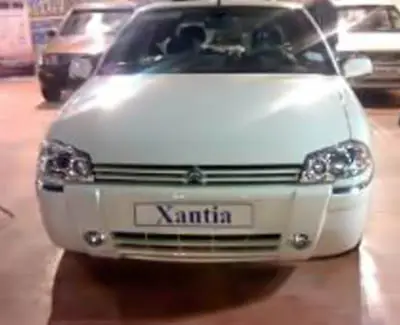
The Saipa Xantia was the Citroën Xantia assembled in Tehran by Saipa from 2001 to 2010. It was the first Citroën built by Saipa since the Dyane Jian and one of the models that kept the French marque on Iranian roads after the Xantia had been replaced in Europe.
Saipa Xantia at a glance
| Maker | Saipa, Tehran (Citroën design) |
|---|---|
| Production in Iran | 2001–2010 |
| Also known as | Saipa Citroën Xantia |
| Body | five-door liftback |
| Gearbox | five-speed manual |
| Variants | four |
| Contract signed | 18 February 2000 |
| French production | 1992–2001 |
| Designer | Bertone |
| Suspension | hydropneumatic |
| Built in France | 1,216,734 |
| Replaced in France by | Citroën C5 (2001) |
The Iranian production of the Xantia is described in a section of the English article on the Citroën Xantia; this page is based on that source.
History of the Saipa Xantia
A Bertone Citroën
The Xantia was Citroën’s large family car, designed by Bertone and presented to the press on 16 December 1992 at the CNIT in La Défense. It replaced the BX and kept the company’s hydropneumatic suspension, the system pioneered by the DS. At first only a hatchback was offered; an estate built by Heuliez followed in September 1995. Citroën built 1,216,734 Xantias at Rennes between 1992 and 2001, and the model was replaced by the C5, although French stock cars were still sold until October 2002. The range was facelifted at the end of 1997, when the grille moved from the body to the bonnet and the bumpers became body-coloured.
The Tehran contract
On 18 February 2000 Citroën and Saipa signed a contract that renewed their relationship and made Saipa a centre for exporting the Xantia to the Middle East, Central Asia, Russia and Ukraine. Production in Tehran ran from 2001 to 2010. The Xantia was the first Citroën produced by Saipa since the Dyane Jian of 1967–1980, and Saipa later described it as one of the best products in the history of Iranian car manufacturing.
What the Iranian cars were
All Xantias built in Iran were five-door liftbacks with a five-speed manual gearbox; no automatic or estate version is recorded. Saipa lists four variants, but the total number of cars completed in Tehran was never published and remains undisclosed. In Europe the most famous version was the Activa, with active anti-roll bars that kept the body flat in corners; it was introduced at the end of 1994 and just over 18,000 were built up to the autumn of 2001. The Iranian cars sat at the cheaper end of the range, and their place in the market was taken over by later models.
Design and features
- Hydropneumatic ride: the Citroën suspension system carried over from the DS.
- One body style: every Iranian car was a five-door liftback.
- Manual only: no automatic was offered in Tehran.
- Export role: the 2000 contract made Saipa a regional export centre.
- Bertone design: the shape penned for the 1992 launch.
Saipa Xantia versions
- Iranian Xantia (2001–2010): four variants, all five-door liftbacks with a five-speed manual.
- Mark 1 (1993–1997): the original shape with the grille in the body.
- Mark 2 (1998–2001): the facelift with the grille on the bonnet.
- Activa: the active-anti-roll version built in just over 18,000 examples.
- Break: the estate built by Heuliez from September 1995.
The Saipa range of the same years is described in Saipa Saba and Saipa Nasim. More cars are in the Saipa collection.
Sources
- Citroën Xantia, English Wikipedia: model history and Iranian production