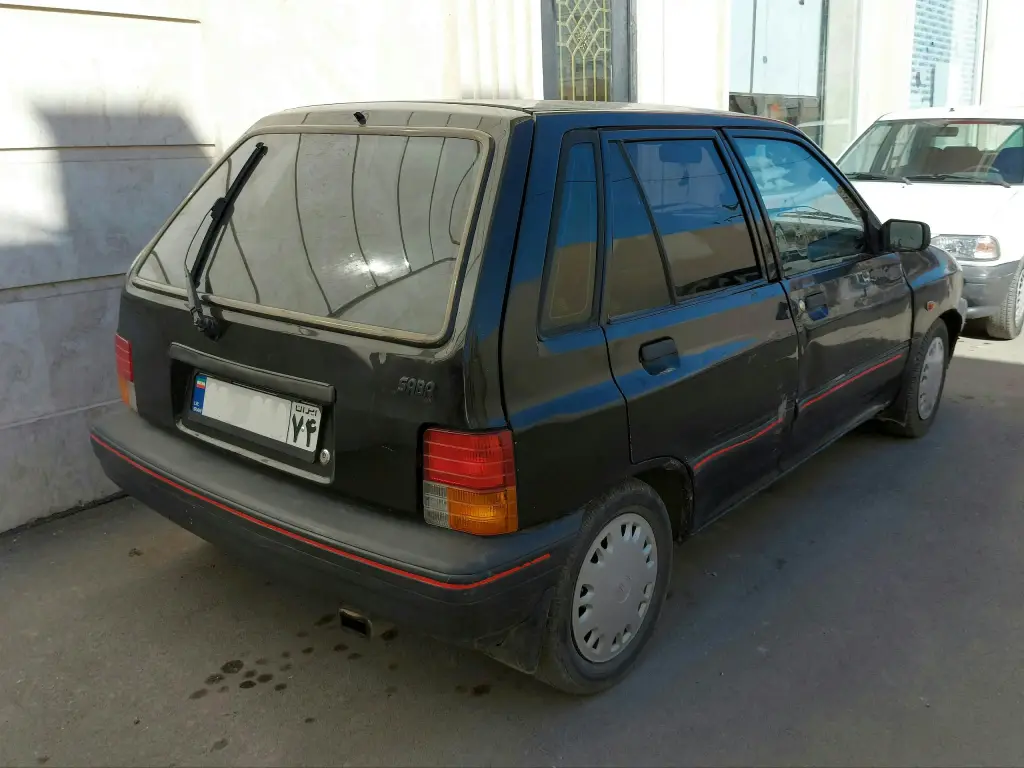
The Saipa Nasim was the hatchback half of the pair with which Saipa began building the Kia Pride in Iran: the Saba was the sedan, the Nasim the hatchback. It was produced from 1993 to 2010, first with a Kia badge and then, from 2005, as a Saipa, and it was replaced by the Saipa 111.
Saipa Nasim at a glance
| Maker | Saipa, Iran |
|---|---|
| Production | 1993–2010 |
| Based on | Kia Pride / first-generation Ford Festiva |
| Body | hatchback |
| Layout | front-engine, front-wheel drive |
| Brand | Kia until 2005, Saipa from 2005 |
| Platform | Mazda DA |
| Replaced by | Saipa 111 (2010) |
| Successor’s engine | 1.3-litre four-cylinder, 63 hp |
| Successor’s gearbox | five-speed manual |
The English article on the Saipa 111 is short; the production history of the Nasim comes from the Persian article on the Pride.
History of the Saipa Nasim
The hatchback Pride
The first-generation Ford Festiva was designed by Mazda and built under licence by Kia in South Korea, where it was sold as the Kia Pride from March 1987. Saipa began building the same car in Iran in 1993, using two names for the two bodies: Saba for the sedan and Nasim for the hatchback. The hatchback kept the front-wheel drive layout, rack-and-pinion steering and the strut front suspension of the original Pride.
Under the Saipa badge
For its first twelve years in Iran the Nasim was sold with a Kia badge, even though it was assembled locally. In 2005 the model passed fully to Saipa, whose badge replaced the Korean one. The Nasim shared its platform and much of its body with the Saba sedan, and both cars were part of a Pride family that became the best-selling car in Iran for years, prized for its low price and cheap spare parts. The same family also included the 132 sedan, the 141 liftback and the 151 pickup.
Replaced by the 111
Production of the original Nasim ended in 2010, when Saipa moved its small cars to the X100 platform. The hatchback role passed to the Saipa 111, a small entry-level hatchback introduced in 2010. The 111 was in effect a hatchback version of the Saipa 132, modified by the Saipa research and development centre, and it used a 1.3-litre four-cylinder engine with a single overhead camshaft, 63 hp at 5,200 rpm and a five-speed manual gearbox. Its 37-litre tank and fuel consumption of 5.6 litres per 100 km outside town and 6.9 litres in town were quoted by the maker.
Design and features
- Hatchback body: the companion to the Saba sedan.
- Pride engineering: front-wheel drive on the Mazda DA platform.
- Two badges: Kia until 2005, Saipa from 2005.
- A long run: seventeen years of production in Iran.
- Clear successor: replaced by the Saipa 111 in 2010.
Saipa Nasim versions
- Saipa Nasim (1993–2010): the standard hatchback.
- Kia-badged cars (1993–2005): locally built but sold as Kias.
- Saipa-badged cars (2005–2010): the final years.
- Saipa 111 (2010): the hatchback successor based on the 132.
The sedan of the same family is the Saipa Saba, and the pickup is the Saipa Z24. More cars are in the Saipa collection.
Sources
- Saipa 111, English Wikipedia: successor and specifications
- پراید, Persian Wikipedia: Nasim production history