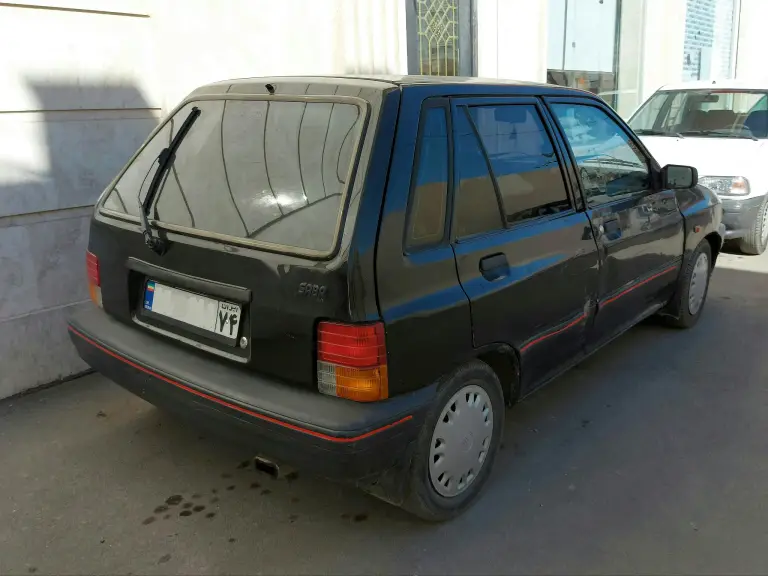
The Saipa Saba was the four-door sedan version of the Kia Pride that Saipa built in Iran from 1993 to 2010. It was one of the two models with which the Iranian company began Pride production, alongside the Nasim hatchback, and it stayed in the range long after the Pride had been replaced in Korea. Its platform and body structure later became the basis of the Saipa 131 and 132.
Saipa Saba at a glance
| Maker | Saipa, Iran |
|---|---|
| Production | 1993–2010 |
| Based on | Kia Pride / first-generation Ford Festiva |
| Body | four-door sedan |
| Layout | front-engine, front-wheel drive |
| Brand | Kia until 2005, Saipa from 2005 |
| Platform | Mazda DA |
| Suspension | struts at the front, torsion beam at the rear |
| Automatic | limited run with a three-speed gearbox, 2002–2003 |
| Late equipment | ABS and hydraulic power steering |
| Successor | Saipa 131, the facelifted Saba |
The Saba has no Wikipedia article of its own; this page is based on the SAIPA Pride section of the English article on the Ford Festiva and the sections on the Saba in the Persian article on the Pride.
History of the Saipa Saba
From Korea to Iran
The Pride began as the first-generation Ford Festiva, designed and engineered by Mazda in Japan on the DA platform and powered by its B-series four-cylinder engines. Kia Motors in South Korea built the car under licence from March 1987 and sold it as the Kia Pride; Kia kept it in production until January 2000, by which time it had been replaced at home by the Rio. Saipa began assembling the same car in Iran in 1993 (1372 in the Persian calendar) under two names: the Saba for the four-door sedan and the Nasim for the hatchback.
A sedan on the Pride platform
Mechanically the Saba was the first-generation Pride: front-wheel drive, rack-and-pinion steering, independent front suspension with struts, coil springs and an anti-roll bar, and a torsion-beam rear axle. The sedan body was the practical member of the pair, and it shared its doors and structure with the hatchback. For more than a decade the cars left the factory with Kia badges. Only in 2005 (1384) did Saipa take over the model completely and replace the Korean badge with its own.
Updates and the 131
Towards the end of its life the Saba received anti-lock brakes and hydraulic power steering, equipment that had been unknown on the earliest Iranian Prides. Between 2002 and 2003 Saipa also built a limited number of cars with a three-speed automatic gearbox. Production of the basic model ended in 2010 (1389), but its platform and body structure were not abandoned: they became the foundation for the next generation of Saipa models, the 111, 131, 132 and 141. The 131 was in effect the facelifted Saba, with a new interior and small exterior changes, and it carried the Pride family in Iran until 2020, when the last cars of the line were built.
Design and features
- Two badges, one car: Kia until 2005, Saipa afterwards.
- Pride engineering: the Mazda-designed DA platform, front-wheel drive and a torsion-beam rear axle.
- Sedan body: the four-door companion to the Nasim hatchback.
- Late equipment: ABS and hydraulic power steering on the final cars.
- Automatic option: a limited run of three-speed cars in 2002–2003.
Saipa Saba versions
- Saipa Saba (1993–2010): the standard four-door sedan.
- Kia-badged cars (1993–2005): the first twelve years of Iranian production.
- Saipa-badged cars (2005–2010): the same car with Iranian badges.
- Three-speed automatic (2002–2003): a limited series.
- Saipa 131: the facelifted successor with a new interior.
The hatchback version is described in Saipa Nasim, and the pickup that Saipa built alongside the Pride is the Saipa Z24. More cars are in the Saipa collection.
Video: Syria – Aleppo. Taxi Saipa Saba ride through the city
Video on YouTube.
Sources
- Ford Festiva, English Wikipedia: origins, platform, layout
- پراید, Persian Wikipedia: Iranian production, Saba history