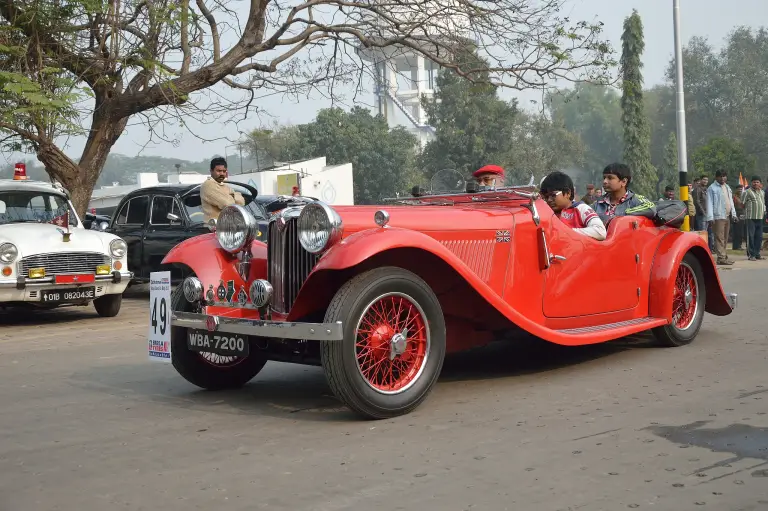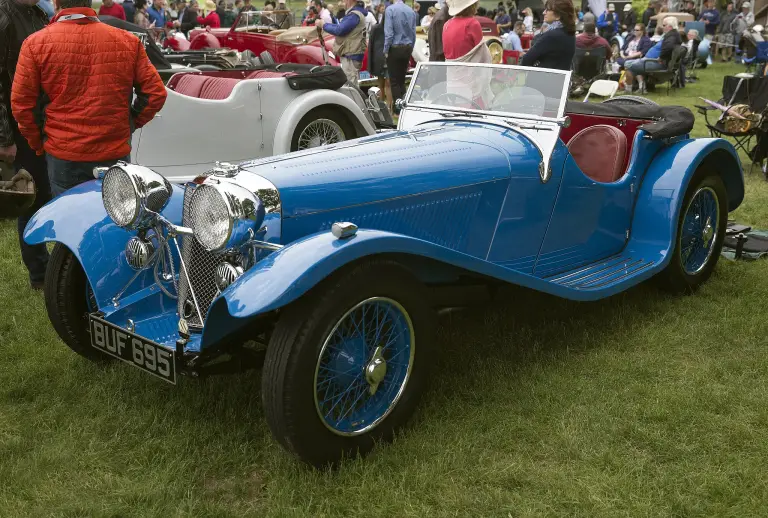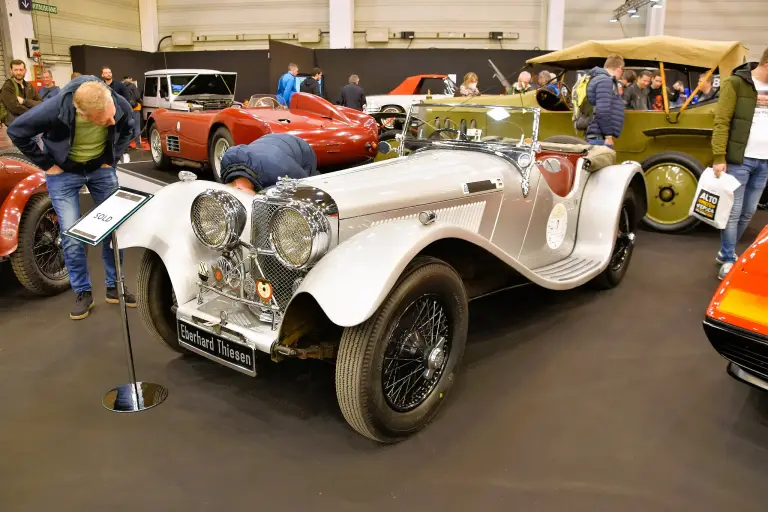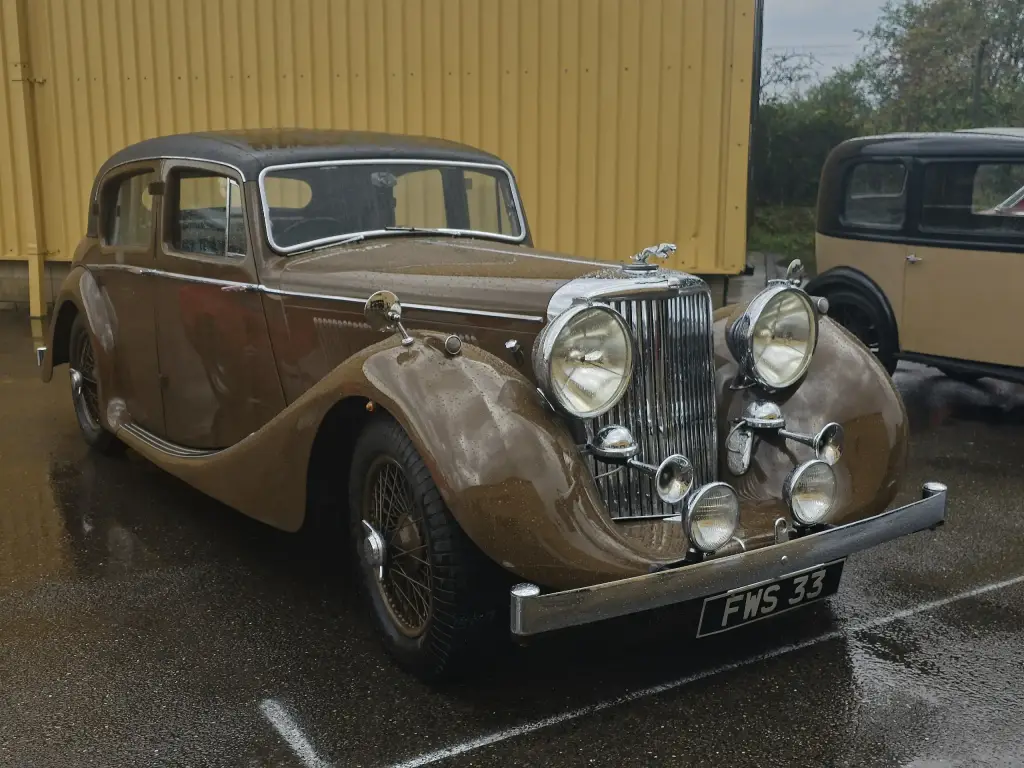
The SS Jaguar was the saloon range that carried the Jaguar name for the first time. Built by SS Cars Ltd from 1935, it was sold as the SS Jaguar 1½, 2½ and 3½ litre, and after the war as the Jaguar 1½, 2½ and 3½ litre; the Mark IV name was applied later to distinguish it from the Mark V.
SS Jaguar at a glance
| Maker | SS Cars Ltd, Coventry (Jaguar Cars Ltd from 1945) |
|---|---|
| Production | 1935–1940 and 1945–1949 |
| Models | SS Jaguar / Jaguar 1½, 2½ and 3½ litre saloons |
| Bodies | saloon; drophead coupé (1½ pre-war, 2½ and 3½ in both periods) |
| Engine, 1½ | 1,608 cc side-valve; 1,776 cc overhead-valve from 1938 |
| Engine, 2½ | 2,663 cc overhead-valve, 102–105 bhp |
| Engine, 3½ | 3,485 cc overhead-valve, 125 bhp |
| Chassis | separate frame, semi-elliptical springs, rigid axles |
| Wheelbase | 3,020 mm (2½), 3,050 mm from 1938 |
| Brakes | Girling, mechanically operated |
| Top speed | 110–150 km/h depending on engine |
| Built | 26,130 cars in total, 1935–1949 |
The Mark IV name was applied retrospectively; the cars were sold as the SS Jaguar before the war and as the Jaguar 1½, 2½ and 3½ litre afterwards.
History of the SS Jaguar
The range appeared in the autumn of 1935 as the S.S. Jaguar 1½ Litre and S.S. Jaguar 2½ Litre, four-door saloons that succeeded the S.S. 1 and S.S. 2. Before the war the Jaguar name was used on all cars built by SS Cars Ltd: the saloons were SS Jaguar 1½, 2½ or 3½ litre, and the two-seat sports cars were the SS Jaguar 100. In March 1945 the company became Jaguar Cars Ltd, and the same cars continued as Jaguars. The Mark IV name came later, retrospectively, to separate them from the Mark V. All were built on a separate chassis frame with semi-elliptical leaf springs on rigid axles front and rear.
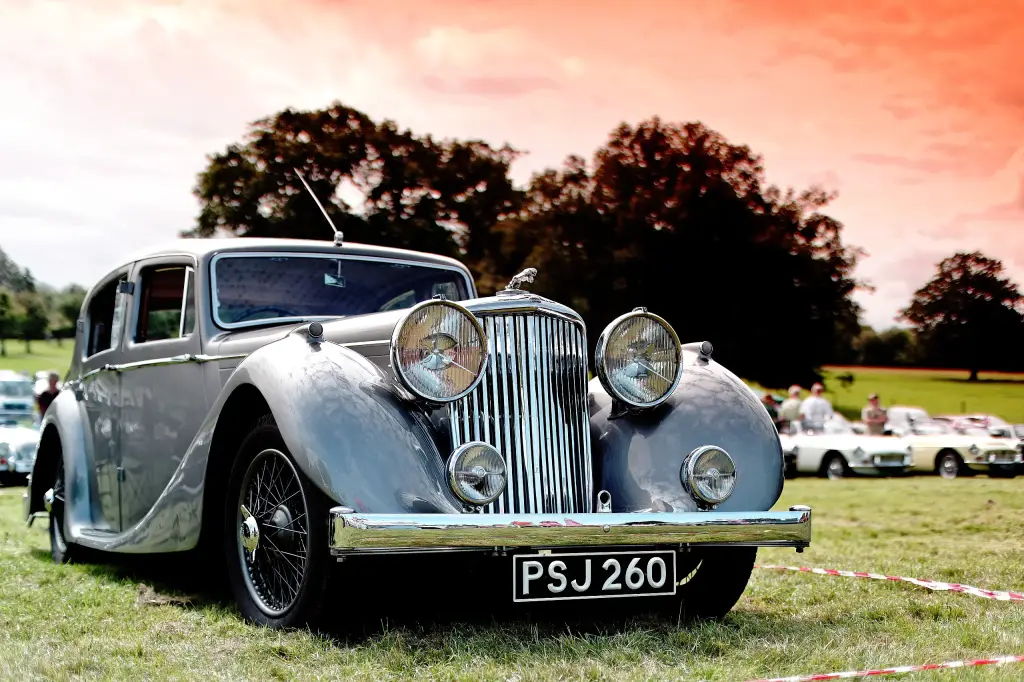
SS Jaguar 1½ Litre
The smallest model began with a 1,608 cc side-valve Standard engine; from 1938 it was replaced by a 1,776 cc overhead-valve unit, also from Standard, which supplied the four-speed gearbox as well. Before the war the car came as a saloon or a drophead coupé, but after the war only the closed body was made. Body construction was steel on wood until 1938, when it changed to all steel. Performance was not a strong point, though 70 mph was possible; the cabin was the same size and finish as its bigger-engined sisters, and a contemporary report called the four-cylinder car “as is often the case … the sweetest running car”. Brakes were mechanically operated Girling units.
SS Jaguar 2½ Litre
The six-cylinder engine also came from Standard, but was redesigned with overhead valves and a cylinder head developed with advice from Harry Weslake, lifting output to 105 bhp. The chassis was 3,020 mm long and grew by 25 mm to 3,050 mm in 1938; the extra length served the six-cylinder engine while passenger space stayed the same. Unlike the 1½ Litre, some drophead models were made after the war, and the top speed was about 140 km/h.
SS Jaguar 3½ Litre
Introduced in 1938, the 3½ Litre used essentially the same body and chassis as the 2½ Litre but with a 3,485 cc engine of 125 bhp. It was faster — about 150 km/h — at the expense of economy, and its rear axle ratio was 4.25:1 instead of 4.5:1. Production stopped in 1940 because of the war, and pre-war output came to 7,335 1½-litre, 5,407 2½-litre and 1,308 3½-litre cars. After the war Jaguar built 5,761 of the 1½-litre, 1,749 2½-litre saloons with 101 dropheads, and 3,860 3½-litre saloons with 498 dropheads. Total production of the range is given as 26,130 cars between 1935 and 1949. Left-hand drive was offered for the first time from the third series, and the Mark V succeeded the range.
Design and features
- Three engines: a four-cylinder 1½ litre and six-cylinder 2½ and 3½ litre units, all based on Standard designs.
- Separate chassis: a traditional frame with leaf springs and rigid axles at both ends.
- Steel body from 1938: the wood-framed construction gave way to all-steel bodies.
- The Jaguar name: the range introduced the name that became the company’s own in 1945.
SS Jaguar versions
- 1½ Litre: 1,608 cc side-valve, then a 1,776 cc overhead-valve engine from 1938.
- 2½ Litre: 2,663 cc overhead-valve six with about 105 bhp.
- 3½ Litre: 3,485 cc, 125 bhp, introduced in 1938.
- Drophead coupés: offered before the war and, for the six-cylinders, after it.
- Post-war saloons: the same cars sold as Jaguars until the end of the 1940s.
The SS Jaguar succeeded the SS 1 and shared its sports sibling with the SS Jaguar 100 and the earlier SS 90. More cars are in the S.S. collection.
Sources
- Jaguar Mark IV, English Wikipedia: model range, engines, chassis
- Jaguar Mark IV, German Wikipedia: production figures, dimensions, equipment
- Jaguar Mark IV, Italian Wikipedia: versions and performance
- Jaguar Mark IV, French Wikipedia: history and body construction