Rudge-Whitworth was a British maker of bicycles, saddles, motorcycles and wire wheels, created in 1894 when two bicycle companies joined forces. Its motorcycles of 1911–1946 were known for engine and transmission innovations and for racing success, while its centre-lock wire wheel became a fixture on sports cars on both sides of the Atlantic.
Rudge-Whitworth at a glance
| Formed | 1894, merger of Whitworth Cycle Co and Rudge Cycle Co |
|---|---|
| Headquarters | Coventry |
| Founders | Charles Henry Pugh and sons (Whitworth); Daniel Rudge’s company (Rudge) |
| Products | bicycles, saddles, motorcycles, wire wheels |
| Motorcycles | 1911–1946 |
| First own motorcycle | 1911, 500 cc F-head single |
| Detachable wire wheel | 1907, patent granted 1908 |
| Isle of Man TT 1908 | 21 of 35 entrants used Rudge-Whitworth wheels |
| Sales motto | “Rudge it, do not trudge it” |
| Italian licence | Rudge Whitworth Milano, founded 1922 by Carlo Borrani |
| Bicycle record | Billie Fleming, 29,603.7 miles in 1938 |
The English, German, Italian and French Wikipedia articles on Rudge-Whitworth describe the company and its products; there is no separate page for the Rudge-Whitworth name itself.
History of the Rudge-Whitworth
Two bicycle makers become one
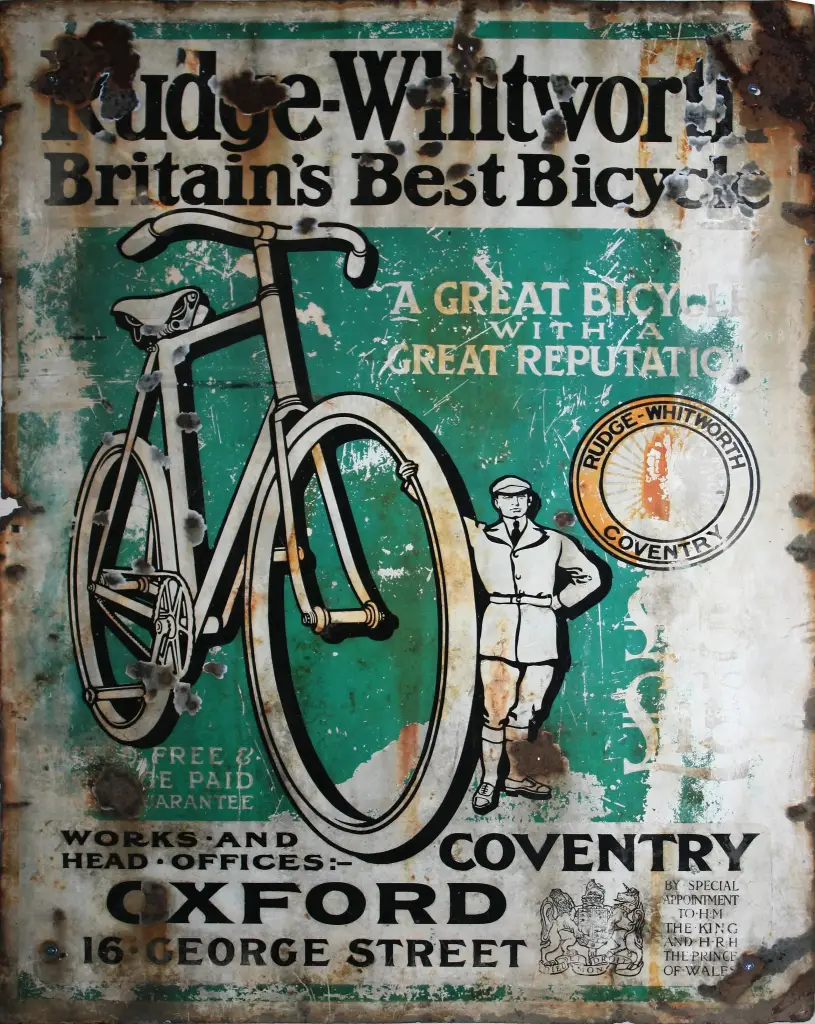
Rudge-Whitworth was created in 1894 by the merger of two bicycle manufacturers: Whitworth Cycle Co of Birmingham, founded by Charles Henry Pugh with his sons Charles Vernon and John, and Rudge Cycle Co of Coventry, which descended from a bicycle company founded by Daniel Rudge of Wolverhampton. The new firm set up in Coventry and carried on making bicycles and bicycle saddles. The name was already familiar in racing: in 1894 riders including Charles Terront, Henri Farman and Paul Baras competed on Rudge and Whitworth machines.
The wheel that came off in seconds
In the early 1900s John Pugh, son of the founder and a pioneer motorist, looked for a better way of dealing with a punctured tyre than changing it with the wheel still bolted to the car. He and Victor Riley of the Riley Cycle Company both designed a detachable wheel locked in place by a single large nut, and Pugh was granted a patent for his version in 1908. The two firms fought over the rights, and Pugh lost the final appeal in the House of Lords. The design itself was a success: it used a splined hub and two cones, one centring the wheel at the inner end and the other built into the nut, and it was self-tightening, with left-hand threads on the right-hand side of the car. At the 1908 Isle of Man TT, 21 of the 35 entrants used Rudge-Whitworth wheels, and by 1913 detachable wire wheels were universal in Grand Prix racing. After the Second World War the rights to the Rudge-Whitworth wheel passed to Jaguar Cars, and wheels of this pattern were still being made in the 1960s.
The Italian connection came in 1922, when Carlo Borrani founded Rudge Whitworth Milano to build Rudge wheels under licence for cars and motorcycles; in the late 1930s the business became Carlo Borrani S.p.A.
Motorcycles from 1911
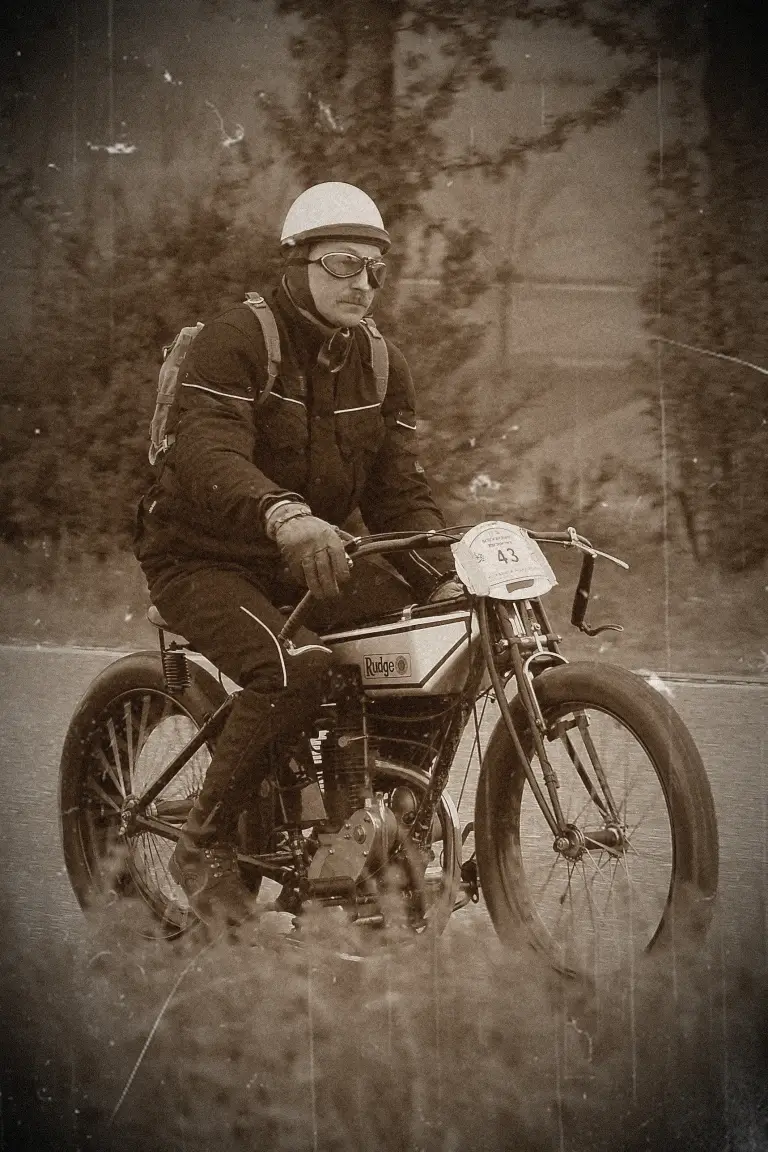
Rudge began by selling re-badged Werner motorcycles in 1909 and built its first own machine in 1911, a single-cylinder 500 cc with an F-head engine. A 1,000 cc model with a Jardine four-speed gearbox followed in 1915, alongside a 1,000 cc Multigear. In 1923 the company replaced the Jardine gearbox with a four-speed of its own design. Between 1912 and 1913 Rudge also built a small cyclecar: a low two-seater with an air-cooled 750 cc single, the Multi-Gear transmission and belt drive to the rear axle, made for less than a year.
The end of the marque
The 1930s brought trouble. Bankruptcy threatened in 1933, and the end came in 1936 with the death of John Vernon Pugh, the last survivor of the founding generation. The Coventry works was bombed in 1940, which put an end to motorcycle production, although the English Wikipedia dates Rudge motorcycles to 1946. Afterwards the wheel business continued under other owners, and the trace of the original company is lost after 1961.
Design and features
- Centre-lock wire wheel: patented by John Pugh in 1908 and supplied to racing teams and sports car makers for half a century.
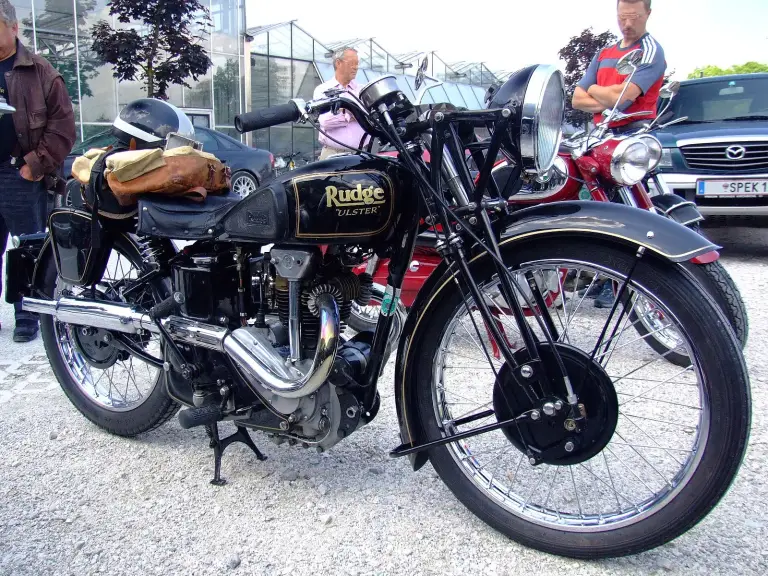
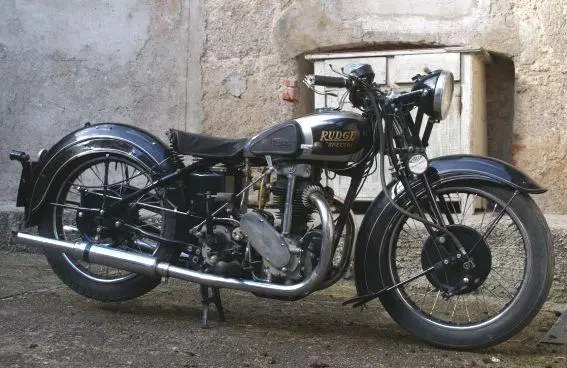
- Engine innovation: from the F-head single of 1911 to the four-valve and radial-valve heads of the 1920s and 1930s.
- Racing reputation: Rudge machines won at the Isle of Man and in the Ulster Grand Prix, and the firm sold replicas of its racers.
- A name on two wheels and four: bicycles, motorcycles, cyclecars and wheels all carried the Rudge-Whitworth name.
Rudge-Whitworth versions
- Bicycles and saddles: the original business of both parent companies, continued after 1894.
- Wire wheels: the detachable centre-lock wheel from 1907, later licensed in Italy and used by Jaguar.
- Motorcycles (1911–1946): singles and four-valve models, including the Multi, the Four and the Special.
- Cyclecar (1912–1913): an air-cooled 750 cc two-seater with Multi-Gear transmission.
Individual Rudge models are described in the articles on the Rudge Multi and the Rudge Four. More machines are in the Rudge collection.
Sources
- Rudge-Whitworth, English Wikipedia: history, wire wheels, motorcycles
- Rudge, German Wikipedia: company history, cyclecar, end of production
- Rudge, Italian Wikipedia: Rudge Whitworth Milano, model history
- Rudge-Whitworth, French Wikipedia: formation, early racing