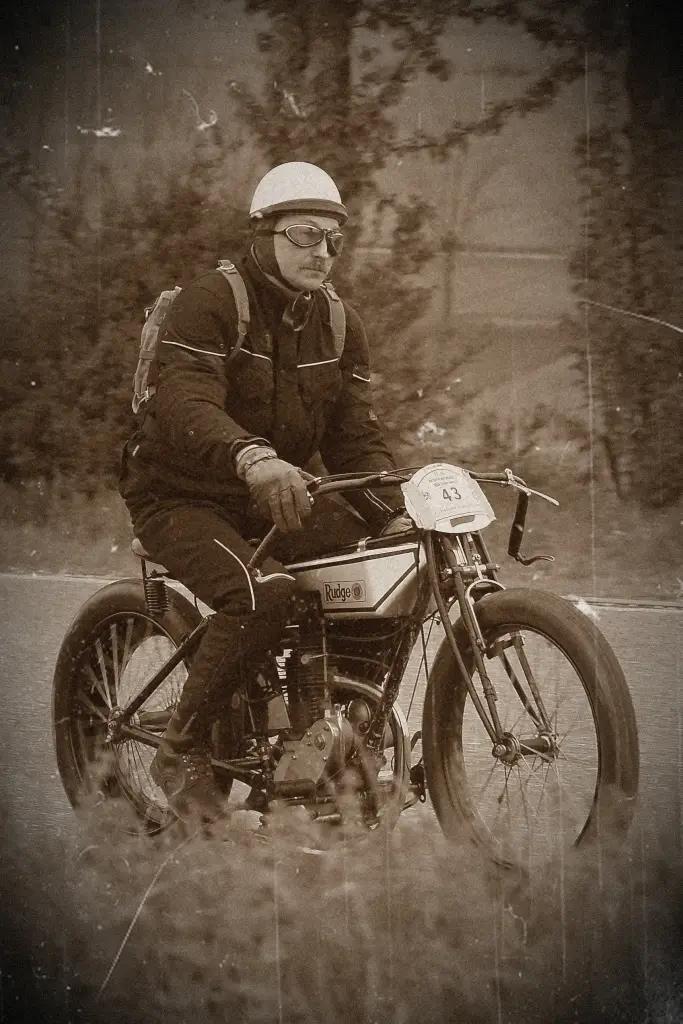
The Rudge Multi replaced the motorcycle gearbox with a pair of pulleys whose grooves changed depth as they turned, giving the rider 21 forward ratios and a stepless change between them. Introduced in 1912 on a 499 cc belt-driven single, it won the Isle of Man TT two years later and is regarded as one of the first continuously variable transmissions.
Rudge Multi at a glance
| Maker | Rudge-Whitworth, Coventry |
|---|---|
| Introduced | 1912 |
| Original engine | 499 cc single cylinder |
| Drive | belt |
| Transmission | variable groove-depth pulleys |
| Gear ratios | 21 forward |
| Top gear | as high as 2.75:1 |
| 750 cc Multi | 1913 |
| 1,000 cc Multigear | 1915 |
| TT victory | 1914, Cyril Pullin, Isle of Man |
| Production ended | 1923 |
The Rudge Multi is described in a section of the English, Italian and German Wikipedia articles on Rudge-Whitworth; this page uses those sections.
History of the Rudge Multi
A transmission without gears
Rudge released the Multi in 1912. Instead of a gearbox the 499 cc single used a belt drive and two pulleys with variable groove depth: as the pulleys altered their effective diameter, the belt rode higher or lower and the ratio changed smoothly. The result was 21 forward gear ratios, with top gear as high as 2.75:1. The idea was not unique — the Zenith Gradua and the 1907 FN 244 cc single used similar systems — but it was unusual enough that the Multi stands with the Zenith-Gradua among the first continuously variable transmissions.
Bigger engines and a TT win
A 750 cc Multi followed in 1913, and Rudge also built a small cyclecar with an air-cooled 750 cc single and the same Multi-Gear transmission, made for less than a year between 1912 and 1913. In 1914 Cyril Pullin won the Isle of Man TT on a Rudge Multi, the most conspicuous proof of the system’s worth. In 1915 Rudge added a 1,000 cc model with a Jardine four-speed gearbox, then a 1,000 cc Multigear alongside it.
The end of the Multi
For a while the Multi and conventional gearboxes existed side by side. That changed in 1923, when Rudge introduced a four-speed gearbox of its own design to replace the Jardine: Multigear production ended that year, and the company moved on to the Rudge Four with its four-speed gearbox and four-valve head.
Design and features
- Variable pulleys: groove-depth changes altered the drive ratio without a gearbox or discrete gears.
- 21 ratios: a very wide spread for a motorcycle of 1912, with top gear as high as 2.75:1.
- Belt final drive: the Multi used a belt rather than a chain.
- Proven in racing: Cyril Pullin’s victory in the 1914 Isle of Man TT.
- An early CVT: one of the first stepless transmissions on a production vehicle.
Rudge Multi versions
- 499 cc Multi (1912): the original belt-driven single.
- 750 cc Multi (1913): the larger-engined version.
- 1,000 cc Multigear (1915): the biggest engine offered with the variable transmission.
- Rudge cyclecar (1912–1913): a small two-seater using the same Multi-Gear system.
The Multi was replaced in the range by the Rudge Four, and the company behind it is described in the Rudge-Whitworth article. More machines are in the Rudge collection.
Sources
- Rudge-Whitworth, English Wikipedia: Rudge Multigear section
- Rudge, Italian Wikipedia: Multi transmission and ratios
- Rudge, German Wikipedia: Multi Gear and cyclecar