The Rudge Four took its name from two things: a four-speed gearbox and a four-valve cylinder head. Introduced with a 350 cc single in 1924, it was faster than the 500 cc machine it replaced and made the four-valve layout the basis of Rudge motorcycles for the rest of the 1920s.
Rudge Four at a glance
| Maker | Rudge-Whitworth, Coventry |
|---|---|
| Introduced | 1924, with a 350 cc single |
| Name | four speeds and four valves |
| Engine | single cylinder, four-valve head, valves arranged in parallel |
| Designer of the head | George Hack |
| Inspiration | the four-valve Triumph Ricardo of 1921–1928 |
| 500 cc version | from 1925, with linked front and rear brakes |
| Oil feed | through the crankshaft pin from 1925 |
| 350 cc dropped | 1926 |
| Later changes | saddle tanks and 8-inch drum brakes for 1928 |
| Dirt-track version | Glanfield Rudge, marketed from 1928 |
The Rudge Four is described in a section of the English and Italian Wikipedia articles on Rudge-Whitworth; this page uses those sections.
History of the Rudge Four
A head with four valves
The Rudge Four arrived in the early 1920s, when Rudge-Whitworth replaced the Jardine gearbox with its own four-speed and, in 1923, ended production of the Multi with its variable pulleys. The new model was a 350 cc single with a four-valve cylinder head. Rudge engineer George Hack is said to have taken the idea from the four-valve Triumph Ricardo, built between 1921 and 1928: he designed a four-valve head for Rudge, and in 1924 the company put its first four-valve cylinder head on a 350 cc engine. The valves were arranged in parallel rather than radially.
More power than a 500
On its release the 350 cc Rudge Four was markedly superior to its competition and had more power than the 500 cc model it followed. In 1925 Rudge added a 500 cc version with linked front and rear brakes, and the big-end bearings were now fed oil through the crankshaft pin rather than by an external supply. The old 350 cc was dropped in 1926, leaving the 500 to carry the four-valve engine.
The four-valve years
The four-valve layout stayed at the centre of the Rudge range. For 1928 the motorcycles were fitted with saddle tanks and 8-inch internal expanding drum brakes, and in the same year Stanley Glanfield designed a Rudge for dirt racing, marketed from 1928 as the Glanfield Rudge. Racing success followed: in 1928 Graham Walker won the Ulster Grand Prix at an average of over 80 mph, and Rudge finished first, second and third in the 1930 Junior TT with prototype radial 350 cc four-valve engines. The parallel four-valve 350 cc and the JAP-engined 250 cc ended production in 1930, as the radial-valve layout took over.
Design and features
- Four-valve head: designed by George Hack after the Triumph Ricardo, with the valves in parallel rather than radial.
- Four-speed gearbox: Rudge’s own unit, introduced to replace the Jardine gearbox.
- Strong performance: the 350 cc Four had more power than the 500 cc model that came before it.
- Linked brakes: fitted to the 500 cc version from 1925.
- Oil through the crankpin: a change to big-end lubrication introduced in 1925.
Rudge Four versions
- 350 cc Four (1924–1926): the original four-valve single.
- 500 cc Four (from 1925): the larger engine with linked brakes and crankpin oil feed.
- Glanfield Rudge (from 1928): Stanley Glanfield’s dirt-track version.
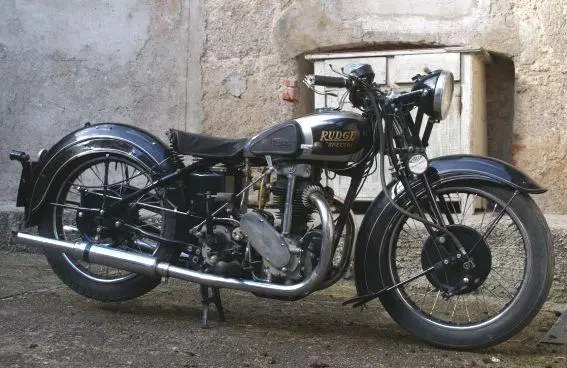
The Four followed the Rudge Multi in the range and shared the four-valve idea with later models such as the Rudge Special. The company itself is described in the Rudge-Whitworth article; more machines are in the Rudge collection.
Sources
- Rudge-Whitworth, English Wikipedia: Rudge Four section, racing
- Rudge, Italian Wikipedia: introduction of the Four and the four-valve head
- Rudge, German Wikipedia: company background