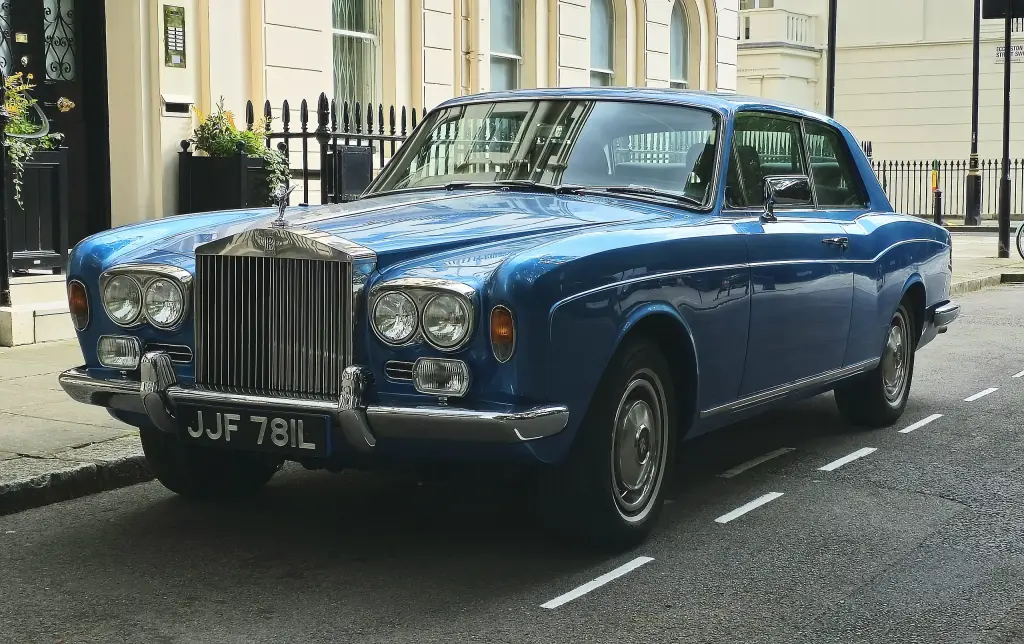
The Rolls-Royce Silver Shadow, and the slightly stretched Silver Wraith II, were full-size luxury cars built from 1965 to 1980. The Shadow was the first Rolls-Royce with fully slab-sided unitary construction and all-round independent suspension, and with 30,057 cars it was the most numerous model the marque had produced.
Rolls-Royce Silver Shadow at a glance
| Maker | Rolls-Royce Ltd., Crewe |
|---|---|
| Production | Silver Shadow 1965–1976; Silver Shadow II 1977–1980 |
| Built | 30,057, plus 2,336 Bentley T-series |
| Body | unitary, four-door saloon, two-door saloon and convertible |
| Engine | 6.2-litre V8 1965–1969; 6.75-litre V8 1970–1980 |
| Output | 172 hp (128 kW) then 189 hp (141 kW) |
| Gearbox | General Motors Turbo-Hydramatic 400 automatic |
| Suspension | independent, hydropneumatic self-levelling licensed from Citroën |
| Brakes | discs all round, dual-circuit |
| Length | 5,170 mm (203.5 in) |
| Weight | 2,100 kg (4,700 lb) |
| Price | £6,557 in the first year |
This page is based on English Wikipedia only, so the figures could not be checked against a second source.
History of the Rolls-Royce Silver Shadow
Planning a smaller Rolls
The idea of a smaller unitary Rolls-Royce had been considered since the early 1960s, when demand for traditional coachbuilt models was falling. Rolls-Royce worked with BMC on a range of smaller saloons and coupés and developed a series of projects, including the Rolls-Royce/Bentley Java with a 3,909 cc six derived from the B-series engine and the Bentley Burma, which was closer to what became the production car. All of these were cancelled in 1964 and the work was streamlined into a single programme known as SY, which emerged as the Silver Shadow and Bentley T-series.
Design and construction
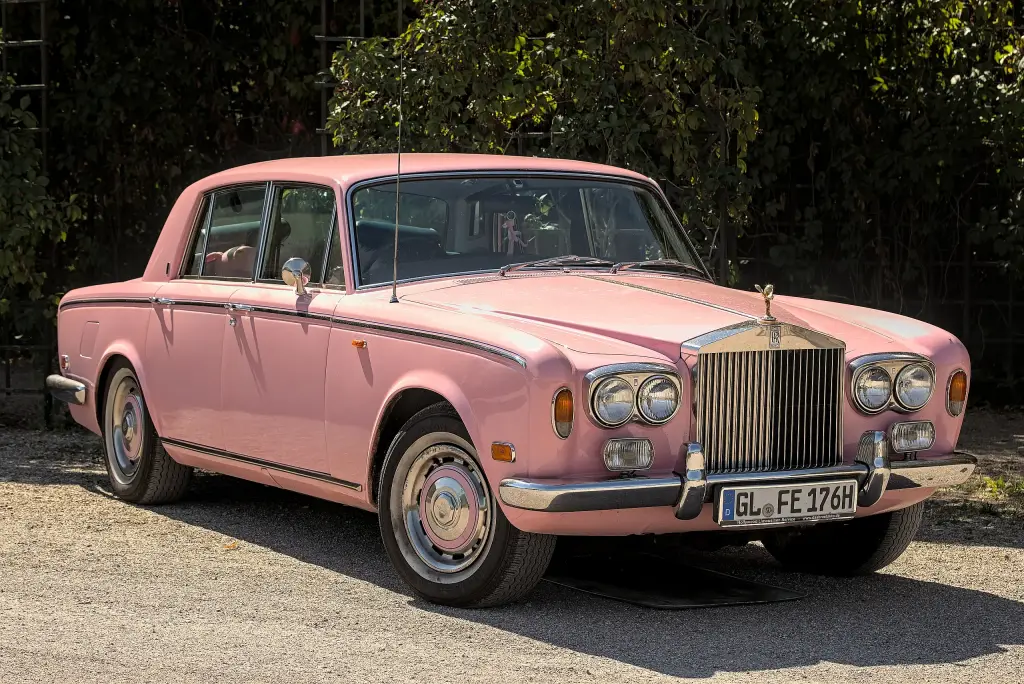
The car was originally to be called Silver Mist, changed at the last minute to Silver Shadow because Mist means manure in German. It was modernised in response to concerns that the company was falling behind, above all by adopting unitary construction; with no experience in the field Rolls-Royce contracted the body engineering to Pressed Steel Fisher, and the body-in-white was built at Cowley before being transported to Crewe for final assembly. The John Polwhele Blatchley design was a major departure from the Silver Cloud: the Shadow was 3½ inches narrower and 7 inches shorter, yet offered more passenger and luggage space thanks to unitary construction and the full-width slab-sided body. It had disc brakes instead of drums and independent rear suspension in place of the live axle. The standard car measured 203.5 inches (5,170 mm), weighed 4,700 lb (2,100 kg) and cost £6,557 in its first year.
Engineering
The Shadow used a 6.2-litre V8 of 172 hp (128 kW) from 1965 to 1969 and a 6.75-litre V8 of 189 hp (141 kW) from 1970 to 1980; no official outputs were quoted, but registration authorities in many markets required them. Left-hand-drive cars used the recently introduced General Motors Turbo-Hydramatic 400 automatic. Before 1970 right-hand-drive cars had a highly modified aluminium-cased version of the original cast-iron four-speed Hydra-Matic built at Crewe under GM licence since 1953; export right-hand-drive cars gained the Turbo-Hydramatic 400 from 1968, and by 1970 the four-speed had gone even in Britain. A distinctive feature was a high-pressure hydropneumatic suspension licensed from Citroën, with dual-circuit braking and hydraulic self-levelling; the front levelling was deleted in 1969 because the rear did almost all the work. The arrangement gave a high degree of ride quality.
Two-door versions and the Corniche
Between 1965 and 1971 two-door cars were sold as the Silver Shadow 2-door saloon and the Silver Shadow Drophead Coupé, a two-door saloon following early in 1966 and a convertible in 1967. In March 1971 these became the Rolls-Royce Corniche Coupé and Convertible, after which the Shadow range was a four-door only. The Silver Shadow II arrived in 1977 and stayed in production until 1980, and a Bentley-badged version, the T-series, was built from 1965 to 1980 in 2,336 examples.
Design and features
- First unitary Rolls-Royce: a slab-sided body with no separate chassis.
- All-independent suspension: with Citroën-licensed hydropneumatic self-levelling.
- Disc brakes: replacing drums, with dual circuits.
- Two V8s: 6.2 litres until 1969, then 6.75 litres.
- Big seller: 30,057 cars, the largest production volume of any Rolls-Royce model.
Rolls-Royce Silver Shadow versions
- Silver Shadow (1965–1976): the original four-door saloon.
- Two-door saloon and Drophead Coupé (1966–1971): later renamed Corniche.
- Silver Shadow II (1977–1980): the second series, sold until the model was withdrawn in 1980.
- Silver Wraith II: the slightly stretched version.
- Bentley T-series (1965–1980): the Bentley-badged equivalent, 2,336 built.
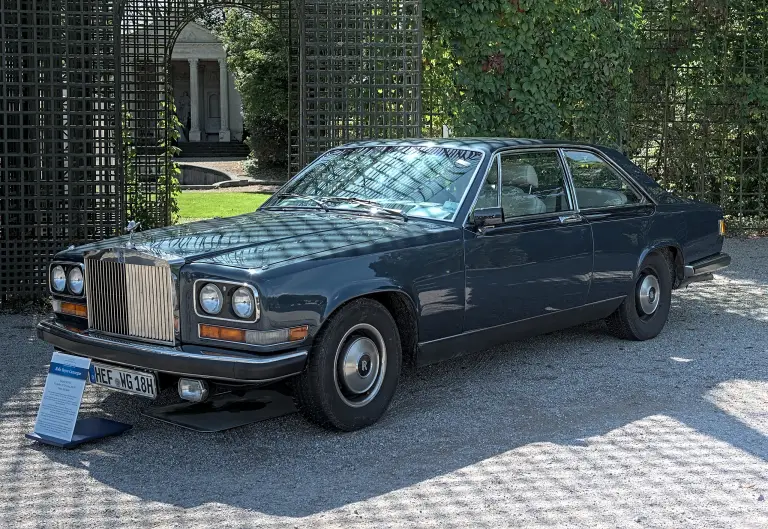
The two-door Shadows became the Corniche, and the Shadow’s platform was shared with the Camargue. More cars are in the Rolls-Royce collection.
Sources
- Rolls-Royce Silver Shadow, English Wikipedia: development, construction, engineering, production