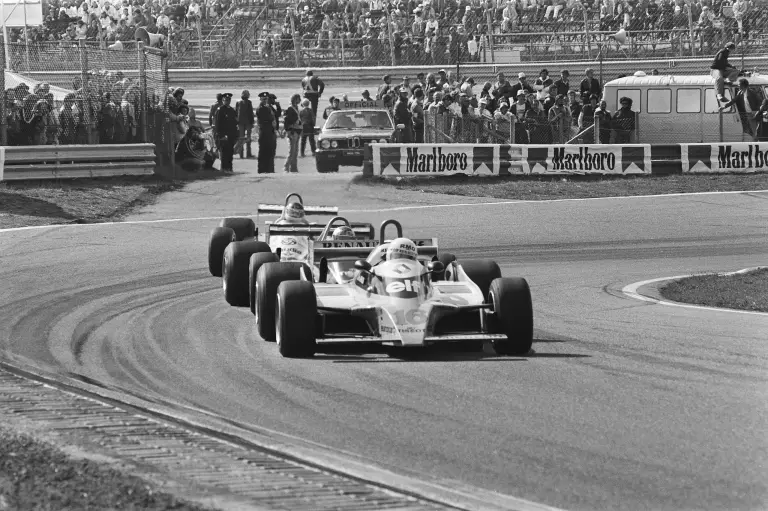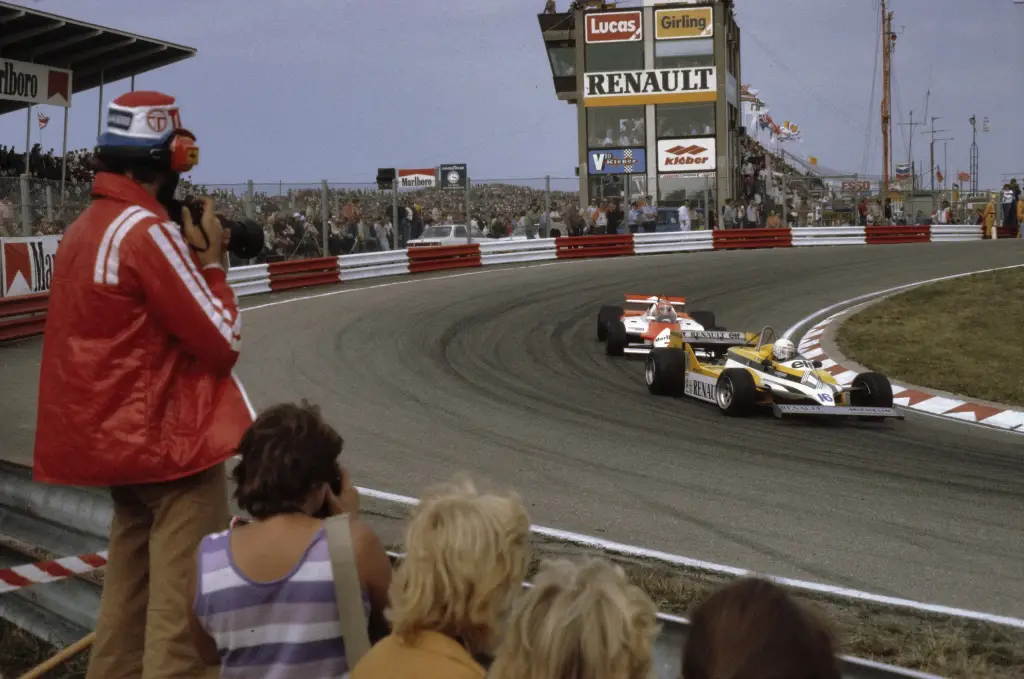
The Renault RE30 was a Formula One car designed by Bernard Dudot and Michel Têtu for the Renault team in the 1981 season. Updated versions, the RE30B and RE30C, were used in 1982 and at the start of 1983.
Renault RE30 at a glance
| Team | Renault, 1981–1983 |
|---|---|
| Designers | Bernard Dudot and Michel Têtu |
| Construction | carbon fibre in parts of the chassis |
| Engine | 1.5-litre turbocharged V6 with twin KKK turbochargers |
| Power | about 540 bhp |
| Aerodynamics | ground effect, with kick-ups ahead of the rear wheels |
| Updates | RE30B for 1982, RE30C for early 1983 |
Based on one source, the English Wikipedia article on the Renault RE30.
History of the Renault RE30
A new design
The RE30 was an entirely different design from its predecessor, the RE20. It used carbon fibre, a material becoming increasingly common in Formula One at the time, in parts of its construction, and had distinctive aerodynamic kick-ups ahead of the rear wheels. The initial version had a full-span front wing.
The engine
The turbocharged engine was developed further to produce around 540 bhp with twin KKK turbochargers. The car had advanced ground-effect technology, with concessions to the new 1981 rules that banned sliding skirts.
Speed without results
The RE30 was quick, probably the quickest car in the field, but it arrived too late in the season to overcome the RE20B’s unreliability in the early races. It was the only car able to pass the very powerful but downforce-lacking Ferrari 126C in a straight line. An updated RE30B was used in 1982 and a further update, the RE30C, at the start of 1983.
Design and features
- Carbon fibre: used in parts of the chassis as the material spread through Formula One.
- Twin KKK turbos: about 540 bhp from the 1.5-litre engine.
- Aerodynamic kick-ups: a signature detail ahead of the rear wheels.
- Straight-line speed: the only car able to pass the Ferrari 126C at speed.
Renault RE30 versions
- RE30 (1981): the original car.
- RE30B (1982): updated version.
- RE30C (1983): further update for the start of the season.
The RE30 replaced the Renault RE20 and was followed by the RS10 era’s successors; Renault’s full history is on the Renault in Formula One page. More cars are in the Renault collection.
Sources
- Renault RE30, English Wikipedia: design, engine, aerodynamics, updates