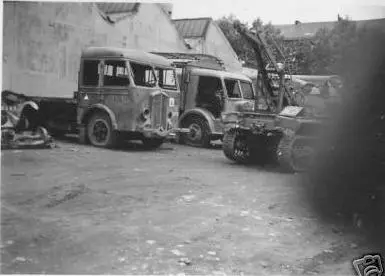
The Renault AGx was a range of light, medium and heavy trucks produced by Renault between 1937 and 1941, including conventional-cab and forward-control models. It is not to be confused with Renault’s later AHx trucks, which replaced it in wartime production.
Renault AGx at a glance
| Maker | Renault, France |
|---|---|
| Production | 1937–1941 |
| Types | conventional cab (AGC, AGT) and forward control (AGK, AGP, AGR) |
| AGC | 1.5 t, 1938–1940, 2.4-litre four of 44 hp |
| AGT | 2.5 t, 1937–1940, 4-litre six of 66 hp |
| AGP | 2.5–3 t, 4-litre petrol or 4.7-litre diesel |
| AGS | 0.4 t commercial and military version of the Primaquatre |
| Gearbox | four-speed manual |
Based on one source, the English Wikipedia article on the Renault AGx.
History of the Renault AGx
The conventional models
The AGC was a conventional-cab light truck with a 1.5-tonne payload built between 1938 and 1940, replacing the Renault ADK. For military use it had a 3,760 mm wheelbase, a length of 5,680 mm in the long version or 5,000 mm, and a width of 1,950 mm; its 2.4-litre four-cylinder engine gave 44 metric horsepower at 2,800 rpm through a four-speed gearbox. Besides a simple truck, the AGC was built as a van and as a 12- to 14-seat bus. The AGT was a conventional-cab 2.5-tonne truck of 1937 to 1940 that replaced the long Renault ADH, with a 4,110 mm wheelbase common to all versions, 6,350 mm length and 2,100 mm width, powered by a four-litre six giving 66 metric horsepower.
Forward control
The AGP was a forward-control light truck with a payload of 2.5 to 3 tonnes, a wheelbase of 2,550 to 3,080 mm and a width of 2,350 mm. It used either a four-litre four-cylinder petrol engine or a 4.7-litre four-cylinder diesel, the diesel cars being known as AGPD; both gave 65 metric horsepower and drove through a four-speed gearbox. The range also included the AGS, a commercial and military version of the Renault Primaquatre with a 0.4-tonne payload.
The trans-Saharan coach
In 1937 the Société Algérienne des Transports Tropicaux ordered a new AGP-based coach for its trans-Saharan passenger service, replacing the heavier Renault AKGD. The design was led by SATT’s chief Georges Estienne, who had already designed a coach on the six-wheeled Renault OX: a van-like streamlined steel body 7,060 mm long with an 85 metric horsepower petrol engine and seven passenger seats. The AGP saw only limited military use.
Design and features
- Wide range: conventional-cab AGC and AGT plus forward-control AGK, AGP and AGR models.
- Petrol and diesel: the AGP could be had with a 4-litre petrol or 4.7-litre diesel four.
- Bus and van bodies: the AGC was also built as a van and a 12- to 14-seat bus.
- Desert coach: a streamlined AGP-based coach served the trans-Saharan route from 1937.
Renault AGx versions
- AGC (1938–1940): 1.5-tonne conventional truck, van and bus.
- AGT (1937–1940): 2.5-tonne conventional truck with a four-litre six.
- AGP and AGPD: forward-control 2.5–3-tonne trucks with petrol or diesel engines.
- AGS: 0.4-tonne Primaquatre-based commercial and military vehicle.
The AGx was followed by the wartime Renault AHx, and its AGS version came from the Renault Primaquatre. More cars and trucks are in the Renault collection.
Sources
- Renault AGx, English Wikipedia: models, payloads, engines, desert coach