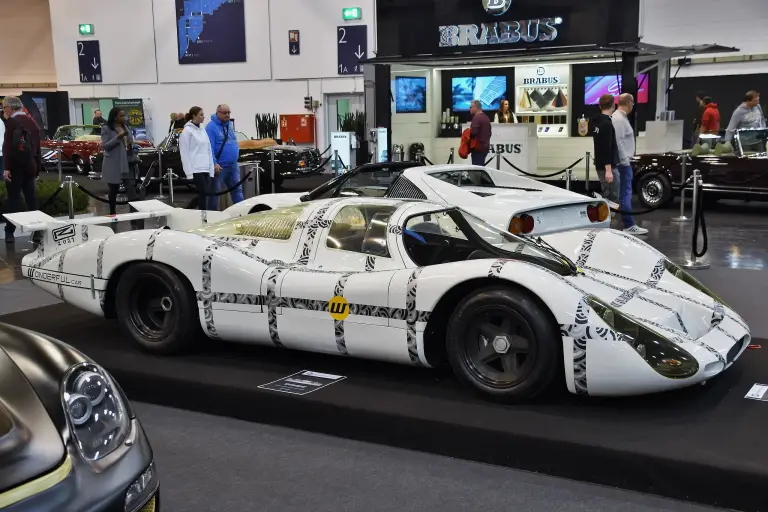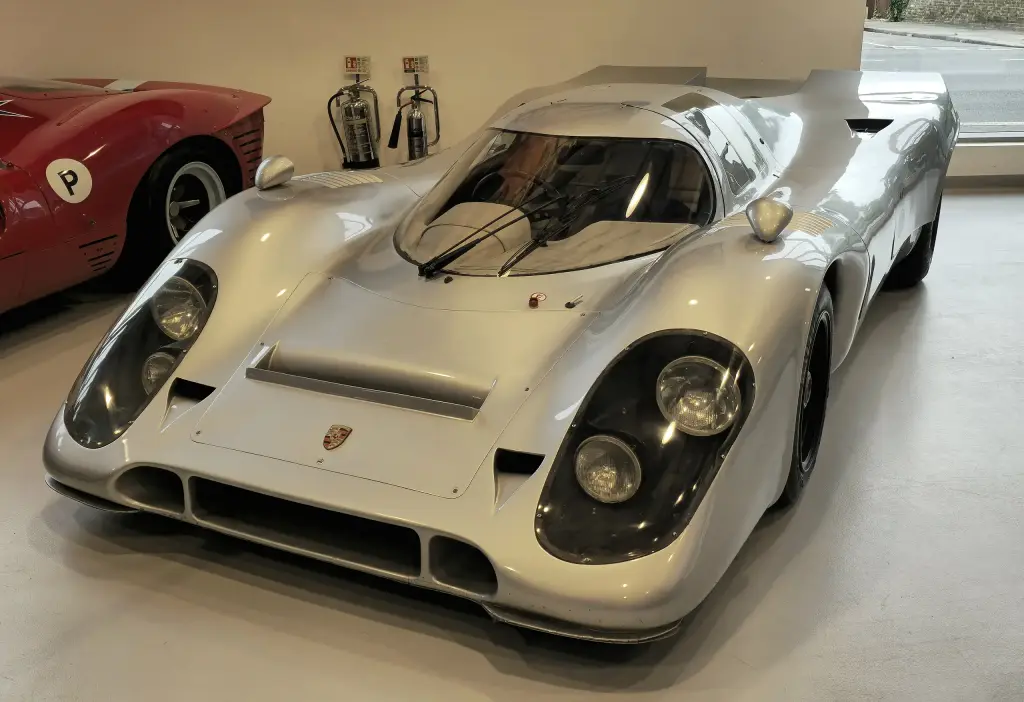
The Porsche 917 is a sports prototype race car developed to exploit the rules for five-litre sports cars. Powered by a Type 912 flat-twelve enlarged from 4.5 to 5.0 litres, it was introduced in 1969, proved difficult at first, and then dominated sports-car racing in 1970 and 1971.
Porsche 917 at a glance
| Maker | Porsche, Stuttgart |
|---|---|
| Introduced | 1969, Geneva Motor Show |
| Designed for | Group 4 sports cars, 5-litre rules |
| Production needed | 25 cars for homologation |
| Chassis | spaceframe of 42 kg, gas-pressurised to show cracks |
| Chassis designer | Helmuth Bott |
| Engine | Type 912 air-cooled flat-twelve, 4.5 litres |
| Engine designer | Hans Mezger |
| Project leader | Ferdinand Piéch |
| Gearbox | Type 920, four or five speeds |
| Price when new | DM 140,000, about ten Porsche 911s |
| Le Mans | overall wins in 1970 and 1971 |
History of the Porsche 917
The 917 came out of a rule change. To slow the unlimited Group 6 prototypes, the Commission Sportive Internationale ran the International Championship of Makes for three-litre cars from 1968 to 1971, but also admitted five-litre Group 4 sports cars of which at least 50 examples had to be built. In April 1968, with few entrants, the minimum was cut from 50 to 25 from 1969. Porsche, which was rebuilding its racers with new chassis every race or two and selling the used cars anyway, saw a way in.
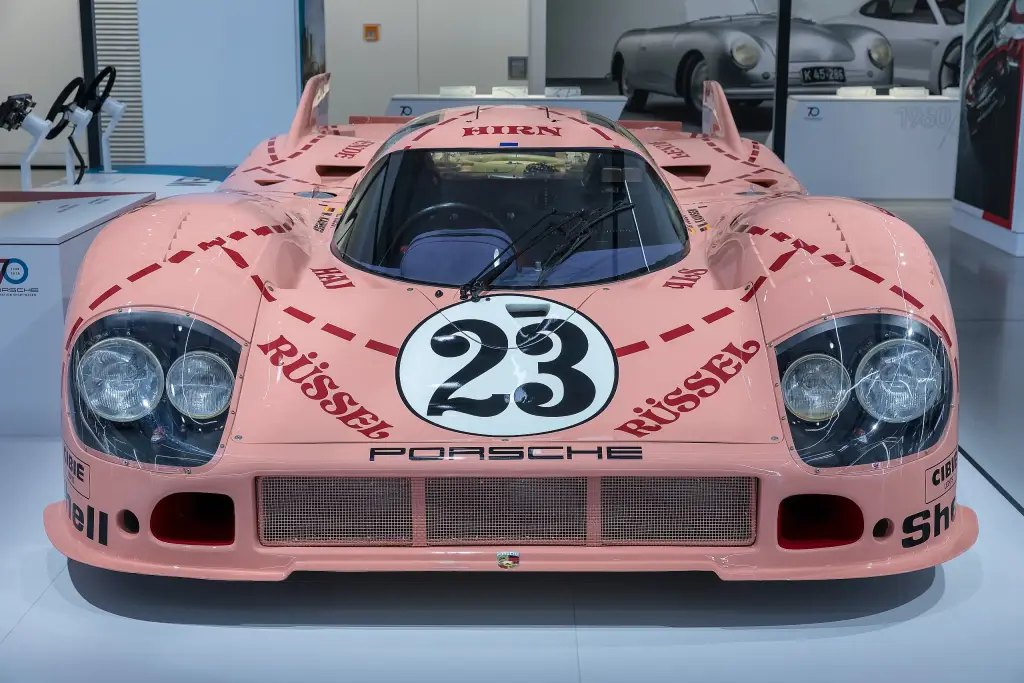
From July 1968 Porsche designed and built 25 examples of an entirely new 4.5-litre car with one aim: its first overall victory at Le Mans on 14 June 1970. The 917 was developed in only ten months on the basis of the 908. When the CSI inspectors first visited, only three cars were complete, with 18 being assembled and seven sets of parts present; Porsche argued that assembling them would only mean taking them apart again, but homologation was refused until 25 working cars could be seen. On 20 April 1969 Piéch lined up 25 917s in front of the factory and offered the inspectors a drive, which they declined.
The car was shown at the Geneva Motor Show on 12 March 1969, painted white with a green nose and a black number 917. The brief literature quoted DM 140,000, roughly £16,000, or about the price of ten Porsche 911s, and that did not cover development costs.
The chassis was designed by Helmuth Bott and the engine by Hans Mezger, both under Piéch. The 917 was built around a very light spaceframe of 42 kg, permanently pressurised with gas so that cracks in the welded structure would show. The new 4.5-litre air-cooled engine was a flat-twelve with six crank throws, each conrod journal shared by a pair of opposed pistons, rather than the twelve of a true boxer, with gear-driven twin overhead camshafts and twin spark plugs fed from two distributors. The large horizontal cooling fan was also driven from centrally mounted gears, and the longitudinally mounted Type 920 gearbox took four or five gears.
To keep the car compact the driving position was pushed so far forward that the driver’s feet were ahead of the front axle. Titanium, magnesium and exotic alloys developed for the Bergspyder hill-climb cars were used throughout; other weight savings were simpler, such as a gear knob of birch wood, and some were clever, such as using the tubular frame itself as oil piping to the front cooler. The glassfibre bodywork saved more weight at the cost of safety, which led James May to call the 917 the world’s fastest canoe. The original cars had a removable long or medium tail with active rear wing flaps; the flaps were banned in May 1969 after Formula One crashes, and the 917 then suffered from rear lift and serious handling problems until the aerodynamics were sorted out. There are at least eleven variants, and the twin-turbocharged 917/30 later dominated Can-Am, where Porsche drivers took the championship in 1972 and 1973.
Design and features
- Flat-twelve engine: a compact 4.5-litre air-cooled unit by Hans Mezger, later enlarged to 5.0 litres.
- 42 kg spaceframe: gas-pressurised so that cracks would show before the frame failed.
- Forward driving position: the driver’s feet sat ahead of the front axle to keep the body small.
- Lightweight engineering: titanium, magnesium, glassfibre and the frame used as an oil pipe.
Porsche 917 versions
- 917 (1969): the original car with a removable long or medium tail and active flaps.
- Short-tail and long-tail developments: part of at least eleven 917 variants built for different circuits.
- 917/30: twin-turbocharged Can-Am car, dominant in 1972–1973.
- 917 PA: the open Can-Am version that preceded the turbocharged cars.
The 917 grew out of the Porsche 908 and was followed by the Porsche 956. More cars are in the Porsche collection.
Sources
- Porsche 917, English Wikipedia: rules, homologation, engineering, racing record