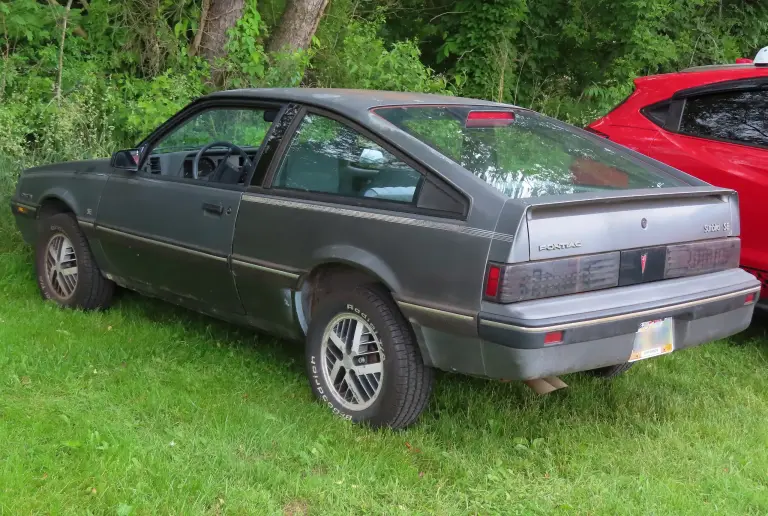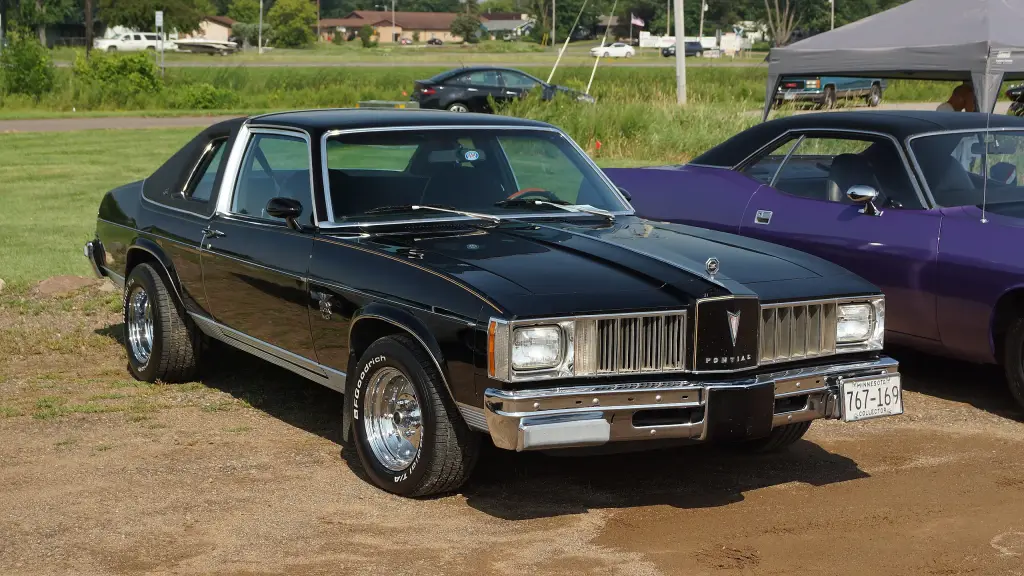
The Pontiac Phoenix was a compact car sold from 1977 to 1984 in two generations, both on the GM X platform and both based on Chevrolet models. The second generation of 1980 was the first front-wheel-drive production Pontiac.
Pontiac Phoenix at a glance
| Maker | Pontiac, General Motors |
|---|---|
| Years | 1977–1984 |
| Generations | two, both GM X platform |
| First generation | 1977–1979, rear-wheel drive |
| Second generation | 1980–1984, front-wheel drive |
| First-gen engines | 2.5 Iron Duke four, 3.8 Buick V6, 5.0 and 5.7 Chevrolet V8s |
| Second-gen engines | 2.5 four and 2.8 V6 |
| Second-gen gearbox | four-speed manual, three-speed automatic optional |
| Bodies, first | two-door coupé, four-door sedan, three-door hatchback from 1978 |
| Bodies, second | two-door coupé and five-door hatchback |
| Replaced by | Grand Am for 1985 |
Based on one source: the English Wikipedia article on the Phoenix.
History of the Pontiac Phoenix
First generation (1977–1979)
The rear-wheel-drive Phoenix arrived for 1977 as an upscale version of the Pontiac Ventura and replaced the Ventura entirely for 1978. It differed from the Ventura only in details such as the grille, square headlights and yellow rear turn signals. It came as a two-door coupé or four-door sedan, with a three-door hatchback from 1978, in base and LJ trim with an optional performance-oriented SJ package. Engines were Pontiac’s new 151 cu in Iron Duke four, a 110 hp 231 cu in Buick V6, a 140 hp 305 cu in Chevrolet V8 and a 350 cu in Chevrolet V8, with three- and four-speed manuals or a three-speed Turbo-Hydramatic.
Second generation (1980–1984)
For 1980 the Phoenix was downsized, moved to the front-wheel-drive X platform and sold as a two-door coupé or five-door hatchback. It was the first front-wheel-drive production model from Pontiac. Base and LJ trims continued with the SJ package, which became a full trim level for 1982; there was a minor exterior refresh and a new PJ model for 1983, and the LJ and SJ became LE and SE for 1984. Engines were the 2.5 litre Iron Duke carried over and a new 2.8 litre LE2 V6, with a four-speed manual as standard and a three-speed automatic optional. The high-output 2.8 litre LH7 V6 was standard in the Phoenix SJ/SE for 1982 and optional elsewhere.
A damaged reputation
Like its sister cars, the Chevrolet Citation, Buick Skylark and Oldsmobile Omega, the Phoenix’s image suffered from poor workmanship, two recalls in 1981 and a dangerous tendency for the rear wheels to lock under emergency braking on the 1980 cars. It was replaced for 1985 by a revived Grand Am on the front-wheel-drive N-body, while its basic architecture lived on in the A-body Pontiac 6000 introduced in 1982.
Design and features
- Two platforms in one life: rear-drive X-body first, front-drive X-body second.
- First front-drive Pontiac: the 1980 car led the division’s move to front-wheel drive.
- V8 option: the first generation could be ordered with Chevrolet 305 and 350 V8s.
- Iron Duke: the 2.5 litre four carried over into the second generation.
- Quality problems: recalls and a rear-wheel locking fault hurt sales.
Pontiac Phoenix versions
- Base and LJ (1977–1983): the standard trims of both generations.
- SJ (1977–1981), full trim from 1982: the sporty package.
- PJ (1983): a one-year trim added in the second generation.
- LE and SE (1984): the renamed LJ and SJ.
The Phoenix replaced the Ventura, shared its architecture with the 6000 and was replaced by the Grand Am. More Pontiacs are in the Pontiac collection.
Sources
- Pontiac Phoenix, English Wikipedia: generations, engines, problems