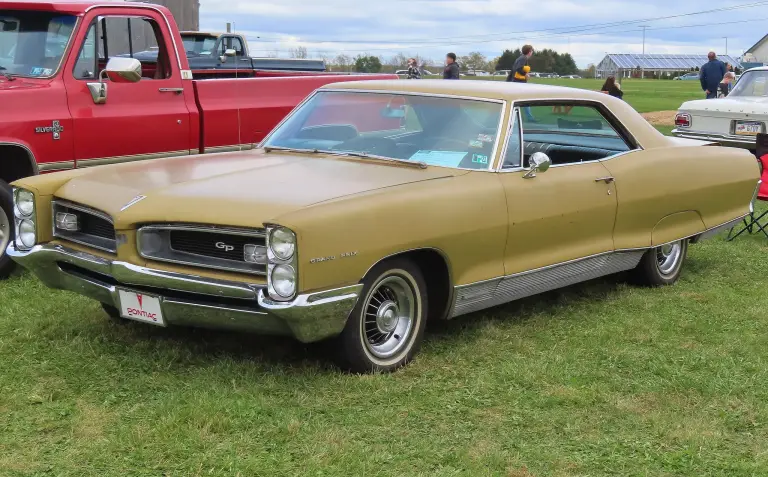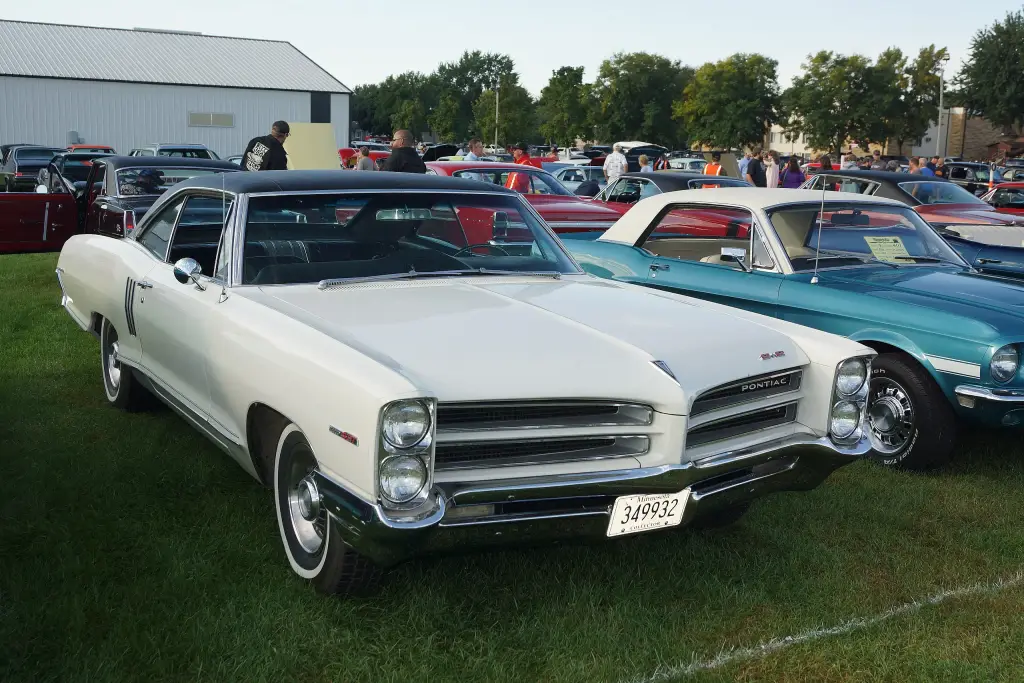
The Pontiac 2+2 is a full-size car built on the GM B-body. It appeared for 1964 as a trim option on the Catalina, with bucket seats, a centre console and its own badging, and Pontiac marketed it as the “big brother” of the GTO.
Pontiac 2+2 at a glance
| Maker | Pontiac, General Motors |
|---|---|
| Production | 1964–1967 in the United States, 1964–1970 in Canada |
| Platform | GM B-body |
| Bodies | two-door hardtop and convertible only |
| 1964 engine | 389 cu in V8, 283 hp, two-barrel carburettor |
| 1965–1966 engine | 421 cu in V8 |
| 1967 engine | 428 cu in V8 |
| 1964 price | $291 option on a $2,869 Catalina hardtop |
| Status | trim option 1964, separate series 1966, option again 1967 |
| Namesake | 1986 Grand Prix 2+2, 1,225 built |
History of the Pontiac 2+2
For 1964 Pontiac offered the 2+2 as a $291 trim option on the base Catalina two-door hardtop, which listed at $2,869. Most of the changes were inside: special door panels, bucket seats and a centre console, plus badges on the fenders, hood and interior. Without those badges the car looked like a standard Catalina. The standard engine was the 389 cu in Trophy V8 with a Rochester two-barrel carburettor, rated at 283 hp, driving through a three-speed transmission with a floor shifter; a four-speed manual and an automatic were extra.
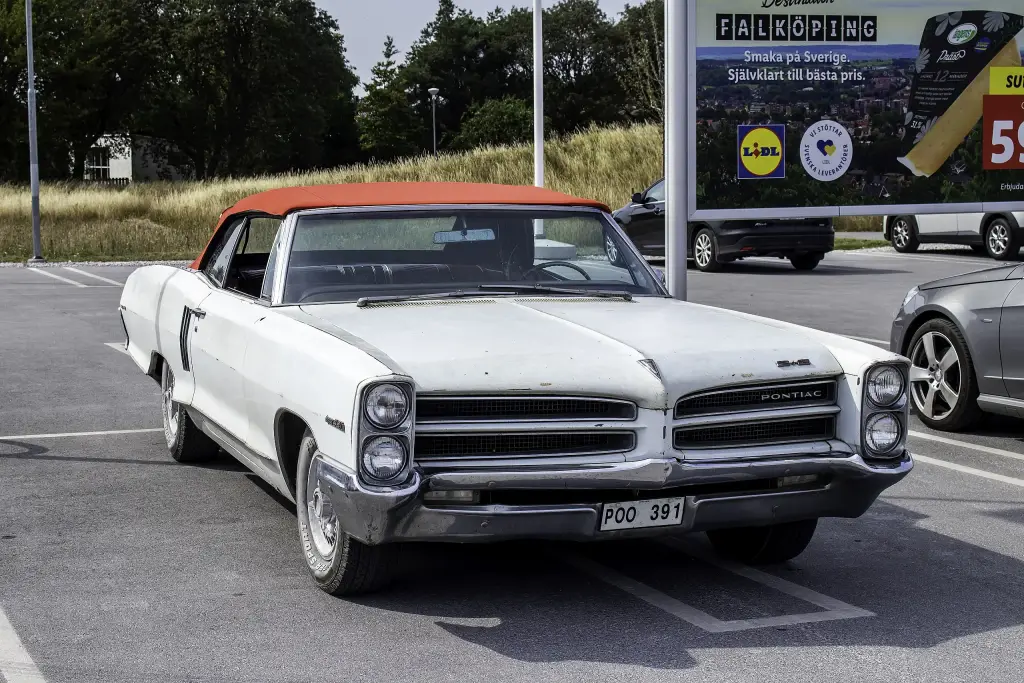
The name was borrowed from European sports car terminology for two seats in front and two in the rear. Pontiac classed the 2+2 officially as a “regular performance” model, and the intention was clear: it was to the Catalina what the GTO was to the LeMans.
A series of its own
From 1965 the word Catalina no longer appeared on the car, although it remained an option on the Catalina. The 389 was replaced by a high-compression 421 cu in V8, and the package now brought dual exhausts, heavy-duty springs and shock absorbers, a performance axle ratio of 3.42:1 and a Turbo-Hydramatic automatic in place of the Hydramatic. In 1966 the 2+2 became a separate Pontiac series, and for 1967 it reverted to an option on the Catalina and was dropped in the United States because of poor sales. The 428 cu in V8 arrived in 1967.
Car and Driver tested a modified Catalina 428 in March 1965 and recorded a top speed of 130 mph and a 0-60 mph time of 3.9 seconds.
The Canadian cars
In Canada the 2+2 continued as a series until 1970, and GM of Canada built it on the Chevrolet B-body shell with Pontiac exterior sheet metal. Buyers could order any Chevrolet engine, from the 283 and 327 small-blocks to the 396 and 427 Mark IV big-blocks, and the cars used Chevrolet 15-inch Rally wheels. Canadian 2+2s were sold under the Parisienne 2+2 name from 1967.
A revived name
The 2+2 name returned briefly in 1986 on the Pontiac Grand Prix 2+2, an aerodynamic G-body coupe of which 1,225 were built. All of them used a 165 hp 305 cu in GM V8 with automatic transmission.
Design and features
- Bucket seats throughout: individual seats for all passengers, with a console-mounted vacuum gauge and an optional tachometer.
- Faux louvers: the quickest way to tell a 2+2 from a Catalina; 1964 was the only year without them.
- Big-block power: a 421 cu in V8 from 1965 and a 428 cu in V8 in 1967.
- Body styles: hardtop coupe and convertible only, never a sedan.
Pontiac 2+2 versions
- 1964 option: a $291 trim package on the Catalina hardtop with the 389 V8.
- 1965–1966 series: the 421 V8, dual exhausts and heavy-duty suspension as standard.
- 1967: back to an option, now with the 428 V8; the last American year.
- Canadian 2+2: Chevrolet B-body shell and Chevrolet engines, built until 1970.
- 1986 Grand Prix 2+2: a 1,225-car aerodynamic coupe with a 305 V8.
The 2+2 was the full-size counterpart of the GTO and shared its body with the Catalina and Bonneville. More models are in the Pontiac collection.
Video: 1965 Pontiac 2+2 – Stock #5923 – Gateway Classic Cars St. Louis
Video by GatewayClassicCars on YouTube.
Sources
- Pontiac 2+2, English Wikipedia: dates, engines, prices, Canadian versions