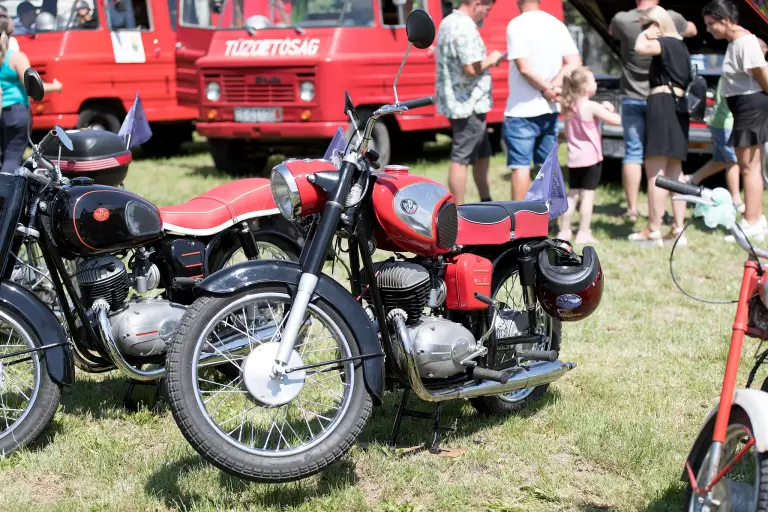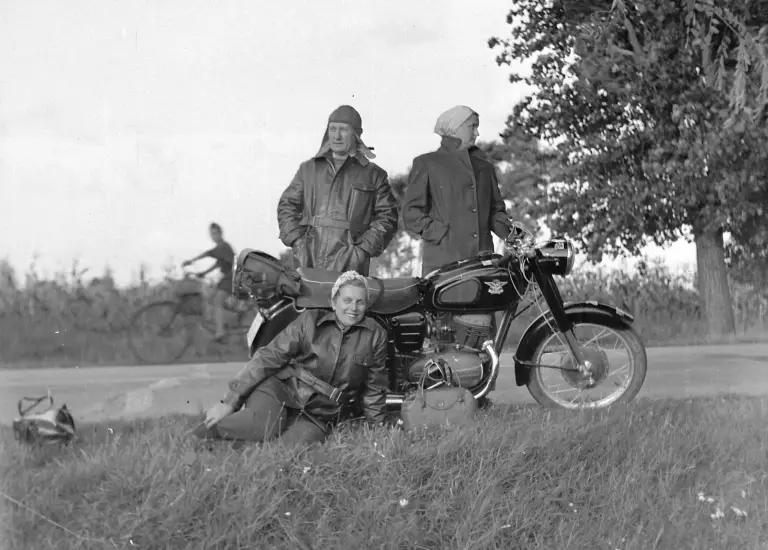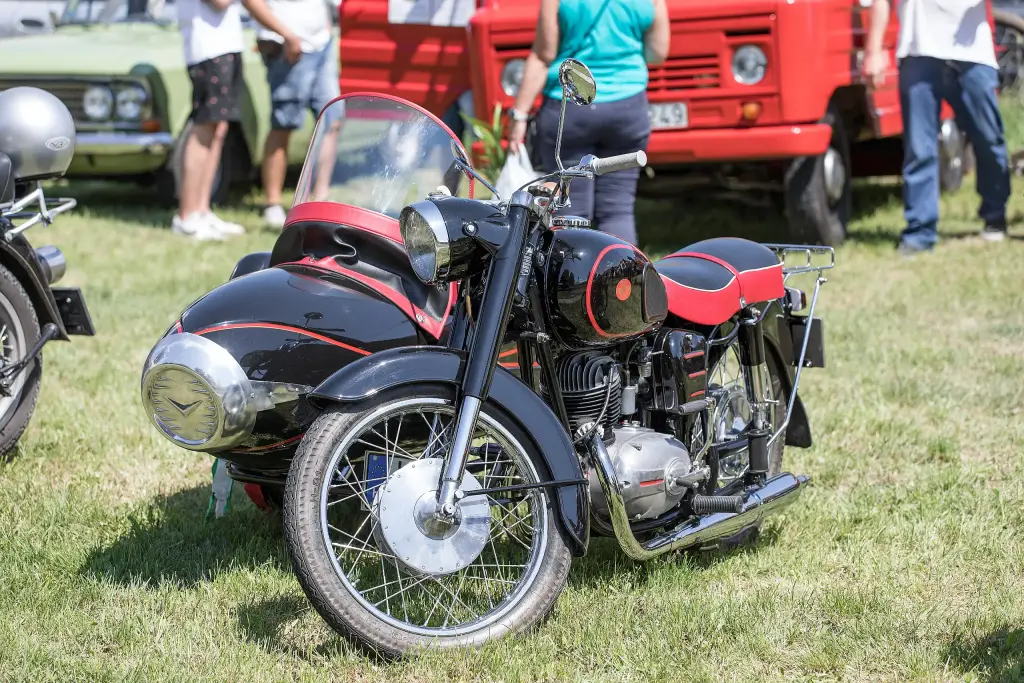
The Pannonia T is not one machine but a whole family of 250 cc two-strokes built at Csepel in Budapest between 1954 and 1975. Its type letters are a small dictionary of the design: the T stands for the telescopic fork at the front, the L for the long swinging arm, the F for magneto ignition and the D for the later dynamo and battery ignition.
Pannonia T at a glance
| Maker | Csepel Motorcycle Works, Budapest |
|---|---|
| Types | TL, TLT, TLF (T1), TLB (T3), TLD (T2), T5, T5H, T6, T7, T8, T9 |
| Production | 1954–1975 |
| Engine | single-cylinder two-stroke, 250 cc |
| TL power | 10 PS |
| TLT power | 12 PS |
| T8 power | 18 PS at 5,250 rpm |
| T9 power | 22 PS at 5,500 rpm, 125 km/h |
| Brakes | 200 mm drums to 1964, then 160 mm |
| Export | East Germany, Poland, the USSR, Yugoslavia |
There is no English Wikipedia article on Pannonia; this page is based on the Hungarian and German articles on the marque.
History of the Pannonia T
The first of the T types was the TL 250 of 1954, built until 1955. Its engine came from the Csepel 250, with a single cylinder of 68 mm by 68 mm giving 10 PS, a four-speed gearbox, a 25 mm Jikov carburettor, magneto ignition and a telescopic fork without damping at the front, with a swinging arm and hydraulic shock absorbers at the rear. It was normally painted bordeaux red and was credited with 105 km/h and 4.5 litres per 100 km on a 1:20 mixture, the 1:25 ratio being approved retrospectively in 1962.
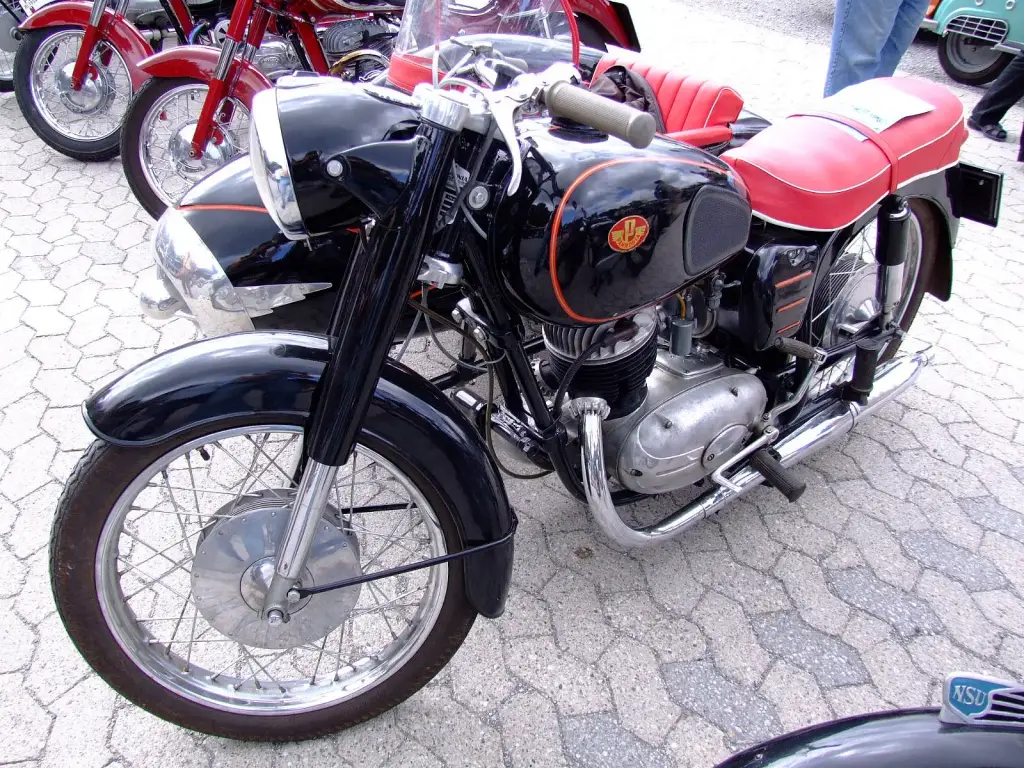
In 1956 came the TLT, the model that shaped every later Pannonia. Its second T came from the enclosed chain case, and with it arrived a front mudguard that moved together with the wheel, tool and battery holders on both sides under the seat, and a modern drum silencer in place of the swallow-tail exhaust inherited from the Csepels. Power rose to 12 PS and the common finish changed from bordeaux to apple green, with some black machines at the end of the run in 1957. Export versions used Fischer Amal carburettors.
The TLT gave way in 1958 to the TLF, where F marked both the magneto ignition and the fact that the model had been developed further. It had a new teardrop tail lamp with a brake-light bulb, and in 1959 it was refreshed with the neutral position moved to the bottom of the gearbox, a new split finned cylinder, a 27 mm BK-3-27 carburettor with a piston enrichment device in place of the 25 mm BK-1-25, a chrome choke lever on the handlebar, rear shocks adjustable in two stages, knee pads on the tank and AVF lighting in place of Hella and Bosch parts. A grab handle under the seat made it easier to haul the machine onto its centre stand. By 1964 the type was known as the T1.
Alongside it Csepel built the TLD, a small-series version with a 6 V 60 W direct-current crankshaft dynamo, an external ignition coil, a larger battery, a voltage regulator and the ignition switch of the TLB. The TLB itself (T3, in battery form T4) was the most expensive Pannonia of its day, a TLF with press-steel enclosures, a shorter rear mudguard, a different tail lamp and a chrome bumper, and a “frog head” handlebar cowl carrying the headlamp and a charging indicator.
The T1 range reached the limit of its development, and in 1964 the T5 appeared with smaller 160 mm brake drums, which gave the whole 1954 base the name of the small-drum Pannonia. Mechanically it was almost unchanged from the T1. The T5 was built until 1975 and, once the P10 of 1965 brought a new hydraulic front fork and rear shock absorbers, new tank and seat shapes and a larger-finned cylinder, some of the improvements found their way back: with an intake silencer and a quieter exhaust the T5 became the T5H in 1968. There were also the export variants T6 with 16 PS for the home market, T7 with 17 PS for western Europe, and the sporting T8 of 1964–1968 with 18 PS at 5,250 rpm, which had no intake silencer, and the T9 of 1965–1967 with 22 PS at 5,500 rpm and 125 km/h.
Design and features
- A letter code: T for telescopic fork, L for long swinging arm, F for magneto ignition, D for dynamo and battery.
- The TLT’s legacy: enclosed chain, moving front mudguard and under-seat tool boxes set the style of all later Pannonias.
- Small-drum models: from 1964 the T5 used 160 mm brake drums instead of 200 mm.
- Sporting versions: the T8 and T9 of the mid-1960s brought 18 and 22 PS.
- Long life: the T5 remained in production until the end of the marque in 1975.
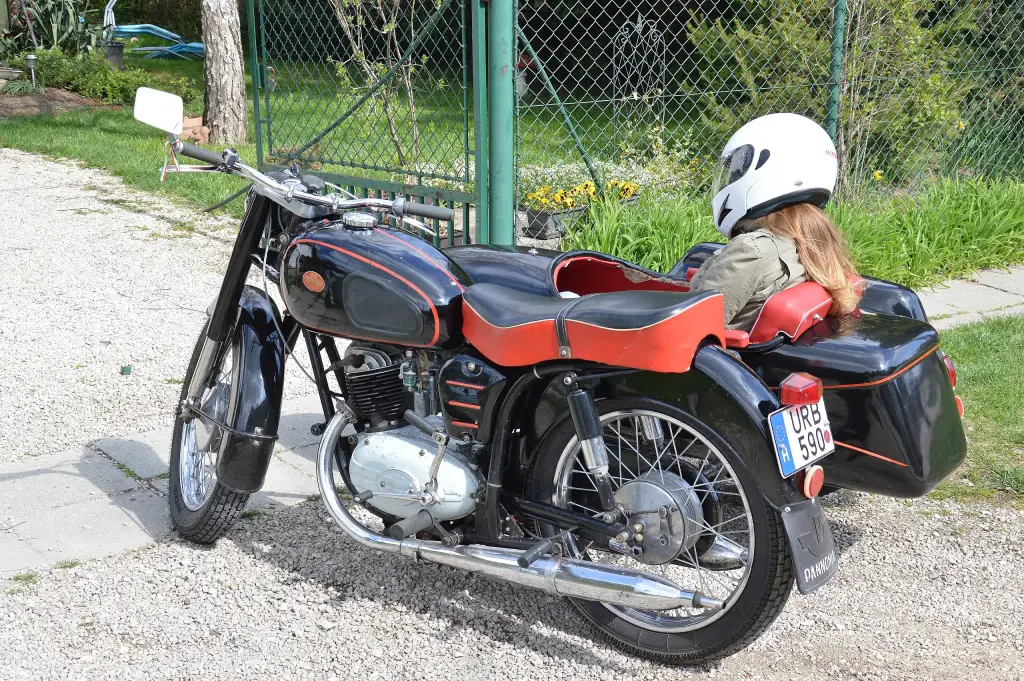
Pannonia T versions
- TL (1954–1955): the original 10 PS two-stroke in bordeaux red.
- TLT (1956–1957): 12 PS, enclosed chain, apple green.
- TLF / T1 (1958–1964): the developed model with magneto ignition.
- TLB (T3) and TLB-D (T4): the enclosed luxury version, with magneto or battery ignition.
- TLD (T2): the small series with a 6 V 60 W dynamo.
- T5 and T5H: the small-drum type, from 1968 with intake and exhaust silencing.
- T6, T7, T8 and T9: home-market, western-export and sporting variants of the later years.
The T types began with the Pannonia 250 and were followed by the twin-cylinder Pannonia P models. More machines are in the Pannonia collection.
Video: Pannonia t -20 C
Video on YouTube.
Sources
- Pannónia (motorkerékpár), Hungarian Wikipedia: TL, TLT, TLF, TLB and T5 history
- Pannónia (Motorrad), German Wikipedia: type designations, TL 250 data, T5 to T9 production