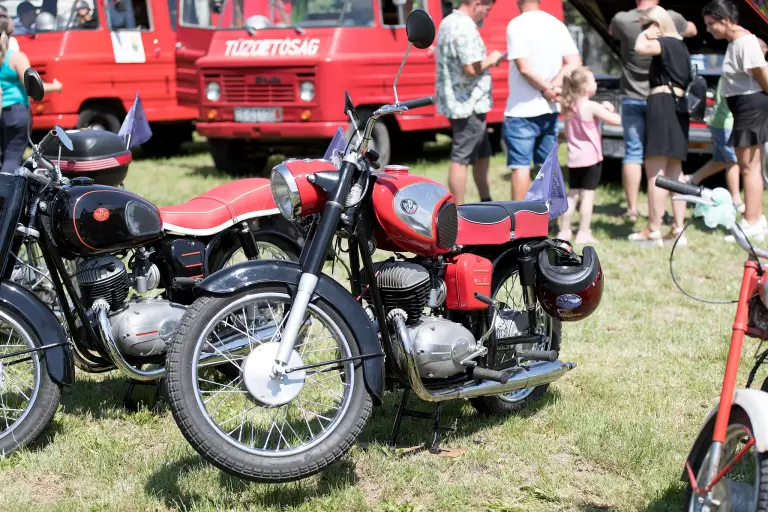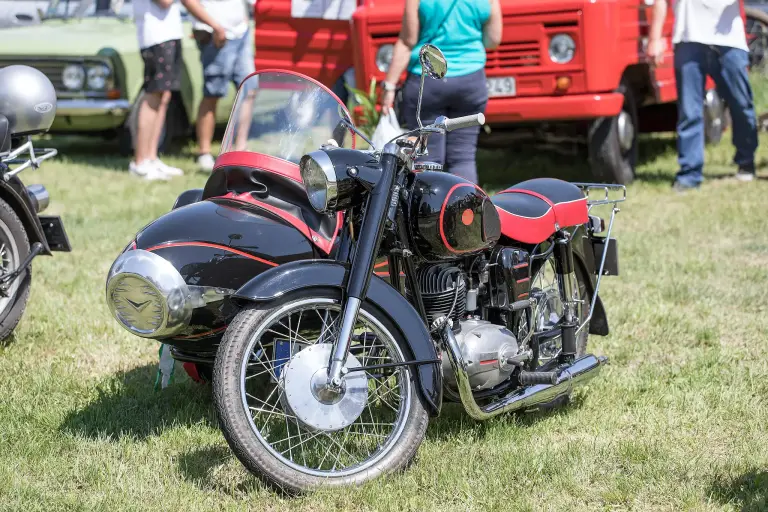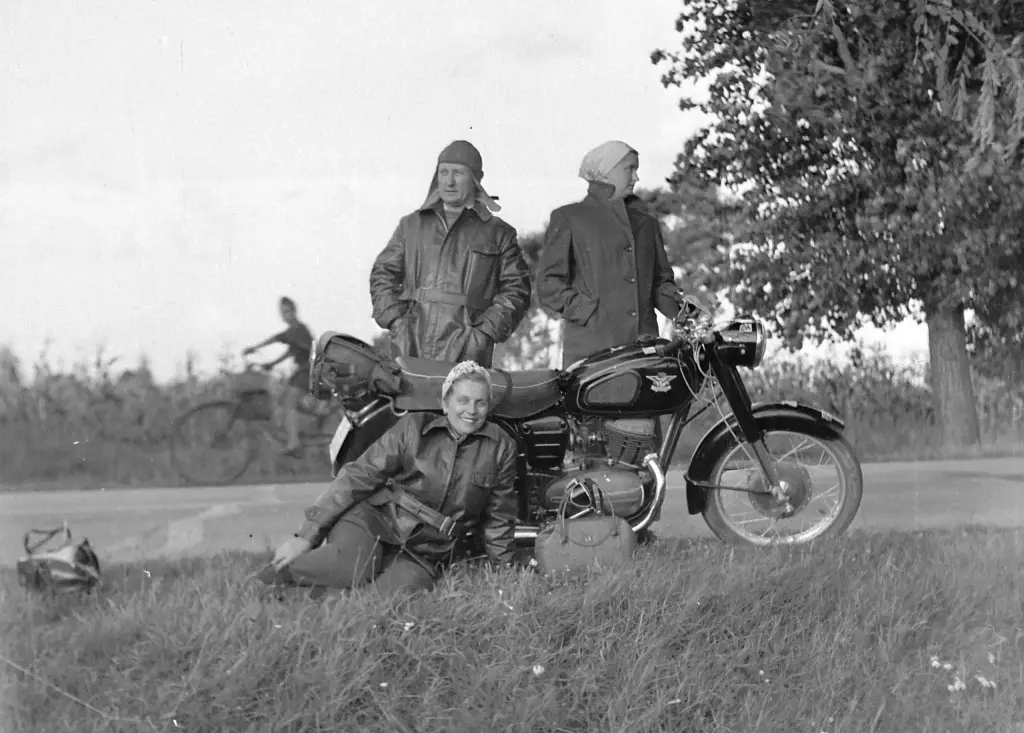
The Pannonia 250 is the 250 cc motorcycle that the Csepeli Motorkerékpárgyár built in Budapest from 1954 until 1975. It was the model that gave the marque its name and its reputation: a simple, sturdy two-stroke that was sold at home in Hungary and exported in large numbers to East Germany, Poland, Yugoslavia and the Soviet Union.
Pannonia 250 at a glance
| Maker | Csepel Motorcycle Works, Budapest |
|---|---|
| Production | 1954–1975 |
| Total built | more than 600,000 Pannonia motorcycles of all types |
| Predecessor | Csepel 250 of 1950 |
| Engine | single-cylinder two-stroke, 68 mm × 68 mm |
| Power | 10 PS in the TL 250, 12 PS in the TLT |
| Top speed | 105 km/h (TL 250) |
| Consumption | 4.5 l/100 km, mixture 1:20 |
| Gearbox | four-speed |
| Brakes | 200 mm drums on the early large-drum types |
| Usual colour | bordeaux red |
There is no English Wikipedia article on Pannonia; this page is based on the Hungarian and German articles on the marque.
History of the Pannonia 250
The direct ancestor of the Pannonia was the Csepel 250, put into production in 1950 first with a twin-piston engine and from 1951 with a single-piston version. That engine looked externally like the block of the first Pannonia, the TL, but inside it differed, mainly through the chain primary drive and the rearward-turning crankshaft of the Pannonia. The first Pannonia, the TL 250, appeared in 1954 and was built until 1955. The name of the marque came from the technician Molnár László, and the type letters stood for Teleszkóp and Lengõvilla, telescopic fork and swinging arm.
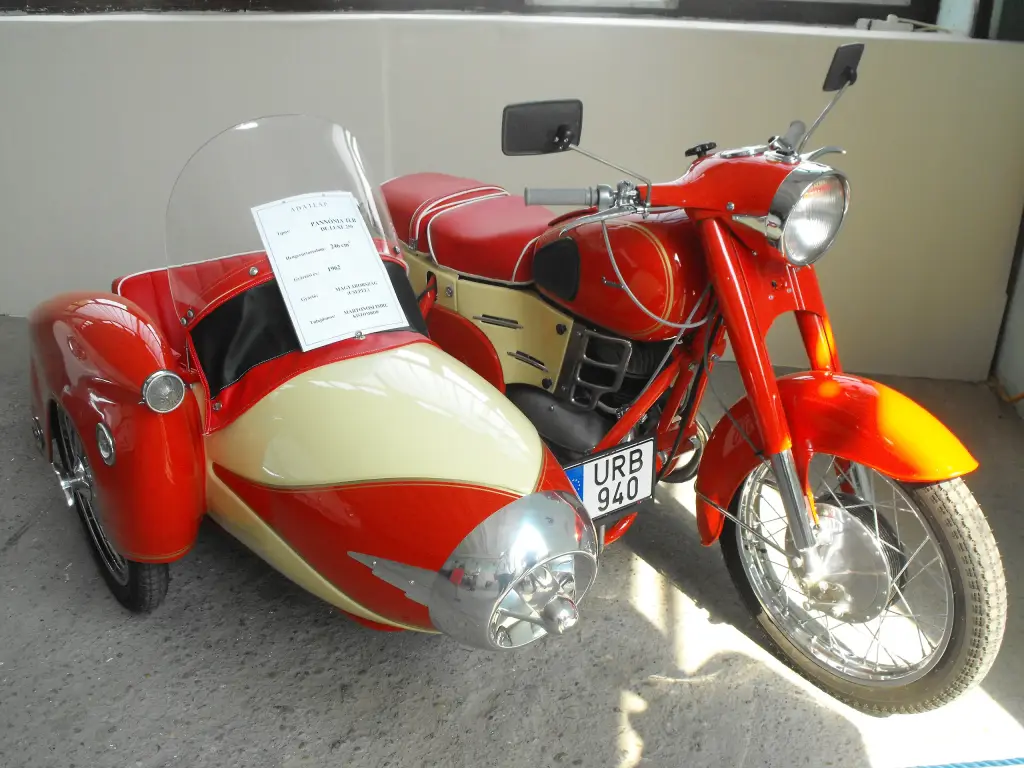
The early models are known in Hungary as the large-drum Pannonia, built from 1954 to 1964 and recognised by their 200 mm brake drums and bent-spoke wheels. The TL was followed in 1956 by the TLT, which brought the enclosed chain case, a front mudguard that moved with the wheel, and tool and battery holders on both sides under the seat; its second T came from the enclosed chain. The TLT was replaced in 1958 by the improved TLF, whose F stood for the magneto ignition and for the development itself. In 1959 the TLF received a new split finned cylinder, a 27 mm BK-3-27 carburettor in place of the 25 mm BK-1-25, a chrome choke lever on the handlebar, rear shock absorbers adjustable in two stages, knee pads on the tank and home-made AVF lighting in place of the Hella headlamp and Bosch electrics. By 1964, after many small changes, it was known as the T1.
The most expensive Pannonia of the period was the TLB, a TLF with press-steel enclosures, a shorter rear mudguard, a different tail lamp and a chrome bumper, and at the front a “frog head” handlebar cowl carrying the headlamp and the ignition switch. A small series was also built with the electrical system of the TLD, the version with a 6 V 60 W dynamo, an external ignition coil, a larger battery and a voltage regulator. Both the TLF and the TLB were exported in quantity to East Germany and the Soviet Union.
In 1964 a more powerful Pannonia 250 LTL Luxus was tested after being shown at trade fairs in 1963. It was credited with 16 PS at 5,250 rpm but received a poor verdict: running on a 20:1 mixture it used 6.5 to 6.9 litres per 100 km, was not happy at full throttle and tended to seize its pistons, with the twin-port exhaust blamed as one cause. The standard Pannonia of the time, with 14 PS, was said to show a similar tendency, and the power and torque curves were criticised because the engine only pulled properly above 4,000 rpm. Only the appearance was praised. Despite repeated show appearances the Luxus was apparently never put into series production.
Between 1950 and 1959 some 100,000 of the 250 cc machines were produced and half of them were exported, among them small numbers to Brazil and Indonesia. The largest customer in the 1950s was East Germany, which imported more than 20,000 by 1960 alone; about 12,000 went to Poland and 6,000 each to the Soviet Union and Yugoslavia. In East Germany some machines were converted to BVF carburettors, which improved performance and reduced fuel consumption, and the specialist press there criticised the lack of cooperation within the socialist camp, which it said had led to the production of a motorcycle backward compared with MZ. The 250 cc line continued through the small-drum T5 and the P series until the whole Pannonia programme ended in 1975.
Design and features
- Simple two-stroke: a single cylinder of 68 mm by 68 mm with magneto ignition and a four-speed gearbox.
- Large brake drums: the 200 mm drums and bent-spoke wheels that identify the 1954–1964 models.
- Export success: half of the 250s built before 1959 were sold abroad, above all in East Germany.
- Careful development: the TLF of 1959 gained a bigger carburettor, a split finned cylinder, adjustable rear shocks and Hungarian electrics.
- The Luxus that never was: a 16 PS version tested in 1964 was rejected for its thirst and its tendency to seize.
Pannonia 250 versions
- TL 250 (1954–1955): the first Pannonia, 10 PS and 105 km/h, usually bordeaux red.
- TLT (1956–1957): 12 PS, enclosed chain, apple green paint and some black machines.
- TLF / T1 (1958–1964): the improved model with magneto ignition and the 1959 updates.
- TLB: the enclosed, most expensive version, also built in a small TLD-electrics series.
- TLD: the dynamo and battery version with a 6 V 60 W generator.
- LTL Luxus: the 16 PS prototype of 1963–1964, shown but not produced.
The 250 cc line led on to the Pannonia T models and then to the Pannonia P series. More machines are in the Pannonia collection.
Video: Pannonia TFL 250
Video on YouTube.
Sources
- Pannónia (motorkerékpár), Hungarian Wikipedia: model history, TL, TLT, TLF and TLB details
- Pannónia (Motorrad), German Wikipedia: technical data of the TL 250, exports, Luxus test