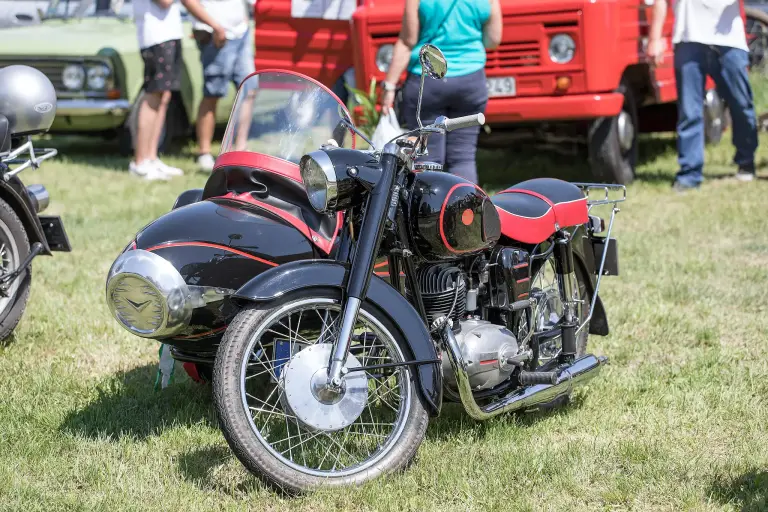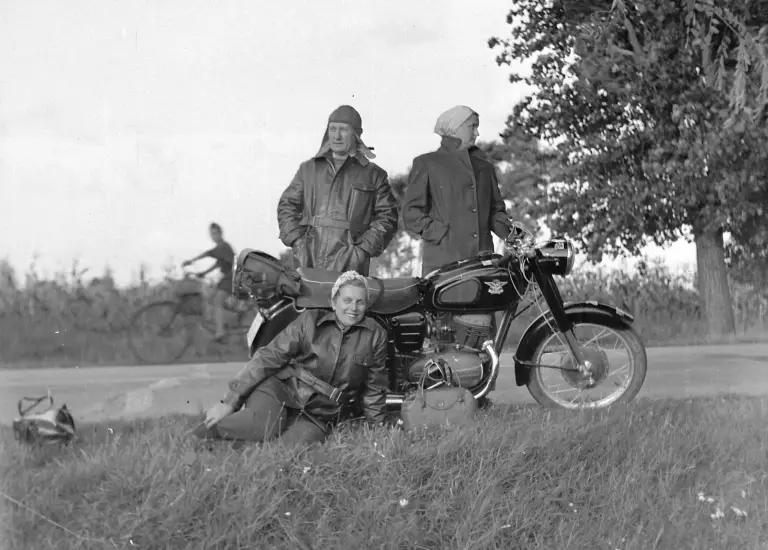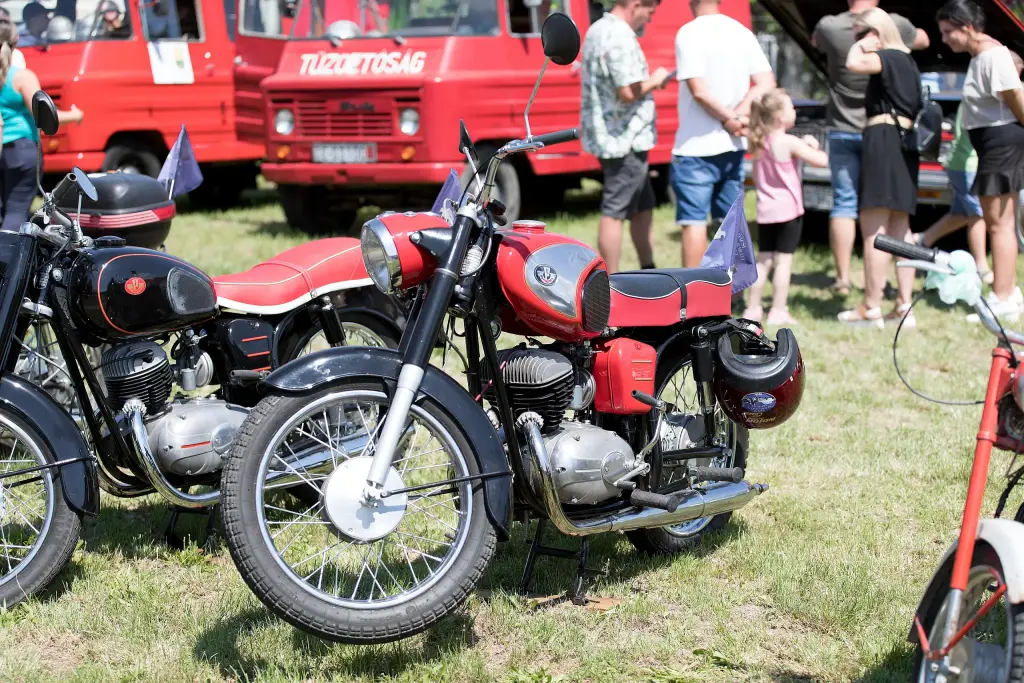
The Pannonia P is the family of models with which the Csepel works in Budapest finished its motorcycle history. It began with the P10, a single shown in 1965 and built from 1966, and reached its high point in the two-cylinder P20, the fastest and most complicated Pannonia ever put into production. The last machines left the works in 1975.
Pannonia P at a glance
| Maker | Csepel Motorcycle Works, Budapest |
|---|---|
| Types | P8, P9, P10, P12, P20, P21 |
| P10 introduced | presented in Budapest in May 1965, built 1966–1974 |
| P10 engine | single-cylinder two-stroke, 250 cc, 7.5:1, 27 mm EFG carburettor |
| P10 power | 16 PS at 5,250 rpm |
| P20 | two cylinders, 56 mm × 50 mm, 23 PS at 7,500 rpm |
| P20 top speed | 130 km/h, 4.2 l/100 km |
| P20 gearbox | five-speed, enclosed chain final drive |
| P20 weight | 142 kg |
| P12 | 16.5 PS at 5,000 rpm, 18-inch wheels |
| P21 | 22 PS at 6,500 rpm |
| End of production | 1975 |
There is no English Wikipedia article on Pannonia; this page is based on the Hungarian and German articles on the marque.
History of the Pannonia P
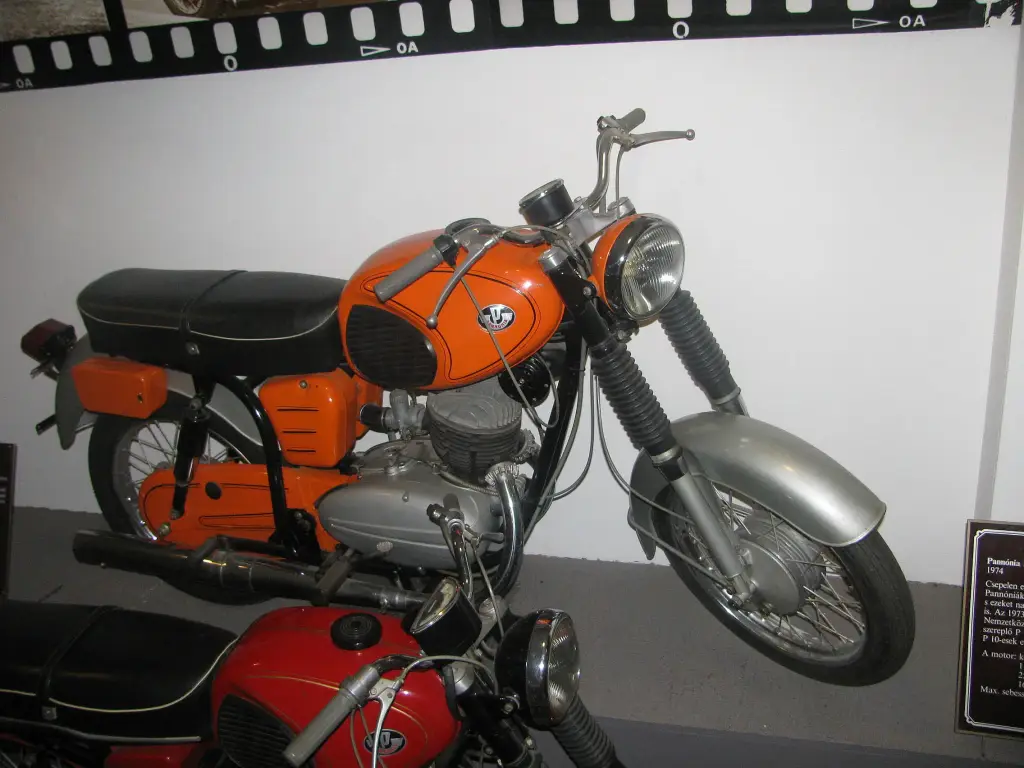
By the early 1960s the single-cylinder Pannonia, based on the 1954 design, had reached the limit of its development, and the works was spending its money on preparing the two-cylinder P20. To save cost, part of the new parts were used on an updated single built on the T5, and that machine was the P10, shown in Budapest in May 1965 and in production from 1966 to 1974. It took the hydraulically damped front fork and the rear shock absorbers, the new tank and the new seat of the P20, while its larger-finned cylinder and head and its finned engine housing were made for this type alone. Later it also received an intake silencer and a quieter exhaust, parts that were then applied to the T5 to create the T5H.
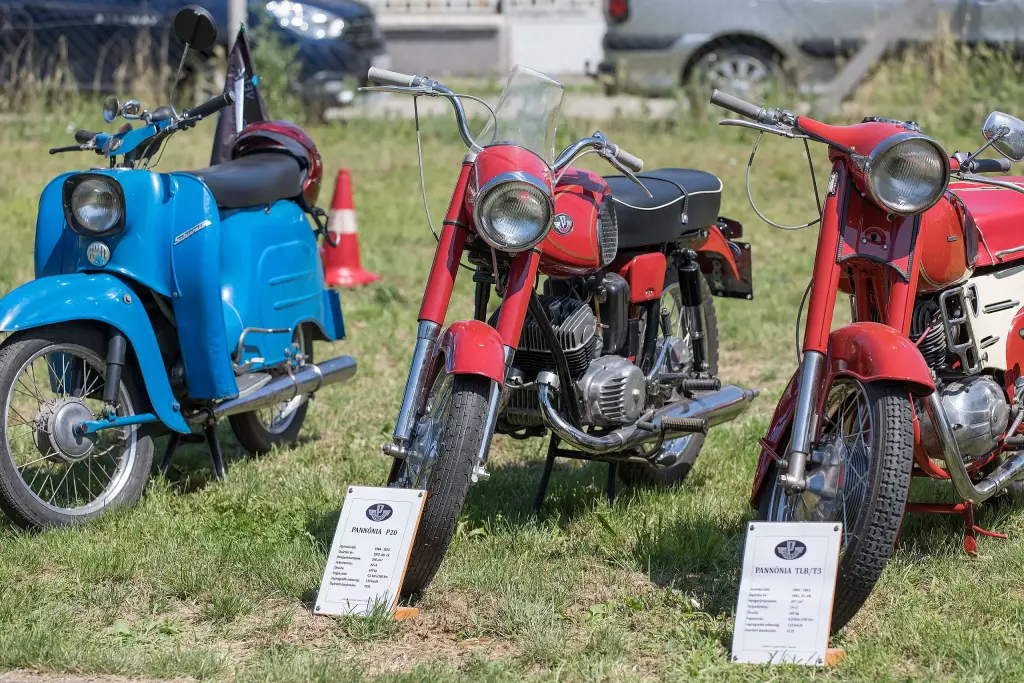
The P10 kept the 250 cc single-cylinder two-stroke, compressed at 7.5:1 and fed through a 27 mm EFG carburettor, with 16 PS at 5,250 rpm. Compared with the LTL that preceded it, it had a broad-wall cylinder and a new tank holding 16.5 litres. The T5 and the P10 ran on 19-inch wheels and both were credited with a top speed of 115 km/h. The export versions of the new types were the P8 and the P9.
The P20 of 1968 was a different kind of machine. Its piston-ported two-stroke twin measured 56 mm by 50 mm and gave 23 PS at 7,500 rpm, enough for 130 km/h on 4.2 litres per 100 km of 1:25 mixture. It had battery ignition, two 20 mm EFG carburettors, a gear primary drive of 1:3.25, a five-speed gearbox and an enclosed chain to the rear wheel, an oil-damped telescopic fork, a swinging arm with oil-damped spring units, a dry weight of 142 kg, 3.00-18 and 3.25-18 tyres and 160 mm by 30 mm light-alloy full-hub brakes. It remained in production until 1974, but only 7,500 were sold.
The single was not abandoned. In 1974 came the P12, built on the P10 but with 16.5 PS at 5,000 rpm and 18-inch wheels, and in the same year the P21, a twin with 22 PS at 6,500 rpm that brought roller bearings in the engine, a telescopic fork with rubber bellows, exposed rear springs and a new headlamp. Only 5,000 P21s found buyers. In 1975, under the five-year plan for the period from 1976, the manufacture of Pannonia motorcycles was stopped and the equipment was used to increase the share of bicycles in the output of the Csepel works.
Design and features
- Modernised single: the P10 of 1965 brought the P20’s hydraulic fork and new bodywork to the 250 single.
- The twin: the P20 of 1968 had a 23 PS two-cylinder engine, five speeds and 130 km/h.
- Full-hub brakes: light-alloy 160 mm drums on the P20.
- Last updates: the P12 of 1974 with 18-inch wheels and the P21 with roller-bearing engine and a new fork.
- The end: only 7,500 P20s and 5,000 P21s were sold before production stopped in 1975.
Pannonia P versions
- P10 (1966–1974): the 16 PS single on 19-inch wheels with a 16.5-litre tank.
- P20 (1968–1974): the two-cylinder, 23 PS, five-speed, 130 km/h.
- P12 (1974–1975): the updated single with 16.5 PS and 18-inch wheels.
- P21 (1974–1975): the final twin, 22 PS, roller bearings and exposed rear springs.
- P8 and P9: the export versions of the new single and twin.
The P series followed the Pannonia 250 and the Pannonia T types. More machines are in the Pannonia collection.
Sources
- Pannónia (motorkerékpár), Hungarian Wikipedia: P10 development and its links with the P20
- Pannónia (Motorrad), German Wikipedia: P10 presentation, P20 data, P12 and P21, end of production